Best Place to Buy an African Grey Parrot: 5 Sources Ranked by Risk
Where should you actually spend $1,700–$3,500 — and who's most likely to take it and run? A working breeder ranks every source by risk, and shows you how to verify any seller in five minutes.
Written by Mark & Teri Benjamin · C.A.Gs African Grey breeders, Midland TX · USDA-licensed since 2014
The safest place to buy — a real breeder you can verify.
USDA
Licensed since 2014
CITES
Appendix I docs
PCR
DNA-sexed birds
$185
Ships nationwide
Want to buy from a breeder you can actually verify?
Tell us what you're looking for and we'll send live video, full paperwork and the birds available now — no pressure, no games.
✓ USDA AWA Licensed✓ CITES Appendix I✓ DNA Sexed✓ Avian Vet Certified✓ Ships Nationwide
On This Page
The short answer
Where Is the Best Place to Buy an African Grey?
The safest place to buy an African Grey is from a reputable, USDA-licensed breeder who will do a live video call with the bird, provide CITES, PCR DNA and avian-vet paperwork, and take a reversible deposit. Online marketplaces and anonymous social sellers carry the highest scam risk. If a seller refuses the video call or the papers, that's your answer — walk away.
Safest sourceLicensed breeder
Highest riskOnline marketplace
Honest price$1,700–$3,500
Never pay byWire · gift card · crypto
Where Is the Best Place to Buy an African Grey in 2026?
Type "best place to buy an African Grey" into Google and the top result isn't a shop — it's people in a forum asking each other for a seller they can trust, because the scams are that bad. That tells you everything about this purchase: you're not really shopping for a bird, you're shopping for someone to trust with $1,700–$3,500 and a 40–60 year commitment. The best place to buy, in one line, is wherever you can verify the seller — and the honest ranking below is really a ranking of how easy each source makes that verification.
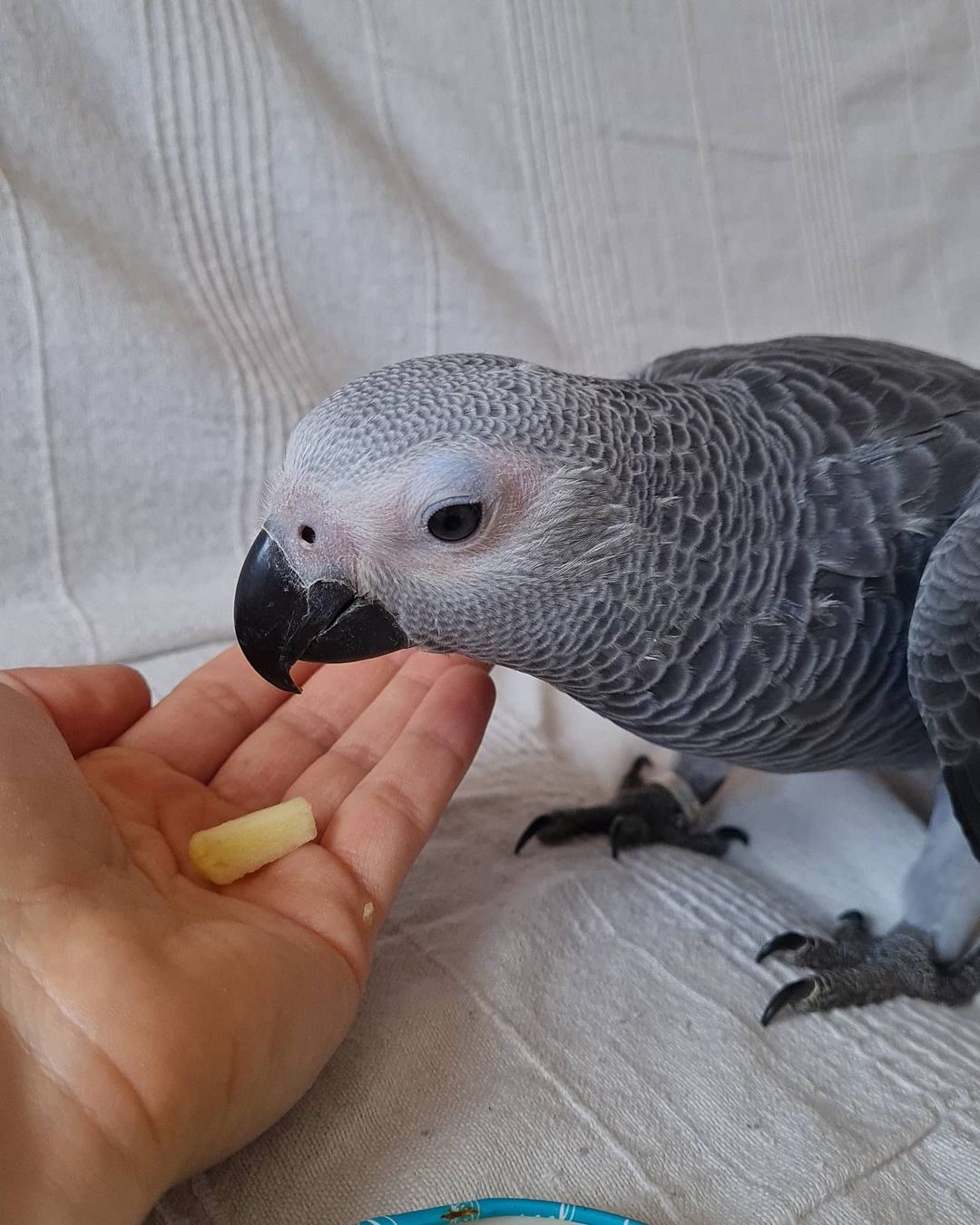
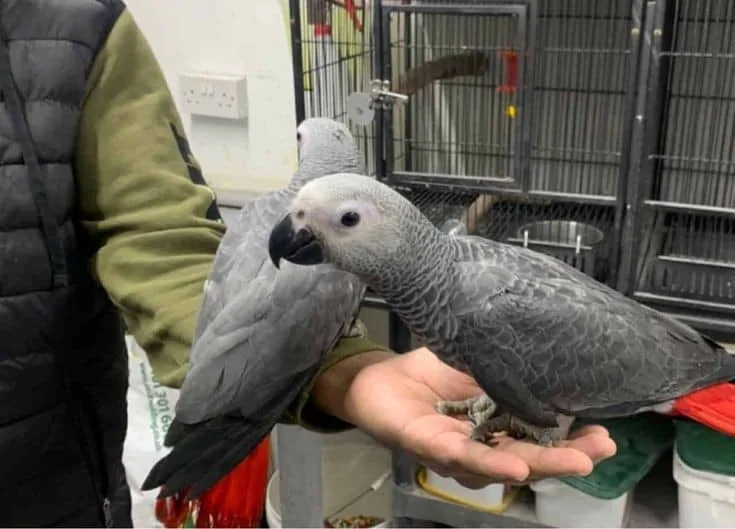
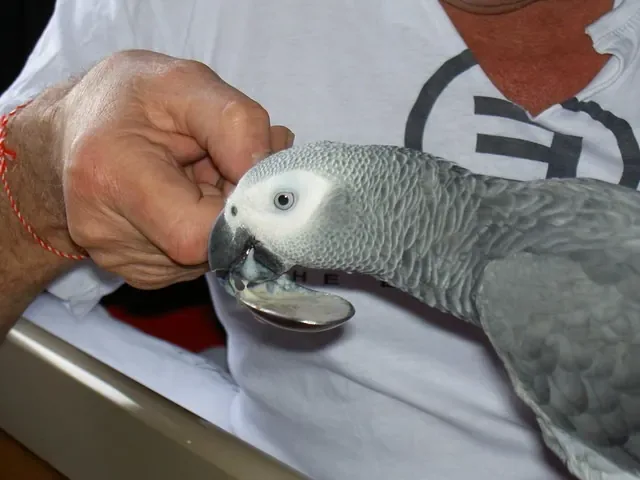
Real, documented Congo African Greys — the bird a trustworthy source can prove is theirs.
Why Does It Matter So Much Where You Buy?
Because the African Grey is one of the most trafficked and most faked birds in the pet trade, and the damage from buying badly isn't only financial. A bird from the wrong source can arrive sick, undocumented, unweaned — or not arrive at all. As the World Wildlife Fund notes about heavy trapping of the species ↗, captive-bred documentation is exactly what separates a legal, ethical bird from a laundered one. Where you buy decides whether you get papers, a health guarantee and a breeder who still answers the phone in year three — or a dead end.
The real cost of choosing the wrong source
A saved few hundred dollars up front routinely turns into thousands at the avian vet, or the total loss of a deposit to a seller who vanishes. The buyers who reach us most upset aren't the ones who paid a fair price — they're the ones who chased a cheap one and are now trying to rescue the situation. Where you buy is the decision every other outcome hangs on.
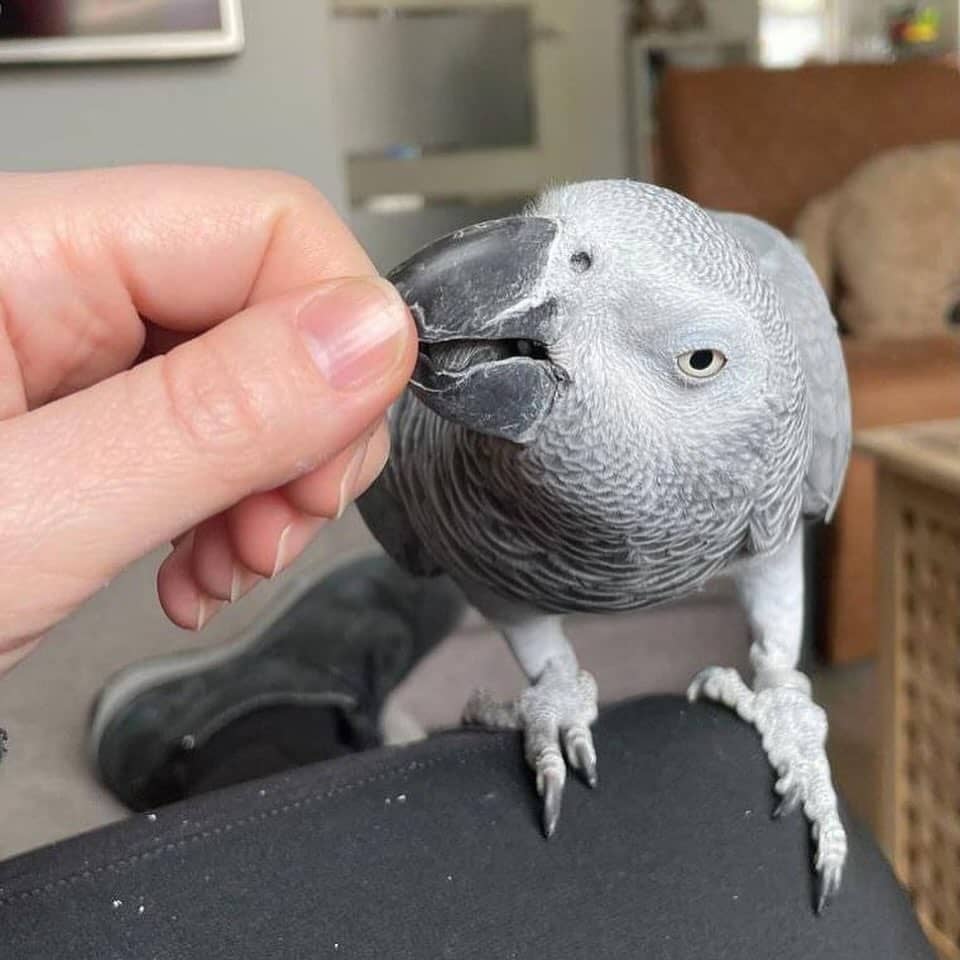
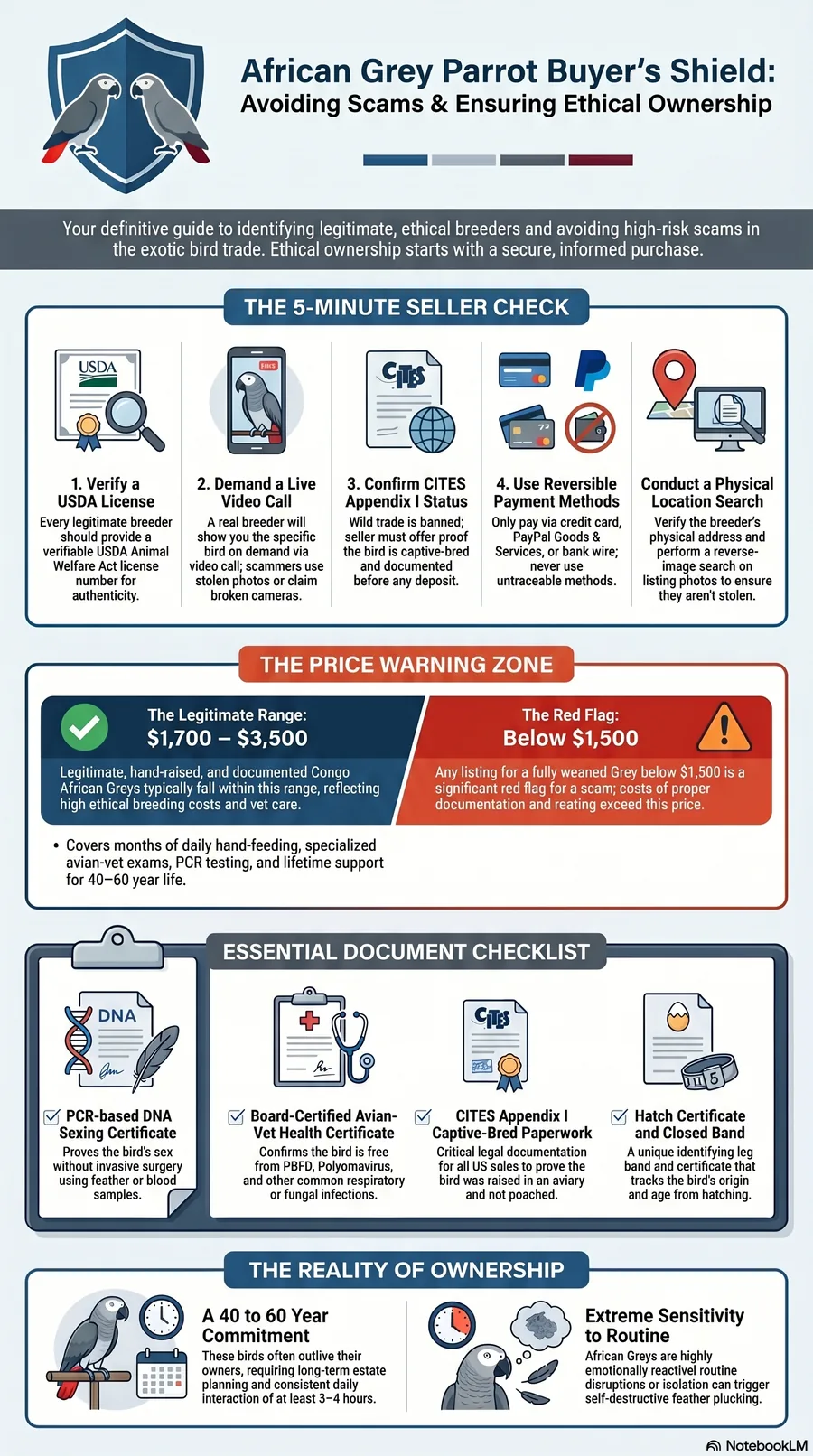
The buyer's shield — the checks and papers that keep your money, and your bird, safe.
What's the One Question That Filters 90% of Sellers?
Ask any seller a single question and most of the risk sorts itself out: "Will you get on a live video call with the bird in your hands right now?" A real breeder says yes without hesitation — we do it every week. A scammer suddenly has a reason they can't: the bird's asleep, the camera's broken, another buyer is deciding. The question costs nothing and it's the fastest trust test in birds.
"Will you do a live video call with the bird in hand?"
It works because it's almost impossible to fake in the moment. Photos can be stolen, paperwork can be promised, prices can be adjusted — but a live, unedited video of a specific bird, on demand, is exactly what a person who doesn't have the bird cannot produce. Lead with this question, and the sources at the bottom of our ranking eliminate themselves before you've risked a cent.
The 5 Places You Can Buy an African Grey, Ranked by Risk
Here's the honest ranking, from safest to most dangerous. We put ourselves at the top, but with the receipts to back it up — the point isn't "buy from us," it's "buy from whoever passes the same checks we happily pass." Every source below can, in theory, sell you a wonderful bird; what changes from top to bottom is how likely you are to end up documented and protected instead of scammed.
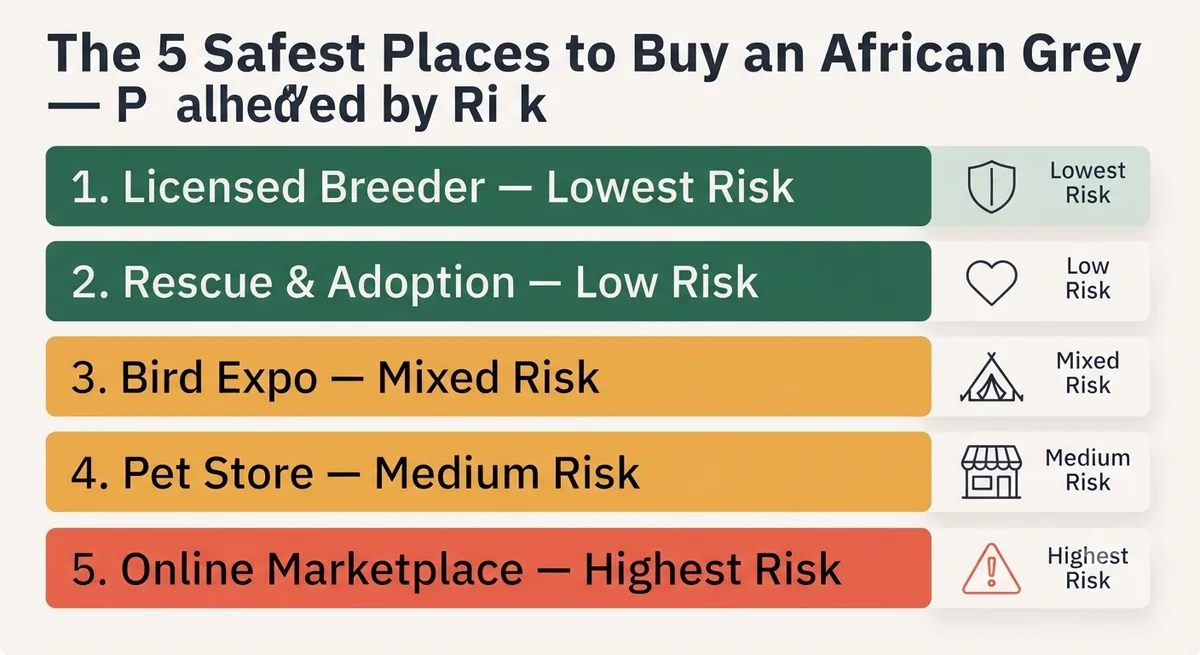
The five buying sources, ranked from lowest risk to highest.
Where you buy
Typical price
Scam risk
Health record
Overall trust
Licensed breeder
$1,700–$3,500
Low
Full & verifiable
Highest
Rescue / adoption
$200–$800 fee
Low
Usually documented
High
Bird expo
Varies
Medium
Ask on the day
Mixed
Pet store
$3,000–$5,000+
Medium
Often thin
Medium
Online marketplace
Suspiciously low
Very high
Rarely any
Lowest
Breeder verdict: A licensed breeder and a documented rescue sit at the safe end; an anonymous online marketplace sits at the dangerous end. Everything in between comes down to how much you can verify before you pay.
1. Licensed Breeder — the Lowest-Risk Source
A reputable, USDA-licensed breeder is the safest place to buy an African Grey, full stop. You get a bird raised by someone who is legally accountable, whose birds you can see on live video, and whose paperwork — CITES, DNA, avian-vet certificate — you can verify before a cent changes hands. It isn't the cheapest headline price, but it's the only source where the price, the papers and the support all line up.
What "licensed" actually means (USDA AWA)
"Licensed" isn't a marketing word. A breeder selling regulated birds is meant to hold a USDA licence under the Animal Welfare Act, administered by USDA APHIS ↗, which means an accountable identity, an inspectable facility and a real address behind the sale. We've been licensed since 2014. Ask any seller for their licence; a real one is proud to give it, and a scammer can't.
Breeder note: the paperwork we send home with every chick
Every Grey that leaves us goes home with the same folder: a PCR DNA-sexing certificate, an avian-vet health certificate, CITES Appendix I captive-bred documentation, a hatch certificate and closed band, and a written health guarantee. That folder is the difference between a companion you can prove is healthy and legal, and a bird you merely hope is. It's also, not coincidentally, exactly what a low-risk source can produce and a high-risk one can't.
2. Rescue & Adoption — Low Risk, for the Right Owner
A parrot rescue or adoption is a genuinely low-risk, ethical way to bring home an African Grey, and for an experienced owner it can be the most rewarding of all. Reputable rescues health-check their birds, are honest about history, and charge a modest adoption fee rather than a sale price. The trade-off is the bird itself: a rescue Grey often comes with a past.
When a rescue Grey is the better choice
If you've kept parrots before and you're prepared for a bird that may be bonded to one person, nervous of hands, or a feather-plucker working through old stress, a rescue is a wonderful thing to do — you're giving a long-lived bird a second home. For a first-time owner who wants a predictable, socialised start, a hand-raised baby from a breeder is usually the gentler path. Neither is "better"; they suit different homes.
3. Bird Expo — Mixed Risk, Verify on the Day
Bird expos and avicultural shows sit in the middle. The good news is you meet the seller and the bird in person, which beats any photo. The catch is that an expo compresses a big decision into a loud afternoon, and not every table is a licensed breeder — some are resellers. Treat an expo as a place to meet breeders, not to make an impulse purchase; take the card, run the same checks later, and buy when you've verified, not because the show ends at five.
4. Pet Store — Medium Risk, High Price
A pet store is usually safer than a random online listing but pricier and shallower than a breeder. You can see the bird, and a good store health-checks its stock — but staff rarely know the bird's hatch history or socialisation, documentation is often thin, and African Greys command $3,000–$5,000 or more at retail. You're paying a premium for convenience and getting less of the paperwork and lifetime support a breeder builds in.
5. Online Marketplace & Social Sellers — the Highest Risk
Anonymous classified listings, Facebook groups and Instagram "aviaries" you can't verify are where the overwhelming majority of African Grey scams live. This is the source the forums are warning each other about. Some legitimate breeders do advertise here — but the platform gives you nothing to verify, so you must do all the checking yourself, and a seller who resists any check is telling you what you need to know.
Why the cheapest listing is the most dangerous
On a marketplace, the lowest price is bait, not a bargain. A documented, hand-raised African Grey costs more than $1,500 to produce, so a listing well under that is almost always missing the bird, the papers, or both. The cheap number exists to switch off your caution — and once you've wired a deposit for a bird you never verified, there's usually no getting it back.
Example: the $600 "African Grey" math that never adds up
A "$600 African Grey, shipping included" cannot exist honestly: the DNA test, avian-vet exam, weeks of hand-feeding and CITES paperwork alone cost a real breeder more than that before the bird is even priced. So the $600 is paying for none of it. Either the papers don't exist, the bird was never properly raised, or — most often on marketplaces — there is no bird, just an advance-fee scam collecting "shipping deposits." The math is the tell.
Breeder note: what it really costs us to raise one
Before we ever set a price, a chick has already run up months of hand-feeding, a DNA test, an avian-vet exam and its CITES paperwork. That floor is why we can't — and wouldn't — sell a documented Grey for a marketplace "bargain," and why a listing that undercuts it is undercutting the bird's own health and legality.
Breeder vs Marketplace vs Rescue vs Pet Store: Side by Side
If you only look at one thing on this page, make it this comparison. It's the block competitors leave out — most tell you where you can buy without ever telling you how the sources actually stack up on the things that decide whether you're happy in a year: price, scam risk, health record and trust. Read across the row and the safe choice tends to make itself.
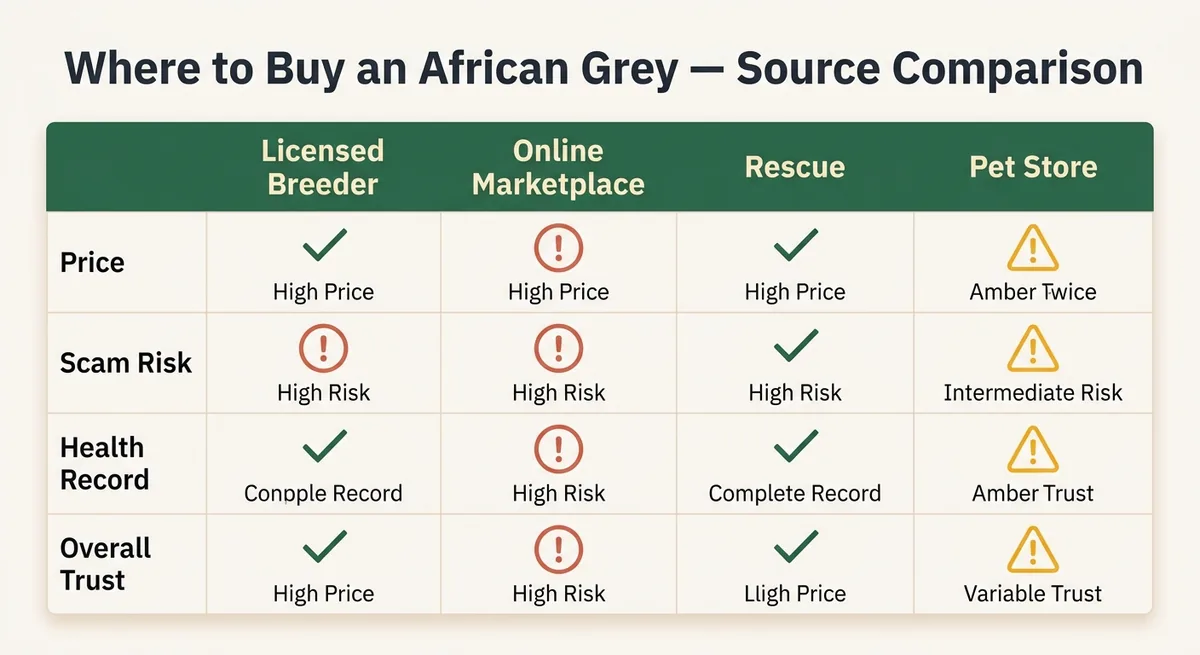
Where to buy compared — price, scam risk, health record and trust.
How to Read This Table as a Buyer
Don't read down the price column and stop — that's the mistake the marketplace listing is counting on. Read across each row. A low price paired with "very high" scam risk and "rarely any" health record isn't a deal; it's the profile of exactly the loss you're trying to avoid. The row that stays green across all four columns is the one worth paying for.
The column most buyers ignore (post-sale support)
There's a fifth column the table can't fully show, and it's the one seasoned owners care about most: what happens after the money's sent. A breeder answers your questions in year three when your Grey starts plucking or stops eating; a marketplace seller is unreachable by the time the box arrives. Over a 40–60 year life, that ongoing relationship is worth more than any price difference on day one — and it only exists at the top of the ranking.
How Do You Identify a Reputable African Grey Breeder?
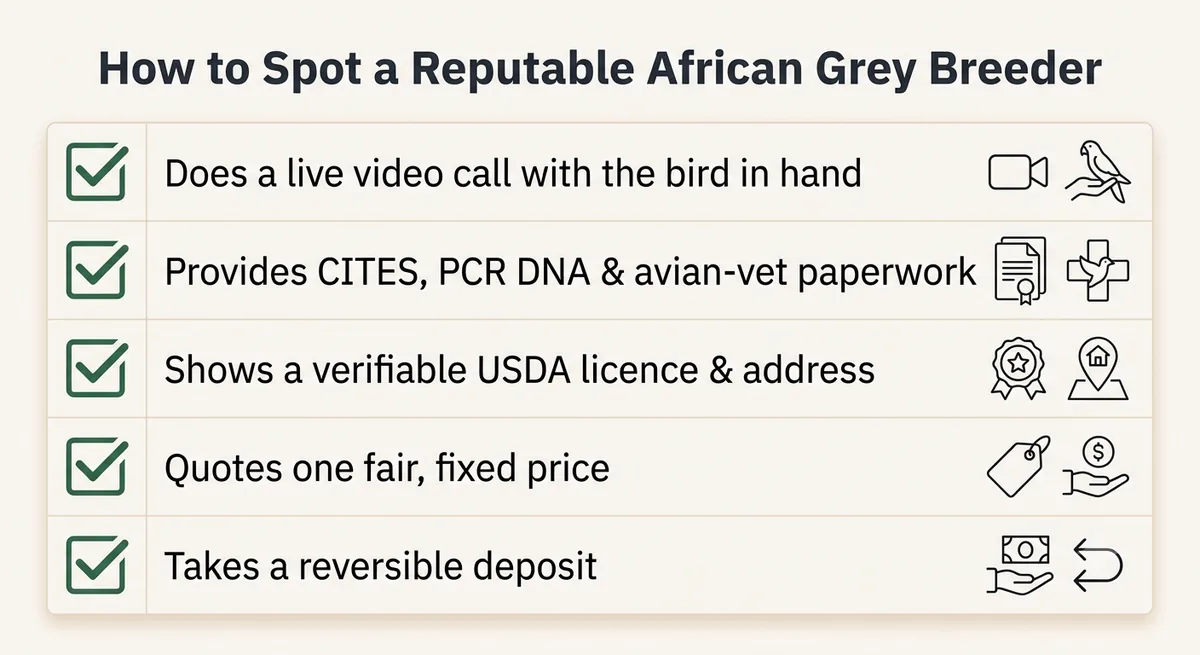
A reputable breeder isn't defined by a nice website — it's defined by what they'll let you check. Every genuine breeder clears the same five signals without complaint, because they have nothing to hide and everything to gain from an informed buyer. Here's what to look for, and what a risky seller does instead when you ask.
The five-point check a reputable breeder passes without hesitation.
A reputable breeder will…
A risky seller will…
Do a live video call with the bird in hand
Refuse, stall, or send old photos
Provide CITES, PCR DNA & an avian-vet certificate
Have 'papers coming later'
Show a verifiable USDA licence & address
Give no licence or a fake one
Quote one fair, fixed price
Dangle a low price, then add 'fees'
Take a reversible deposit
Demand wire, gift cards or crypto
Breeder verdict: A reputable breeder makes verification easy; a risky seller makes it awkward. If checking a seller feels like pulling teeth, that resistance is your answer.
Will They Do a Live Video Call?
This is the first and most powerful test, so lead with it. A reputable breeder will happily video-call you with the actual bird in hand — we treat it as a normal part of every sale. If a seller dodges, delays, or only ever sends photos and pre-recorded clips, stop there. Everything else on this list matters, but nothing substitutes for seeing the specific bird, alive, on demand.
Do They Provide Health Testing & DNA Paperwork?
A genuine breeder tests and documents, and hands you the proof. That means a PCR DNA-sexing certificate that tells you for certain whether your Grey is male or female, and a real avian-vet examination — not a glance, but a wellness check by a qualified avian vet. If the "paperwork" is always arriving after payment, it usually never arrives at all.
PCR DNA Sexing and the Avian-Vet Exam
Two documents do the heavy lifting here. A PCR DNA test settles your Grey's sex with certainty rather than a guess, and an avian-vet certificate records a genuine physical exam by a qualified vet. A breeder who provides both unprompted is showing you the testing a cheap seller quietly skips.
Phone the vet on the certificate before you pay
The certificate is only as good as the vet behind it, so call them. A legitimate breeder will gladly give you the clinic's number and encourage the check; a forged certificate falls apart the moment a real practice says they've never seen the bird.
Citation: the Association of Avian Veterinarians on pre-purchase exams
A pre-purchase or new-bird veterinary exam is standard best practice, and the Association of Avian Veterinarians ↗ maintains the professional standards behind it. A breeder who works with a real avian vet — and lets you phone that vet to confirm the certificate — is showing you the single clearest sign of a legitimate operation.
Can They Show CITES & Captive-Bred Documentation?
Because the African Grey is CITES Appendix I, captive-bred documentation isn't optional paperwork — it's what makes owning and transporting the bird legal. A reputable breeder provides it as a matter of course; a seller who can't, or who gets vague when you ask about origin, is exposing you to a bird that may be undocumented or wild-caught.
What the Captive-Bred Papers Actually Prove
The documentation traces your bird to a captive breeding source rather than the wild, which is what keeps ownership and interstate transport legal. It's the paper equivalent of a clean title on a car — easy to overlook until it's missing, at which point it's the only thing that matters.
Why "origin unknown" is never acceptable for an African Grey
If a seller can't say where a Grey came from, assume the worst, because on an Appendix I species "origin unknown" is a legal and ethical dead end. A reputable breeder always knows — and can show — a bird's captive-bred lineage.
Breeder note: what CITES Appendix I means for you (captive-bred is legal)
African Greys were uplisted to CITES Appendix I in 2017, and the CITES appendices ↗ set the framework. That does not make owning one illegal — a captive-bred bird with proper documentation is entirely legal to own and transfer within the USA. It simply means the paperwork is essential, and any seller who treats it as an afterthought is a seller to avoid.
Is Their Pricing Transparent, With Real Reviews?
A reputable breeder quotes one fair, fixed figure and can point to real, verifiable reviews or references. Watch for the opposite pattern: a headline price that's suspiciously low, then "fees" for shipping, crates or paperwork that inflate it — or a wall of reviews that all sound identical and can't be traced to real buyers. Honest pricing and traceable reputation travel together.
Reading Prices and Reviews Together
Price and reputation are best read as a pair. An honest figure backed by traceable reviews is reassuring; a bargain figure propped up by identical, unverifiable testimonials is the opposite. Treat a price that seems too good, and reviews that seem too perfect, as the same warning wearing two hats.
What an honest price range looks like ($1,700–$3,500)
For context, a documented, hand-raised Congo runs $1,700 for a tame adult up to $2,500 for a baby, and a Timneh $1,500–$1,600 — the honest band we break down in our price guide. A figure sitting comfortably in that range, quoted plainly and inclusive of the papers, is a good sign. A figure far below it is the loudest red flag there is, which is exactly where the next section starts.
Should You Buy From This Seller?
They'll video-call you live with the bird, and show CITES, DNA and vet papers
Green light on the two checks that matter most. Confirm the USDA licence and a verifiable address, use a reversible deposit, and you're buying from a real breeder — proceed.
They have the bird on video but the paperwork is 'coming later'
Pause. Real documentation exists before a sale, not after payment. Ask to see the CITES, PCR DNA and avian-vet certificate now — if they can't produce them, treat it as a red flag.
They refuse a live video call or only send photos
Walk away. A refusal to show the actual bird, live, is the single most reliable sign the bird doesn't exist. No paperwork or price makes that safe.
The price is well under $1,500 and they want wire, gift cards or crypto
Stop and keep your money. That combination — bargain price plus irreversible payment — is an advance-fee scam in progress. Run the seller check on our scam guide before you send a cent.
Red Flags That Mean Walk Away
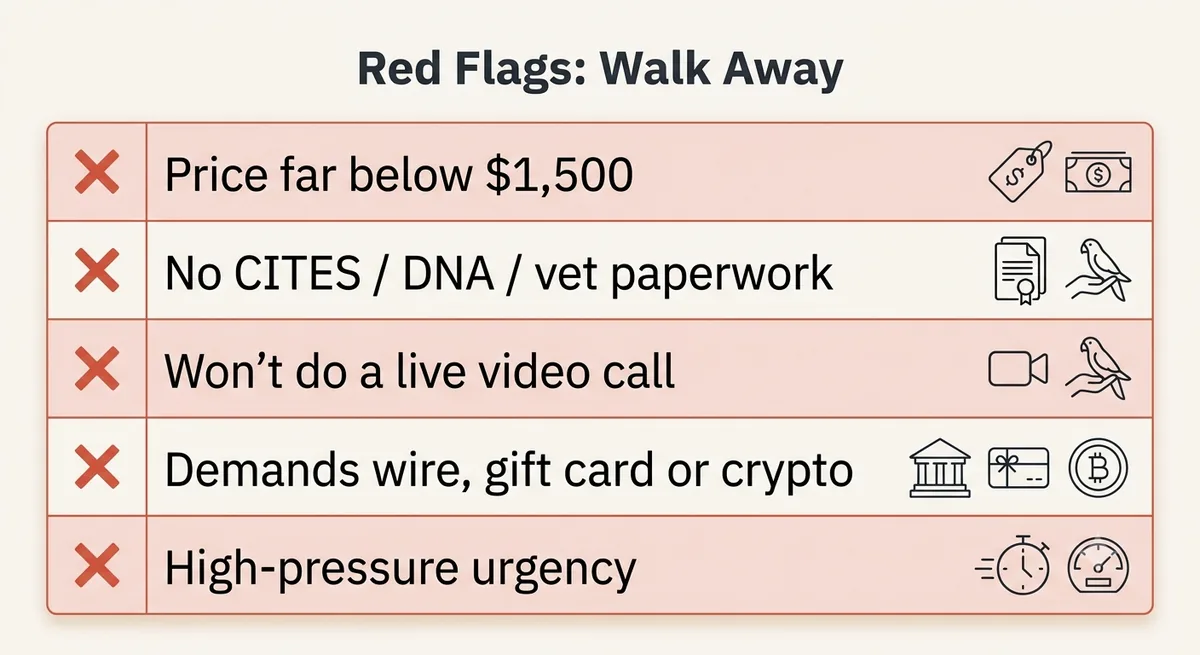
Some warning signs are worth memorising, because they show up in almost every African Grey scam. Any single one of these is a reason to slow down; two or more together is a reason to close the tab. We won't make jokes in this section — this is the part that protects your money, and the con only works while you're excited enough to skip the obvious.
The red flags that mean walk away — before you pay anyone.
Red flag
What it usually means
Price far below $1,500
No papers, unweaned, or a pure scam
No CITES / DNA / vet certificate
Untested, undocumented or wild-caught risk
Won't do a live video call
The bird may not exist at all
Wants wire, gift card or crypto
Irreversible — classic advance-fee scam
Pressure and urgency
'Another buyer is waiting' is a sales trap
No verifiable licence or address
Nobody to hold accountable
Breeder verdict: Any one of these is a reason to pause. Two or more is a scam in progress — keep your money and move on.
The Five Warning Signs, in Detail
Each of these deserves a closer look, because scammers rely on you recognising none of them until the money's gone. Read them once now and they'll jump out at you the next time a listing feels too good to be true.
Price Far Below Market
A price well under the $1,700 floor is the most common bait in the trade. A legitimate, documented, hand-raised African Grey simply costs more than that to produce, so a bargain listing isn't generosity — it's the hook. The gap between the "deal" and the real price is precisely the testing, papers and weaning that were skipped, or the bird that was never there.
No Paperwork or Vet Records
If a seller can't produce CITES documentation, a DNA certificate and an avian-vet record before you pay, treat the bird as undocumented — because that's what it is. "Papers coming later" is the single most reliable phrase in a bird scam. Real documentation exists before the sale; a promise of documentation after payment is a promise scammers make and never keep.
Crypto, Gift-Card or Wire-Only Payment
The payment method is often the clearest tell of all. Scammers insist on wire transfers, gift cards or cryptocurrency for one reason: those payments are irreversible, so once you've sent the money it's gone. A legitimate breeder takes a payment you can dispute and reverse. Anyone who only accepts irreversible methods is choosing the one option that leaves you no recourse.
Reversible payment is your only real safety net
A payment you can dispute is the difference between a bad experience and an unrecoverable loss. Insist on one, and a scammer's favourite tools — wire, gift cards, crypto — lose their power entirely.
Citation: the FTC on reversible vs irreversible payments
Consumer-protection guidance is blunt on this point. As the FTC's advice on avoiding pet scams ↗ spells out, demands for wire transfers, gift cards or crypto are a defining signature of pet-purchase fraud, and the Better Business Bureau's scam tracker ↗ logs these advance-fee pet cons by the thousand. Use a reversible method, every time.
Urgency & Pressure Tactics
"Another buyer is deciding tonight." "I need the deposit in the next hour to hold her." Manufactured urgency exists to stop you running the checks in this guide. A real breeder understands that a 40–60 year commitment deserves a few days' thought and will hold a reasonable, reversible deposit without drama. If someone is rushing you, they're rushing you past the very step that would expose them.
Myth
If the seller has lots of photos and a professional-looking website, the bird must be real and it's safe to pay.
Fact
Photos and slick sites are the easiest things to fake — scammers routinely steal real breeders' images. Legitimacy is proven by a live video call, verifiable paperwork and a reversible payment, not by how polished the listing looks. Verify the seller, not the screenshots.
Why Buyers Choose C.A.Gs (and How We Rank Ourselves Honestly)
We put ourselves at the top of the ranking, so it's only fair we show our work. Here at C.A.Gs, we're not the cheapest listing you'll find and we'd never pretend to be — we're the source that passes every check in this guide, because we built the aviary around exactly those checks. Most of our buyers reach us after a scare somewhere else, wanting a bird they can verify, and here's what that looks like.
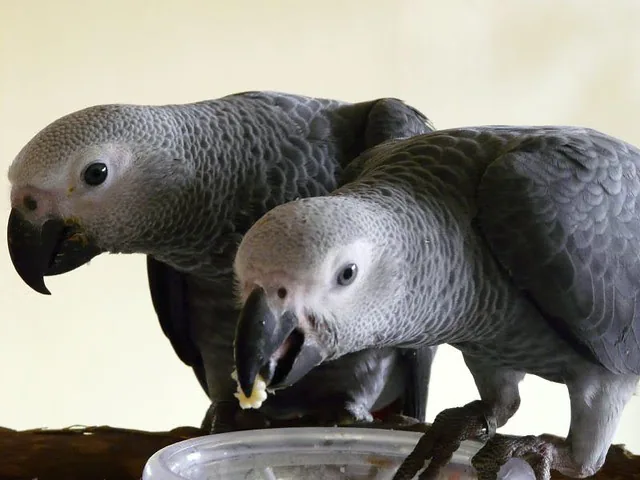
A verifiable, USDA-licensed breeder — real people, real birds, real paperwork.
Health Testing & a Written Guarantee
Every C.A.Gs Grey is PCR DNA-sexed, examined by an avian vet, and screened for the diseases that matter, then sent home with a written health guarantee and the certificates to match. You're not hoping the bird is healthy; you're holding the paperwork that proves it — and you're welcome to call the vet on the certificate to confirm every word before you commit.
Hand-Raising & Socialisation
Our birds are hand-raised in our home in Midland, Texas — fed, handled and gentled every day from hatching — so they arrive bonded to people and ready to learn. That daily work is the whole reason a well-raised Grey is calm on your hand and quick to start training and talking, and it's the one thing a marketplace flipper can't fake with a stolen photo.
Lifetime Breeder Support + Nationwide Shipping
When you buy from us, the relationship doesn't end at the airport. We answer questions for the life of the bird — the plucking scare in year three, the diet question in year eight — and we ship nationwide on IATA-compliant flights, $185 to your nearest airport or $350 home delivery. That combination of verifiable documentation and a breeder who stays reachable is exactly what the top of the ranking is supposed to mean.
What "Lifetime Support" Means in Practice
It means you have a number to call for the next four decades, not just until the sale clears. New Grey owners hit the same milestones — the first moult, the first tantrum, the first vet scare — and having the breeder who raised the bird on the other end of the line is worth more than any discount.
Shipping that's safe, tracked and IATA-compliant
Distance rarely needs to decide this purchase. Our birds travel on IATA-compliant Delta, United or American flights — $185 to your nearest airport or $350 home — crated, monitored and documented the whole way, so a verifiable breeder a few states away is still the safer choice.
Breeder note: the buyers who came to us after nearly losing a deposit
We hear the same story constantly: a "$700 African Grey" on a marketplace, a seller pushing gift cards, a knot in the stomach — and a search that finally led somewhere they could verify. It's why this whole page exists. We'd genuinely rather you ran every check in this guide on us and bought with total confidence than sent a hopeful deposit to someone who couldn't pass a single one.
See Our Available Hand-Raised Greys
Here are the African Greys available now — each one hand-raised in Midland, Texas, PCR DNA-sexed, vet-checked and CITES-documented, at one fair, fixed price with nothing hidden behind it. Every card shows exactly what you'd verify on a live call before reserving with a $200 deposit.
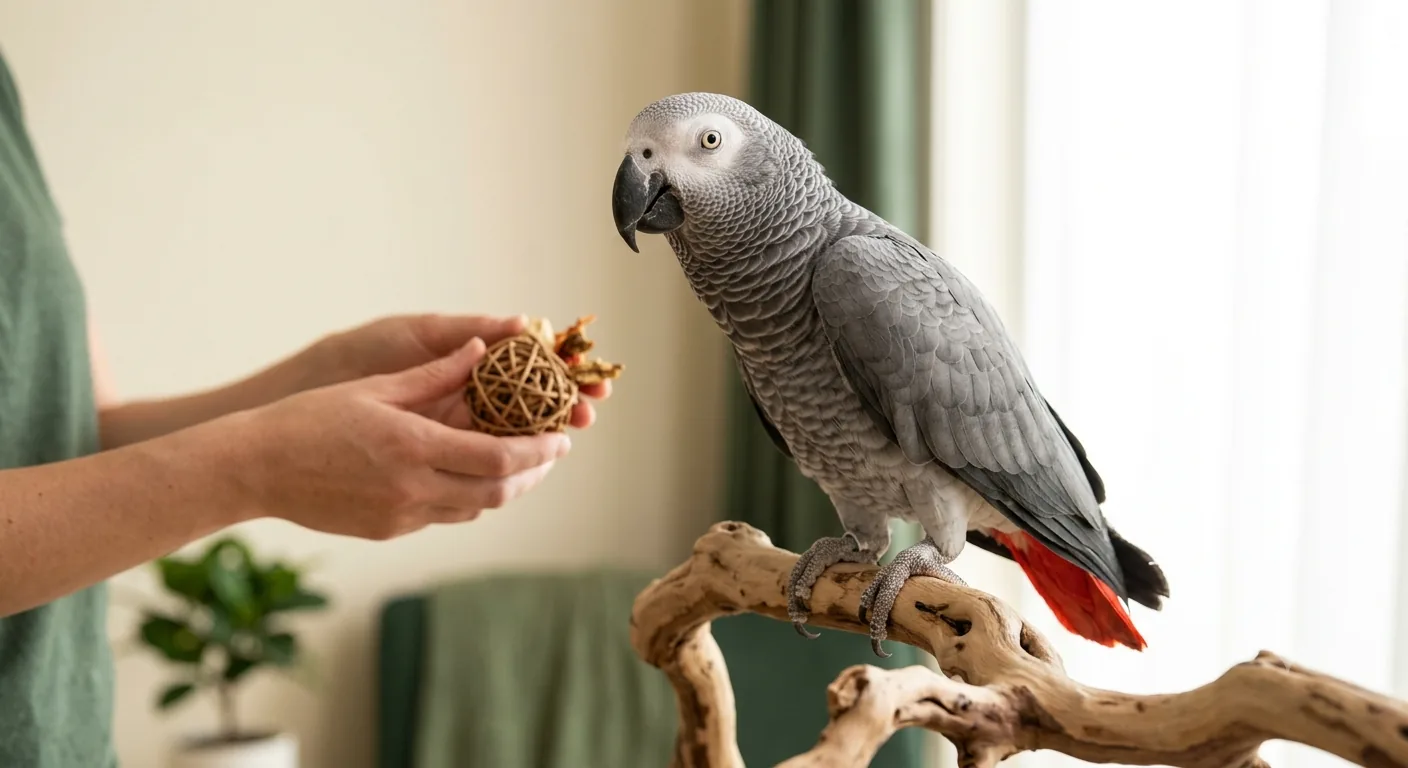
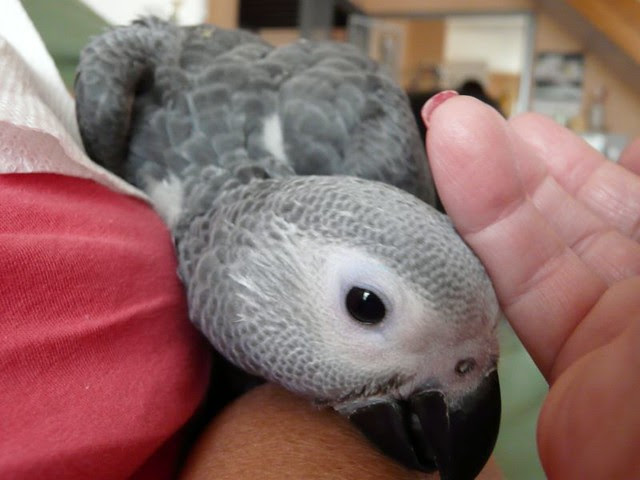
New Arrival Midland, TX
Amie
Female · 3 mo · Congo African Grey
"Hand-raised, fully documented, ready to reserve."
Premium hand-raised female, 3 months old. PCR DNA-sexed, vet-checked, CITES-documented — captive-bred in the USA with the full paper trail.
— Written by Mark & Teri Benjamin, the breeders behind C.A.Gs · USDA-licensed African Grey aviary, Midland, TX
Where to Buy an African Grey: Frequently Asked Questions
Can I buy an African Grey online safely?
Yes — but only when you verify the seller the same way every time. Buying online is safe with a reputable, USDA-licensed breeder who will do a live video call with the bird in hand, provide CITES Appendix I papers, a PCR DNA-sexing certificate and an avian-vet health certificate, and accept a reversible deposit. It becomes dangerous the moment a seller refuses any of those. The internet isn't the risk; skipping the checks is.
Are Facebook or Instagram bird sellers legit?
Some are, but social platforms are where most African Grey scams start, so treat every listing as unverified until it passes the seller check. A genuine breeder on Facebook or Instagram will happily move to a live video call, show full paperwork and a USDA licence, and take a payment you can dispute. A scammer will push you toward urgency, wire transfers or gift cards, and will always have a reason they can't video-call the bird right now. If you can't verify a physical location and licence, don't send money.
How much should an African Grey deposit be?
A reasonable deposit to hold a specific bird is a few hundred dollars — we take $200 — paid by a reversible method, with the balance settled before the bird travels. Be wary of a seller who wants the full amount up front by wire or crypto, or a 'deposit' that's suspiciously large. A real breeder reserves the bird, keeps you updated while it finishes weaning, and never needs an irreversible payment to hold it.
Is a breeder or a rescue better for a first-time owner?
For most first-time owners, a reputable breeder is the more predictable path, because a hand-raised, health-tested baby arrives socialised, documented and without a hidden behavioural history. A rescue African Grey can be a wonderful choice too, but rescued Greys often carry trust issues, feather-plucking or bonded-to-one-person behaviour that suit an experienced home better. Either way, insist on health records and never on wild-caught origin.
What paperwork should a reputable breeder provide?
Every legitimate African Grey should come with CITES Appendix I captive-bred documentation, a PCR DNA-sexing certificate, an avian-vet health certificate, a hatch certificate and a closed band number — plus a written health guarantee and a USDA licence you can verify. If a seller can't produce that full set before you pay, that isn't a paperwork delay; it's a warning. Missing papers is the single most common thread in undocumented and scam birds.
How do I find an African Grey breeder near me?
Start with breeders who publish a real address, a USDA licence and original photos and video of their own birds, then verify them the same way you'd verify any online seller. 'Near me' matters less than 'verifiable' — a reputable breeder a few states away who ships on IATA-compliant flights is safer than an anonymous local listing. We ship nationwide, $185 to your nearest airport or $350 home delivery, so distance rarely needs to decide it.
What's the safest way to pay for a parrot?
Use a payment method you can dispute and reverse if something goes wrong. Never wire money, buy gift cards or send cryptocurrency for a bird you haven't verified, because those payments are gone the instant you send them — which is exactly why scammers demand them. A reversible deposit, paid only after you've seen the bird live and the paperwork in full, is the safest route every time.
New hand-raised clutches, verified and documented, before they're listed — socialised families first.


 New Arrival Midland, TX