- Home
- Scam Prevention
How to Avoid African Grey Parrot Scams: 12 Red Flags + CITES Verification Guide
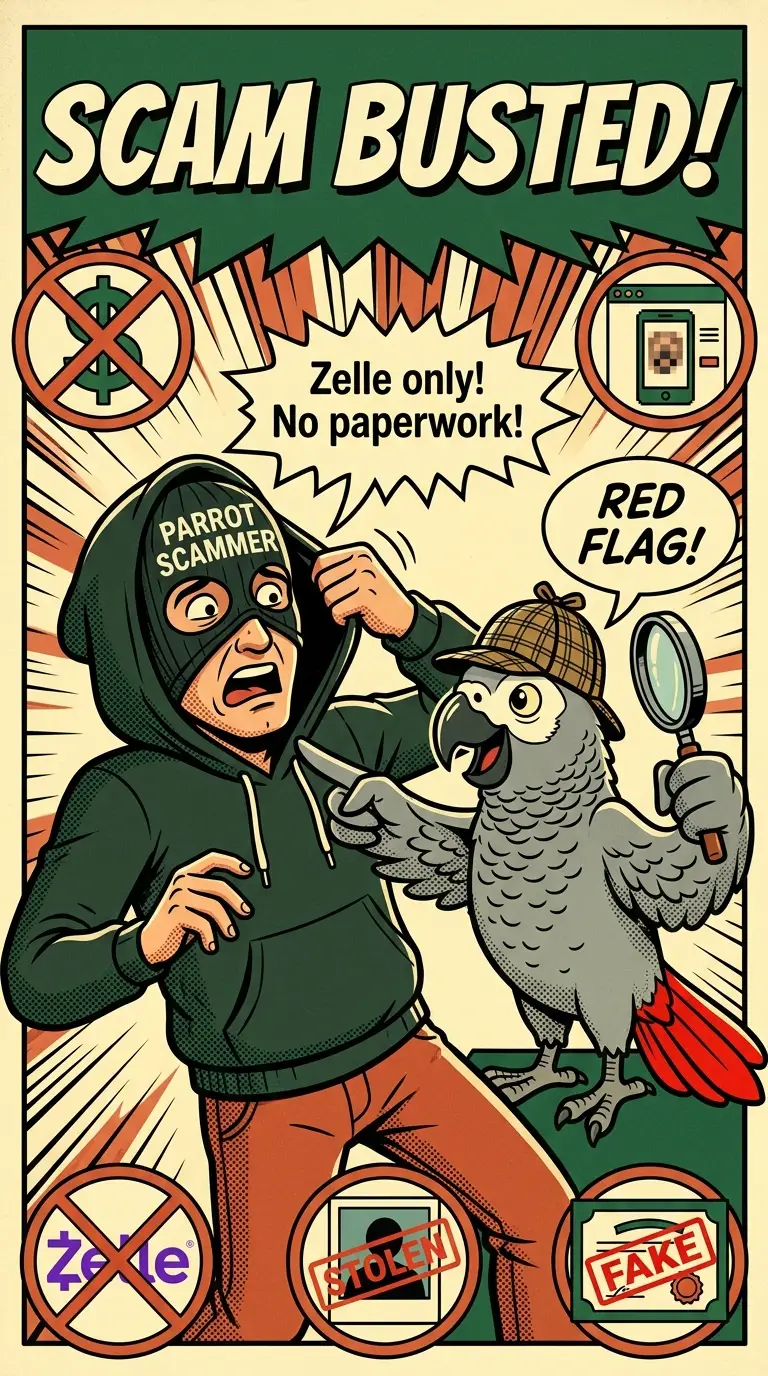
Key Takeaways Before You Read Further
- 92% of scam sites use stolen bird photos — always reverse image search
- Legitimate Congo African Greys cost $1,500–$3,500 (never $400–$800)
- Never pay via Zelle, CashApp, Western Union, gift cards, or wire transfer
- Verify USDA AWA license at aphis.usda.gov/awa/public-search first
- CITES Appendix I captive-bred documentation is legally required
- Anonymous, flat-priced "parrot eggs for sale" farms are scams — buy candled eggs only from a USDA-licensed breeder
- Any breeder who won't video call with a live bird is a red flag
- Report fraud to FBI IC3, FTC, and BBB — it helps shut scammers down
Why African Grey Parrot Scams Are Rampant in 2025–2026
The African Grey parrot (Psittacus erithacus) is listed under CITES Appendix I — a protected species whose international trade is strictly regulated.
Wild-caught African Greys have been banned from import to the United States since 1992 under the Wild Bird Conservation Act.
Every legitimate African Grey for sale in the U.S. must be captive-bred — our captive-bred guide explains exactly what that status guarantees — documented with CITES papers, and sold by a USDA AWA licensed facility.
Scammers know most buyers don't understand these requirements. They post fake listings on Facebook Marketplace, Craigslist, Hoobly, and Kijiji — offering birds that don't exist at prices far below market rate.
By the time a buyer realizes they've been defrauded, the scammer has vanished with the deposit.
Demand
Breeders
of African Grey parrot scam websites use stolen photographs taken from legitimate breeders, pet photography sites, or stock libraries.
The same bird photo frequently appears on dozens of different fake listings simultaneously — catch it with a 30-second reverse image search.
The problem has escalated dramatically because of social media.
Rolling Stone and IFAW have documented how African Grey parrot fraud rings operate across TikTok, Instagram, and Facebook — using professional-looking pages, fabricated reviews, and high-pressure scripts that rush buyers into untraceable wire payments "before someone else claims the bird."
Why African Greys Are Specifically Targeted by Scammers
- High price point: Legitimate birds cost $1,500–$3,500 — scammers can extract large deposits
- Emotional investment: Buyers form attachment to the "bird" even before meeting it — scammers leverage this ruthlessly
- Documentation complexity: CITES + USDA requirements confuse first-time buyers who don't know what to check
- Long search cycle: Buyers search for months; when a "good deal" appears, urgency overrides caution
- Limited legitimate supply: Ethical breeders have waitlists — scammers offer "immediate availability" that legitimate breeders cannot match
- 40–60 year commitment framing: Scammers use the emotional weight of the purchase to create panic and rush payment
A thread on ScamWarners.com specifically targets searches for "Congo African Grey" — the same keywords as congoafricangreys.com. Concerned buyers searching for our brand may encounter scam-warning content.
This guide exists to capture that traffic, establish C.A.Gs' verified legitimacy, and redirect skeptical buyers to our USDA AWA and CITES documentation.
The 5 Types of African Grey Parrot Scams You Need to Know
African Grey parrot fraud is not one-size-fits-all. Scammers use multiple tactics depending on the platform, the buyer, and how much they think they can extract.
Here are the five most common fraud patterns to recognize before you send a single dollar.
Type 1: Advance-Fee Fraud
A bird is listed at an attractive price. Buyer sends a deposit, then the scammer invents escalating fees — "shipping insurance," "CITES customs clearance," "thermal travel crate." Each payment is followed by another invented fee.
The bird never exists. Victims lose $200–$2,000+ before the scammer disappears.
Type 2: Stolen Photo Listing
The scammer steals real African Grey photos from legitimate breeders or stock sites. The listing looks completely authentic.
The "breeder" may even send follow-up photos (also stolen). A reverse image search reveals the same photos on multiple sites or unrelated pages. 92% of scam sites use stolen images.
Type 3: Parrot Egg Fraud
The overwhelming majority of "African Grey fertile eggs for sale" listings are fake-farm scams — anonymous sites with one flat price across every species, a "free cage" bundled in, and no verifiable license. Hatching parrot eggs genuinely requires specialized incubation, 24/7 monitoring, and expert hand-feeding, so these listings target buyers chasing a cheaper "start from an egg" deal.
A real egg program is the rare exception, and it is verifiable: named breeding pairs, a lookup-able USDA license, CITES Appendix I documentation, and candling proof. That is the standard behind our own candled African Grey eggs — if a listing cannot show those, it is the scam described here.
Type 4: Fake Shipping Company
The scammer confirms the sale, "ships" the bird, then a fake "International Animal Transport Agency" demands additional payment — "pet insurance," "customs clearance," "temperature-controlled container upgrade." The fake shipping company is run by the same scammer. The bird never ships.
Type 5: Free Bird / Rehome Scam
The scammer posts an African Grey "needing a good home" for free or near-free due to a "life change." They ask only for "shipping costs." Once money is sent, they vanish.
This scam bypasses price-based skepticism — victims aren't looking for a deal, they're "rescuing" a bird. Especially common on Facebook groups.
Never send money via Zelle, CashApp, Venmo, Western Union, MoneyGram, wire transfer, or gift cards for any bird purchase — ever, for any reason, regardless of how legitimate the seller appears.
Legitimate USDA AWA licensed breeders accept credit card or PayPal Goods & Services, which provide buyer protection and reversal rights. If a seller insists on untraceable payment, it is a scam.
12 Red Flags That Identify an African Grey Parrot Scam
These 12 red flags are drawn from real scam reports, documented fraud cases on petscams.com, parrotalert.com, scamwarners.com, and victim accounts analyzed by the FBI's Internet Crime Complaint Center (IC3).
If a listing or seller exhibits any two of these signs, walk away immediately.
Price Is Far Below $1,500 (Congo) or $1,200 (Timneh)
This is the #1 red flag and the most reliable indicator of fraud. Captive-bred, CITES-documented Congo African Grey parrots from legitimate breeders cost $1,500–$3,500.
Timneh African Greys cost $1,200–$2,500. The cost of breeding, hand-raising, veterinary care, and documentation alone makes pricing below $800 mathematically impossible for a legitimate captive-bred bird.
Scammers offer $300–$700 birds specifically to trigger the emotional response of "I'm getting a great deal." The moment you feel that thrill, stop and verify everything else on this list.
For the full, honest math behind legitimate pricing, our African Grey price guide breaks down what goes into every dollar.
Immediate Disqualifier if Combined with Other FlagsThey Only Accept Zelle, CashApp, Western Union, or Wire Transfer
Scammers demand untraceable, non-reversible payment methods for one reason: they cannot be recovered once sent. Zelle has no buyer protection policy.
Western Union and MoneyGram are explicitly flagged by the FTC as common fraud payment methods. Gift cards are a guaranteed scam — no legitimate business accepts gift cards as payment for a living animal.
Legitimate payment methods that any real USDA AWA licensed breeder will accept: credit card (reversible via chargeback) or PayPal Goods & Services (buyer protection included). If a seller insists on any other method, they are a scammer.
Automatic Red Flag — No ExceptionsThe Listing Photos Appear on Multiple Sites
Research shows that 92% of online pet scam sites use stolen photographs.
The same African Grey parrot photo may appear on dozens of different fake listings simultaneously — sometimes with different names, prices, and "breeder" stories attached to the same image.
This takes 30 seconds to check and is one of the most reliable scam detection methods available.
How to check: Right-click any photo in the listing → "Search image" in Chrome, or upload to images.google.com or tineye.com and check the matches.
If the image appears elsewhere, it is stolen. Even if it doesn't — scammers sometimes use private photos — continue verifying everything else.
Check Every Photo Before Any ContactThey Sell "Fertile Eggs" With No Verifiable Proof or License
Anonymous egg listings are almost universally a scam. Hatching and hand-raising a parrot egg genuinely requires a professional incubator held at precise temperature and humidity for ~28 days, an avian veterinarian on call, formula feeding every couple of hours for the first weeks, and 12–16 weeks of intensive care before weaning — so these listings prey on buyers chasing a cheaper "start from the egg" deal.
The fake-farm tells are consistent: no name behind the site, one flat price across every species, a "free cage" bundled in, non-reversible payment, and no license you can look up. When eggs from those sellers arrive at all, they are typically infertile or dead in shell.
The legitimate exception is a documented aviary selling candled eggs to experienced breeders, with named pairs, a USDA license, and CITES paperwork — the standard behind our own African Grey eggs. If a listing cannot show that, treat it as the scam described here.
Verify the Breeder Before Buying Any EggNo CITES Appendix I Documentation Offered or Mentioned
Every legally sold captive-bred African Grey parrot in the United States must be accompanied by CITES Appendix I documentation confirming captive-bred status. This is not optional — it is a federal legal requirement.
A seller who cannot produce CITES documentation, doesn't know what it is, or dismisses the question is either selling an illegally obtained bird or running a scam.
Ask directly: "Can you provide the CITES Appendix I captive-bred certificate and the facility's USDA AWA license number?" A legitimate breeder will answer immediately. A scammer will deflect, make excuses, or disappear.
Required by Federal Law — Non-NegotiableThe Breeder Website Is Less Than 6 Months Old
Scammers build professional-looking websites quickly and cheaply — sometimes in a single day using website builders.
A site that claims the breeder has "15 years of experience" but was created 3 months ago is a direct contradiction that reveals the fraud. Use a WHOIS lookup to verify.
How to check: Visit lookup.icann.org or whois.domaintools.com → enter the seller's domain name → look for "Creation Date." Real breeders like C.A.Gs have maintained web presence for multiple years with verifiable history.
Cross-Reference Against Experience ClaimsThey Can't or Won't Do a Live Video Call With the Bird Present
Any legitimate breeder with a real bird can FaceTime, Zoom, WhatsApp video, or Google Meet with you in real time.
They will happily show the bird — its behavior, its ring/band number, its environment, how it responds to their voice. A scammer cannot do this because the bird doesn't exist.
Excuses include: "My camera is broken," "The bird is at the vet," "I'm traveling," "We don't do video calls for security reasons." None of these are valid.
Insist on a live video call before any payment. Request the seller hold up today's newspaper or say a word you specify to confirm the video is live and not pre-recorded.
Require Live Video Before Any PaymentA "Shipping Company" Sends Emails Demanding Extra Fees After Purchase
After the initial "purchase," the buyer receives an email — apparently from a separate shipping company — demanding additional payment for "pet insurance," "USDA import health certification," "temperature-controlled crate upgrade," "customs clearance," or "thermal container rental."
The names of fake shipping companies documented in real cases include "PShippings.com," "Impeccable Logistics," and "International Animal Transport Agency."
Real IATA-approved airlines and licensed pet shippers do not cold-contact buyers. Real shipping costs are disclosed before purchase by the breeder.
Any post-purchase "shipping company" contact requesting additional payment is run by the same scammer under a second fake identity.
Never Pay a "Shipping Company" You Didn't HireNo Verifiable Physical Address or In-Person Visit Option
USDA AWA licensed breeders operate from a licensed facility with a documented physical address registered with USDA APHIS. This address is publicly searchable.
If a "breeder" cannot provide a physical address, won't allow visits, or gives an address that doesn't appear in USDA records, they are not a licensed breeder.
C.A.Gs operates from Midland, TX — verifiable in USDA records. Mark and Teri Benjamin welcome buyer inquiries and coordinate video calls showing the birds in our home environment. We don't hide behind a web form.
Verify Address in USDA Public DatabaseThey Can't Provide a USDA AWA License Number
Any person or facility that breeds birds for commercial sale in the United States and sells more than $500 in birds annually is required to hold a USDA AWA Class A Exhibitor or Breeder license.
The license number can be verified instantly at the USDA APHIS public database. A seller who cannot provide this number — or provides one that doesn't match their name/address in the database — is not a legitimate licensed breeder.
Ask: "What is your USDA AWA license number?" A real breeder answers immediately. Then the aphis.usda.gov public search lets you verify it yourself.
Verify at aphis.usda.gov Before Any PaymentExtreme Urgency: "Another Buyer Is Ready — Pay Now or Lose the Bird"
Artificial urgency is a cornerstone of advance-fee fraud. Scammers manufacture time pressure to short-circuit your due diligence process.
Common phrases include: "I have three other inquiries," "This bird will be gone by tomorrow," "I need a deposit today to hold it," "My landlord said I have to find a home for this bird by Friday."
Legitimate breeders — especially USDA AWA licensed facilities with waitlists — do not pressure buyers.
If anything, a real ethical breeder will ask you questions to ensure you're the right fit for a 40-year commitment. Any pressure to pay before you've completed your verification is a scam technique.
Take All the Time You Need — Scammers Hate This"Free" Bird or $100–$150 "Rehome" Requiring Only Shipping Payment
The rehome scam is designed for buyers who would never fall for an obviously too-cheap listing.
By framing the offer as a charitable act — "I'm moving abroad and can't take her" / "My partner is allergic" / "She needs a loving home more than money" — the scammer bypasses the price-based skepticism that protects most buyers.
Once you express interest, they ask for "just the shipping cost" via Zelle or Western Union. The shipping company then invents additional fees.
The bird never existed. The "moving abroad" story is a script — the same one used in thousands of documented fraud cases across multiple countries.
"Free" African Grey = 100% Scam, No Exceptions
How to Verify a USDA AWA License in 3 Steps
C.A.Gs (Mark and Teri Benjamin) holds an active USDA AWA Class A license. Here is exactly how to verify any breeder's license before sending money — takes less than 2 minutes.
How Long Does It Take to Verify a USDA AWA License Number?
Navigate to the USDA APHIS Public Search Tool
Go to aphis.usda.gov/awa/public-search in any browser. This is the official federal database of all USDA AWA licensees — it is free, public, and updated regularly. No login required.
Search by Breeder Name, Business Name, State, or License Number
Enter the seller's name, their business name, or the state they claim to be in. You can also enter the license number they provided directly.
The database will return matching results including: licensee name, business address, license type, license status (Active/Expired), and last inspection date.
Verify the License Is Active and the Address Matches
Confirm three things: (1) The license status is Active — not Expired or Terminated; (2) The licensee name matches the person or business you're dealing with; (3) The address in the database matches the address the breeder provided to you.
Any mismatch is a red flag requiring immediate clarification before any payment.
Not all small hobby breeders are required to hold a USDA AWA license — the requirement applies to breeders who sell more than $500/year in animals commercially.
If a breeder is exempt (very small scale, non-commercial), they should be able to explain why clearly. For any breeder claiming commercial scale or professional status, the license should exist and be verifiable.
How to Verify CITES Documentation for an African Grey Parrot
CITES (Convention on International Trade in Endangered Species) Appendix I documentation is the legal proof that your African Grey parrot was captive-bred — not wild-caught.
African Greys were uplisted from Appendix II to Appendix I at CoP17, effective January 2017, which is exactly why scammers now wave fake "CITES certificates" at buyers who know the term but not the paperwork.
Here at C.A.Gs we hand every buyer the real thing, and our complete CITES documentation guide walks through each form line by line. Below is what real CITES documentation looks like and how to verify it.
What CITES Documentation Must Include
Can I Buy an African Grey Without CITES Documentation?
- Species designation: Psittacus erithacus (Congo) or Psittacus timneh (Timneh) — the full scientific name
- "Captive-bred" declaration: Explicitly stating the bird was bred in captivity, not wild-caught
- Hatch date and band/ring number: The bird's individual identification — must match the physical band on the bird's leg
- Breeder facility name and USDA AWA license number
- Issuing authority signature: Signed by a USDA-authorized official or CITES authority
- Date of issue — documentation should be issued at the time of the bird's sale
How to Verify CITES Documentation Is Real
- Request the documentation in writing (email or PDF) before sending any payment
- Cross-reference the USDA AWA license number in the document against the USDA public database
- Confirm the band number on the document matches the physical leg band visible in video call
- Check that the issuing authority is a real, verifiable USDA-registered entity
- Contact USDA APHIS directly at (844) 820-2234 if you have doubts about document authenticity
How to Reverse Image Search a Bird Photo (30-Second Scam Check)
The fastest scam detection tool available to any buyer is a reverse image search. It takes 30 seconds and has exposed more African Grey parrot scams than any other single technique.
Right-Click Any Photo in the Listing
In Google Chrome or Edge, right-click on any bird photo in the listing. Select "Search image with Google" (Chrome) or "Search for image" (Edge). This instantly launches a Google Image Search using that exact photo.
If Right-Click Doesn't Work: Save and Upload
Save the image to your device, then go to images.google.com → click the camera icon → upload the saved photo. Alternatively use TinEye.com — it searches specifically for exact image matches across the web.
Look for the Same Photo on Multiple Sites
If the search results show the same bird photo appearing on other websites — different "breeder" pages, stock image sites, unrelated social media accounts, or other pet sales pages — the photo is stolen and the listing is a scam.
Also check if the photo appears attributed to a photographer or a different breeder by name.
How to Check if a Breeder Website Is New (WHOIS Domain Age Check)
Scammers build websites fast. A site claiming 10 years of experience might have been created 6 weeks ago. A WHOIS lookup reveals the truth in under 60 seconds.
Go to lookup.icann.org or whois.domaintools.com
Both tools are free. lookup.icann.org is the official ICANN WHOIS registry — the most authoritative source. whois.domaintools.com shows additional historical data about domain ownership changes.
Enter the Breeder's Domain Name
Type the seller's website address (e.g., "exampleafricangreybreeder.com") into the WHOIS search box. Do not include "http://" or "www." — just the domain name and extension.
Find the "Creation Date" — Compare to Experience Claims
The "Creation Date" or "Registered On" field shows when the domain was first registered. If a "breeder" claims 15 years of experience but their domain was created 3 months ago, that is a direct contradiction.
Legitimate breeders like C.A.Gs have domain registrations spanning multiple years, consistent with their stated experience. Our own domain is happily middle-aged — run the lookup on congoafricangreys.com and check our math.
Many domains use privacy protection services that mask the registrant's personal details. This alone is not a red flag — even legitimate businesses use domain privacy.
What matters is the Creation Date, which is always visible regardless of privacy protection. If the creation date is recent and the experience claims are old, that's the contradiction to act on.
10 Questions to Ask Every African Grey Breeder Before You Send a Dollar
A legitimate USDA-licensed captive-bred African Grey breeder — like Mark & Teri Benjamin at C.A.Gs in Midland, TX — will answer every one of these questions without hesitation, with documentation to back it up.
A scammer will dodge, deflect, or fabricate.
Can you provide your USDA AWA license number?
What to expect: Legitimate breeders give the number immediately. The aphis.usda.gov/awa/public-search database lets you verify it yourself. Red flag: "It's in the paperwork when you pay" or any version of "later."
Will you do a live video call showing this specific bird?
What to expect: Yes — within 24–48 hours. The bird should be present, interactive, and clearly the same bird in the photos. Red flag: Camera "broken," bird "at the vet," or the video call never materializes.
What CITES Appendix I documentation will come with the bird?
What to expect: A complete description of the captive-bred certificate, hatch date documentation, and ring/band number. Red flag: "African Greys don't need paperwork" or "We'll sort it out after purchase."
Can I have a reference from a previous buyer?
What to expect: A legitimate breeder either provides references directly or points you to documented reviews (Google, testimonials page).
Red flag: Vague responses, "we protect buyer privacy," or references that go unanswered when you reach out.
How long has your breeding program been operating?
What to expect: A specific founding year with corroborating details — and a website creation date that matches.
C.A.Gs has been breeding since 2014, and our domain history backs it up. Red flag: Vague "many years" answers with a domain registered last quarter.
Do you have a health guarantee and avian vet certification?
What to expect: A written health guarantee with specific terms — ours is 72 hours, in writing — and documentation of a pre-shipment avian vet health check. Red flag: "Healthy birds, no guarantee needed" or verbal-only assurances.
Is the bird DNA-sexed? Can I see the certificate?
What to expect: A dated certificate from a recognized avian DNA testing lab.
African Greys are not visually sexable — any seller who claims they can tell by looking is misinformed or lying. Red flag: "Trust me, it's a female" without documentation.
What payment methods do you accept?
What to expect: Credit card, PayPal Goods & Services, or bank transfer for verified business accounts. Red flag: Zelle only, CashApp only, Western Union, wire transfer, or — the biggest red flag of all — gift cards.
What is the bird's hatch date and current age?
What to expect: Specific date with documentation. Congo African Greys should be at minimum 12 weeks — ideally 14–16 weeks — before leaving the breeder. Red flag: "Ready to ship immediately" for a bird supposedly only 6–8 weeks old.
Do you offer post-purchase support?
What to expect: An offer to answer questions about diet, weaning, and adjustment — signs of a breeder invested in the bird's long-term wellbeing, not just closing a sale.
Red flag: Complete silence or "that's not my problem" after payment clears.
All 10 answers from C.A.Gs? Yes, before you commit a dollar. Mark & Teri Benjamin built C.A.Gs on the principle that a buyer who feels informed and protected becomes a lifelong relationship — not a transaction.
Ask C.A.Gs Anything →Get Clutch Alerts + Scam Warnings
New birds available + fraud alerts when scams target African Grey buyers. No spam, unsubscribe any time.
Is This Listing Legitimate? Ask a Verified Breeder.
Unsure about a listing you've found? Send it to Mark & Teri Benjamin at C.A.Gs, USDA-licensed, CITES-documented captive-bred African Grey breeders since 2014. We'll tell you what we see, for free.
Inside the Advance-Fee Fraud Script: How Scammers Escalate the Take
The advance-fee fraud — also called the "419 scam" or "Nigerian prince" pattern adapted for pet sales — follows a predictable escalation script. Recognizing each stage can stop you before you lose anything beyond your first payment.
Stage 1: The Hook — The Attractive Listing
The scam opens with a listing too good to ignore: a hand-raised baby Congo African Grey at $600–$900, photos of a beautiful bird, and a heartwarming backstory.
"We're missionaries relocating to Africa and can't bring our beloved companion." Or: "We're a breeder downsizing our program." The story is designed to trigger sympathy and lower your defenses.
Stage 2: The Rapport Build
Before any money is mentioned, the scammer spends time building trust. Multiple emails or texts, detailed "answers" to your questions (all vague), and affectionate language about how much they love their bird.
They're patient — a good scammer invests days or weeks before making the ask. You start to feel like you know this person.
Stage 3: The Deposit Request
After rapport is established, the seller asks for a "small deposit" — $150–$400 — to "hold the bird" and "start the paperwork." The payment method is Zelle, CashApp, or Western Union.
They explain that "their bank doesn't accept credit cards for animals." Once you pay, the bird is "reserved for you."
Stage 4: The First Escalation — Shipping Costs
A few days later, you're told the bird is "ready to ship" but there's a problem: the special IATA-approved airline crate costs $185–$350, which wasn't included in the original price.
"Just send this and the bird ships tomorrow." Most victims pay — they're already emotionally invested and have already paid the deposit.
Stage 5: The Second Escalation — Insurance or CITES Customs
Another fee: "shipping insurance" ($200), or a "CITES customs fee" that has to be paid before the bird can legally cross state lines.
Each fee is framed as required, official, and temporary — you'll be "reimbursed" upon delivery. Victims who've paid $400–$700 already often pay this too, not wanting to lose what they've invested.
Stage 6: The Ghost
The scammer stops responding. The phone number is disconnected. The email bounces. The listing disappears from the platform. The "bird" never existed.
Victims are left with $400–$2,000+ in losses and no recourse — because every payment went through an untraceable, non-reversible channel.
Every advance-fee parrot scam uses this same escalation. The names change. The birds change. The stories change. But the escalation — deposit → shipping → insurance → CITES fee → ghost — never varies.
If you recognize any step of this pattern in a transaction you're considering, exit immediately. You are in a scripted fraud.
Fake Shipping Company Red Flags: How the "Transport" Scam Works
A subset of advance-fee fraud uses a fake shipping company as a second layer of extraction.
After the initial deposit, the scammer refers you to a "licensed bird transport company" that charges escalating fees. Here is how to identify the fake immediately.
Red Flag 1: The Shipping Company Contacts YOU
No legitimate shipping company cold-contacts a buyer. Real bird transport is arranged by the breeder through a licensed carrier (Delta Cargo, American Airlines Cargo, Southwest Cargo).
If you receive an unsolicited email from a "PetTransport" company right after engaging with a seller, that company is controlled by the scammer.
Red Flag 2: The Company Has a Gmail or Yahoo Address
Real cargo companies communicate from their own domain (e.g., @deltacargo.com, @united.com).
Any "shipping company" using a @gmail.com, @yahoo.com, or @outlook.com address is not a shipping company — it is the scammer under a second persona.
Red Flag 3: The Invoice Requests Zelle, CashApp, or Wire Transfer
Actual airline cargo services process payments through their corporate billing systems — credit cards, corporate accounts, or ACH bank transfers to verified business accounts.
A "shipping company" insisting on Zelle or CashApp is a fraud. There is no legitimate reason for this payment method in commercial cargo transport.
Red Flag 4: Escalating "Compliance" Invoices
Initial shipping quote: $185. Then a "USDA APHIS permit fee" email: $225. Then a "live animal insurance" invoice: $175. Then a "CITES export clearance" demand: $350. Each invoice arrives from a slightly different email address or domain.
The bird is never shipped because it does not exist — but the invoice factory keeps running until you stop paying.
Red Flag 5: No IATA Airwaybill Number
Every legitimate live animal air shipment generates an IATA airwaybill (AWB) number — an 11-digit tracking number you can verify directly with the airline.
If a "shipping company" cannot provide a real AWB number that returns a result when you enter it on the airline's cargo tracking page, no bird has been shipped.
How C.A.Gs Handles Shipping
All C.A.Gs birds ship via Delta Cargo or American Airlines Cargo in IATA-approved carriers. You receive the AWB number and can track the shipment in real time.
There are no hidden fees: our two delivery tiers — Airport Pickup $185 or Home Delivery $350 — are quoted upfront, before any deposit is taken. No surprises, no escalations.
Real African Grey Parrot Scam Stories: What Victims Describe
These accounts are composites drawn from public reports filed with the BBB Scam Tracker, FTC, IC3, and parrot owner forums.
Names are changed to protect victims. The details — the scripts, the fee amounts, the ghost — are consistent across hundreds of documented reports.
What Do Real African Grey Parrot Scam Victims Experience?
"I sent $400 and never heard from them again. The photos were stolen from a real breeder's Instagram — I found out after doing a reverse image search."— Victim report via BBB Scam Tracker, 2024
"I Sent $1,240 Before I Realized the Bird Didn't Exist"
Texas — BBB Scam Tracker Report"I found a baby Congo African Grey listed for $750 on a Facebook group. The seller — 'Jennifer' — answered every question I had.
Photos, videos of the bird talking, even a 'reference' from a previous buyer. I felt like I'd done everything right."
"After a $300 deposit via Zelle, I got an email from 'National Pet Courier' about a $320 shipping crate. Then a $285 insurance invoice.
Then a $335 CITES customs clearance fee. Each time I asked about my bird, they reassured me it was 'almost there.' After the fourth email, everything went silent."
Total lost: $1,240. Recovery: $0. The Zelle payments were non-reversible. The Facebook profile was deleted within 24 hours of the ghost. The "reference" was a second persona operated by the same scammer.
"The CITES 'Certification' They Sent Was a Google Images Screenshot"
California — IC3 (FBI) Report"I specifically asked for CITES documentation before paying. They sent me a PDF that looked official — letterhead, a CITES logo, a certificate number. I thought I was protected. I sent $800 via CashApp."
"When the bird never arrived and I tried to report them, I showed the CITES document to my state fish and wildlife office.
They confirmed it was fabricated — the certificate number didn't exist in any registry, the formatting didn't match real CITES documents, and the issuing authority listed was fictional."
Total lost: $800. Recovery: $0. CashApp flagged the account 3 days later — but by then the money had been withdrawn.
What You Can Do Right Now
If either of these stories sounds like your current situation — stop the transaction immediately.
Do not send another payment, even if the previous payment is "about to be refunded." Report what you've experienced to the FBI IC3 at ic3.gov and via reportfraud.ftc.gov to the FTC.
Your report helps catch the same operators targeting other buyers.
How to Spot a Scam Listing Before You Ever Contact the Seller
Most African Grey parrot scam listings share a fingerprint — a cluster of signals that appear together. No single signal is definitive, but three or more in the same listing means exit immediately.
The 7 Scam Listing Signals That Cluster Together
- Price anchor below $800 — listed as "$600 to a good home," "$750 OBO," or "free to loving family, just pay shipping"
- Contact method is Gmail, Yahoo, or WhatsApp only — no business email, no website, no phone number that rings through to a real person
- Location is vague or inconsistent — "TX" without a city, or the stated city doesn't match the area code of the number provided
- No CITES documentation mentioned — listing describes the bird in detail but never references captive-bred status, documentation, or CITES Appendix I compliance
- Listing appeared recently on multiple platforms simultaneously — same photos on Craigslist, Facebook Marketplace, Hoobly, and PetFinder within the same week
- Seller pushes urgency without provocation — "I have three other serious inquiries," "if you don't commit today I'll offer it to someone else," without any context that explains why speed matters
- Backstory is emotionally designed — "relocating for missionary work," "divorce forces sale," "spouse is allergic," "elderly parent can no longer care for bird" — a backstory crafted to lower your defenses, not answer your questions
The "Free Rehome" Scam — A Special Category
A growing variant: the listing is entirely free. The bird is "just looking for a loving home." All you pay is shipping.
The scammer presents this as altruistic — they want to ensure the bird "goes to the right person." What follows is the standard advance-fee escalation: shipping crate fee, insurance, CITES clearance, veterinary travel certificate.
Total extracted: $400–$1,200. Bird: never existed.
Scam listings appear on every platform: Facebook Marketplace, Craigslist, Hoobly, PetFinder, Kijiji, Gumtree, and even platforms that claim to vet sellers.
No platform verifies USDA AWA licenses or CITES documentation. Platform presence is not a trust signal. The verification steps in this guide are the only reliable check.
Safe vs Unsafe Payment Methods for Buying an African Grey Parrot
Payment method is the single most important decision in the entire transaction. Choose wrong and there is no recovery — not from your bank, not from law enforcement, not from the platform.
The rule is simple: never pay via a method you cannot reverse.
What Is the Safest Way to Pay for an African Grey Parrot?
| Payment Method | Safety | Reversible? | Buyer Protection | Verdict |
|---|---|---|---|---|
| Credit Card | ✓ Safe | Yes — chargeback up to 120 days | Full via card issuer dispute | Best option |
| PayPal Goods & Services | ✓ Safe | Yes — 180-day dispute window | Full PayPal Purchase Protection | Strongly recommended |
| Bank Wire (verified business) | Caution | Limited — must request recall within 24–48h | Minimal — requires bank cooperation | Only for verified, established breeders |
| Zelle | ✗ Unsafe | No — instant, non-reversible | None | Never use for bird purchases |
| CashApp | ✗ Unsafe | No — non-reversible once sent | None | Scammer's preferred method |
| Venmo | ✗ Unsafe | No — personal payments non-reversible | None (personal) / Limited (business) | Avoid for high-value purchases |
| Western Union / MoneyGram | ✗ Unsafe | No — cash pickup, untraceable | None | Never — scammer's classic tool |
| Gift Cards (any brand) | ✗ Unsafe | No | None | Immediate scam indicator |
| PayPal Friends & Family | ✗ Unsafe | No — explicitly excludes goods | None — waives all protection | Treat same as Zelle |
| Cryptocurrency | ✗ Unsafe | No — blockchain transactions irreversible | None | Never for any live animal purchase |
How C.A.Gs Accepts Payment
C.A.Gs accepts credit card and PayPal Goods & Services — both fully reversible methods with buyer protection. We never ask for Zelle, CashApp, or wire transfer.
If a seller claiming to be C.A.Gs requests any other payment method, it is not us — contact us directly via our inquiry form to verify.
The "PayPal Friends & Family" Trick
Many scammers specifically request PayPal Friends & Family instead of Goods & Services. The difference: Goods & Services includes PayPal Purchase Protection — the buyer can file a dispute and recover funds.
Friends & Family does not. It is designed for personal transfers between people who know each other. A seller requesting it is explicitly asking you to waive your protection. Refuse — or switch to a credit card directly.
What Legitimate CITES Documentation Looks Like: A Complete Checklist
The single most effective scam prevention tool is knowing what real documentation looks like before you ask for it.
Scammers send fabricated PDFs that look official — a legitimate captive-bred Congo African Grey from a licensed breeder arrives with a specific, verifiable set of documents.
For the deep dive on each form, our CITES documentation guide shows real examples; here is the checklist version.
- CITES Appendix I Captive-Bred Certificate
Issued or referenced by the breeder's state wildlife agency or USDA. Must state "captive-bred" explicitly, reference the bird's species (Psittacus erithacus), and include the band/ring number.
The certificate number is cross-referenceable with the issuing authority. Any PDF without these fields is fabricated.
- Hatch Certificate with Band/Ring Number
Documents the bird's date of birth and the unique band or microchip ID assigned at the breeding facility. The band number must match the band on the bird's leg. Without a physical match, the certificate is meaningless.
- DNA Sexing Certificate
African Greys are not visually distinguishable by sex. A legitimate DNA sexing certificate comes from a licensed avian DNA testing laboratory, not from the breeder's own word.
The certificate includes the lab name, test date, sample type (feather or blood), and the result (male/female).
- Avian Veterinarian Health Certificate
A pre-shipment health exam by a licensed avian vet, conducted within 10 days of shipping (required by most airlines).
The certificate must include the vet's license number, clinic address, exam date, and the bird's species, band number, and health status. Ask for the vet's name and verify they exist at their stated practice.
- Breeder's USDA AWA License Number
The license number of the breeding facility must appear on all documentation.
You can verify it independently at the USDA APHIS public search tool before any payment is made. A license number that returns no results or a different name is fraudulent.
- IATA Live Animal Airwaybill (if shipping)
Every airline-shipped bird generates an IATA airwaybill (AWB) number — an 11-digit code you can verify on the carrier's cargo tracking site.
The AWB proves the bird was physically checked in for cargo. Absence of a real AWB number after the stated ship date means no bird was shipped.
Scammers use template PDF editors. Signs of fabrication: certificate numbers that return no results when verified, issuing authority names that don't match real agencies, fonts inconsistent with official documents, and missing fields (no band number, no vet license number, no dates).
When in doubt, call the issuing authority directly — every legitimate document has a phone number or verification process.
Why C.A.Gs Is a Verified, Legitimate African Grey Parrot Breeder
Every claim on this page — every verification step, every red flag — applies equally to us. Mark & Teri Benjamin at C.A.Gs welcome all of the scrutiny we've described here. Here is exactly how we satisfy each verification test.
USDA AWA Licensed
Our USDA Animal Welfare Act Class A license is publicly searchable at aphis.usda.gov/awa/public-search. Enter our name or Midland, TX and verify it yourself before you spend a dollar.
CITES Appendix I Compliant
Every C.A.Gs bird comes with CITES Appendix I captive-bred documentation. No exceptions. If we can't provide it for a specific bird, that bird doesn't ship.
PCR DNA Sexed + Vet Certified
Each bird is PCR DNA sexed by a licensed laboratory and examined by our board-certified avian veterinarian before shipment. Certificates ship with every bird.
Breeding Since 2014
Our domain registration date matches our stated founding year. Our WHOIS record, our customer history, and our USDA file all tell the same story.
Real IATA Cargo Shipments
Every bird ships via Delta Cargo or American Airlines Cargo. You receive a real IATA airwaybill number before the bird lands. Track it live — no surprises, no phantom shipments.
Verified Buyer Reviews
Real families. Real testimonials. Read C.A.Gs buyer reviews — not anonymous posts, but families who have brought our birds home and share their experience by name.
What Health Screening Separates a Real C.A.Gs Bird From a Scam Listing?
Here at C.A.Gs, the screening happens long before a buyer ever sees a listing.
Every chick we hand-raise is tested for PBFD (Psittacine Beak and Feather Disease) and Avian Polyomavirus (APV) — the two viral diseases that scam-sourced and laundered birds most commonly carry, because no one screened the parents and no one quarantined the chicks.
We run PCR-based DNA sexing on every bird (African Greys cannot be sexed visually — any seller who "can just tell" is guessing or lying), and our board-certified avian veterinarian examines each bird before it travels.
Then the paperwork follows the bird, not the other way around: the hatch certificate records the hatch date and the number on the closed band placed on the chick's leg in the first weeks of life — a band that physically cannot be slipped onto an adult bird, which is exactly why scammers never mention banding.
Our 72-hour written health guarantee puts our screening on the line in writing, and our health guarantee page publishes the exact terms. Ask a scammer for any single item on this list and watch the conversation end.
How Do I Verify CongoAfricanGreys.com Is a Real Breeder?
Live Video Call — Anytime, Before Any Commitment
Ask us for a live FaceTime or video call showing your specific bird before you pay anything. We'll show you the bird interacting with our family — the same bird in the photos, in our home, responding to us.
No breeder who passes this test is a scammer. We've never declined a pre-purchase video call request.
How to Report an African Grey Parrot Scam: 5 Agencies That Take Action
If you have been defrauded — or if you identify an active scam before losing money — report it immediately.
Each agency below handles a different jurisdiction. Filing all five maximizes the chance of a takedown and helps protect the next buyer.
Agencies That Take Action
FBI Internet Crime Complaint Center (IC3)
The FBI IC3 online fraud portal is the primary federal channel for internet-based fraud. File at ic3.gov. IC3 feeds into federal investigation pools — multiple complaints about the same operator trigger action.
What Should Your IC3 Report Include?
Who They Are
The seller's name, email address, phone number, and the platform where the listing appeared.
How You Paid
The payment method used — Zelle, CashApp, wire transfer, or card — plus the account or handle the money went to.
What You Lost
The total amount, broken into each payment: deposit, shipping crate, insurance, and any "clearance" fees.
What You Can Prove
All communication records — emails, texts, chat screenshots, and any fake invoices or fabricated documents the scammer sent.
Federal Trade Commission (FTC)
ReportFraud.ftc.gov handles consumer fraud at the federal level.
The FTC uses complaint data to identify patterns — a surge of reports about the same phone number or email triggers investigation.
Also report to the FTC if the scammer's payment platform (Zelle, CashApp) refuses to cooperate with your refund request.
Your State Attorney General
Every state AG office has a consumer protection division.
File online at your state's AG website — search "[your state] attorney general consumer complaint." State-level complaints can trigger action against operators based in your state and create public records that warn other buyers.
This is especially effective for scammers operating within the same state as the victim.
Your Bank or Credit Card Issuer
If you paid by credit card or debit card, call the number on the back of your card immediately and request a chargeback under "item not received" or "fraud."
How Fast Do You Need to File the Chargeback?
Time is critical — most issuers require the dispute to be filed within 60–120 days of the transaction.
If you paid via Zelle through your bank's app, report it as an "unauthorized" transaction; banks have increasingly been reversing Zelle scam payments under regulatory pressure.
The Platform Where the Listing Appeared
Report the listing and seller profile to Facebook Marketplace, Craigslist, Hoobly, or whichever platform hosted the scam.
Platforms have fraud teams and can remove listings, ban accounts, and in some cases preserve evidence for law enforcement.
Use the platform's "Report" button — and also email their trust & safety team directly if the listing is actively targeting other buyers.
Even If You Can't Get Your Money Back — Report Anyway
Many victims don't report because recovery seems unlikely. But the same scammer who took $800 from you is targeting someone else right now. Your report — combined with others — is what puts operators on federal radar.
The IC3 and FTC do not act on individual complaints; they act on patterns. Your report is one data point in a pattern that stops the next victim.
Buying African Grey Eggs or a Breeding Pair — Without Getting Scammed
Eggs and breeding pairs draw even more fakes than single chicks, because the buyers are often in a hurry and the "product" is easy to fake in a photo. The safe rule is identical to everything above: only buy verified African Grey eggs and a documented breeding pair from a USDA-licensed, CITES-papered breeder. Here at C.A.Gs we sell both — candled eggs at $95 each (free US shipping on five or more) and proven, closed-banded pairs from $3,000 — each with the same closed-band records and CITES Appendix I paperwork that travels with our hand-raised babies. No "papers after payment," no Zelle-only demands.
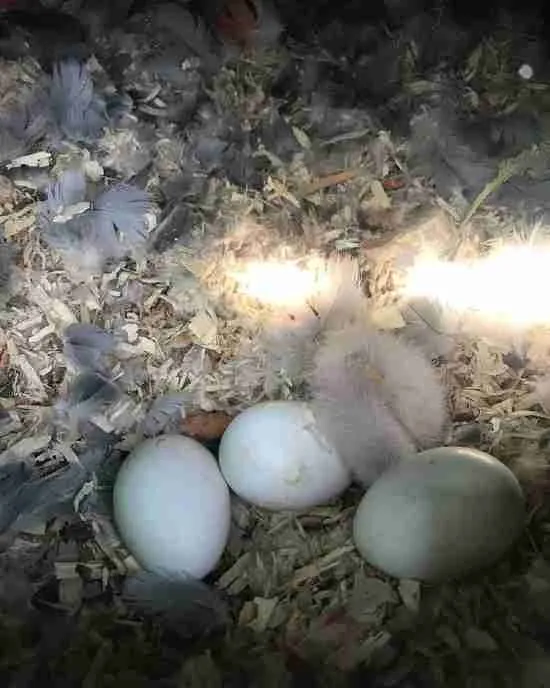 Verified Eggs
 Verified African Grey Eggs
Candled, fertility-checked Congo & Timneh eggs from a documented aviary — $95 each, free US shipping on five or more. Reversible payment only. View verified eggs →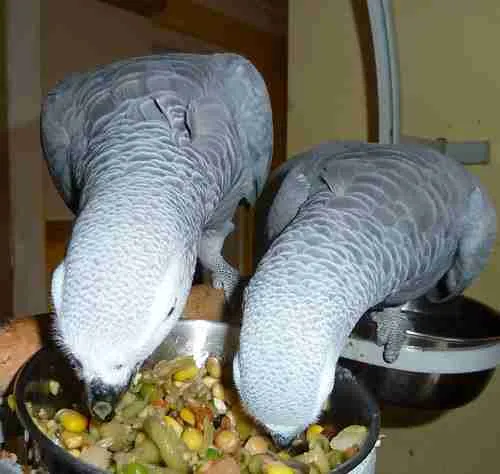 Documented Pairs
 Documented African Grey Breeding Pairs
Closed-banded, proven pairs with full CITES paperwork — from $3,000. The opposite of an anonymous "cheap pair" listing. View documented pairs →Unsure whether an egg or pair listing you found elsewhere is legitimate? Send it to us through the form below and we'll tell you what to check before you pay a cent.
Frequently Asked Questions: African Grey Parrot Scams
Every question below came from real buyers — people who searched for African Grey parrots and encountered suspicious listings, confusing pricing, or documentation gaps. If your question isn't here, our inquiry form reaches C.A.Gs directly.
Key red flags: pricing below $1,500 (Congo) or $1,200 (Timneh), seller accepting only Zelle/CashApp/Western Union/wire transfer, photos that appear on multiple sites (reverse image search them), no CITES Appendix I documentation offered, breeder website created less than 6 months ago, and refusal to do a live video call.
Three or more signals together = exit immediately.
The USDA AWA (Animal Welfare Act) Class A license is required for all professional bird breeders in the United States.
Verify any breeder's license at the USDA APHIS public search tool — enter the breeder's name, state, or license number. If the number doesn't appear or belongs to a different person, do not proceed.
CITES Appendix I lists African Grey parrots as a protected species under international treaty.
US Fish & Wildlife CITES enforcement requires all captive-bred African Greys sold in the US to have documentation proving captive-bred status.
Any seller who cannot provide this is either selling an illegally obtained bird or running a scam.
Safe: credit cards (reversible via chargeback) and PayPal Goods & Services (180-day dispute window, full buyer protection).
Never use: Zelle, CashApp, Venmo personal, Western Union, MoneyGram, wire transfer, gift cards, cryptocurrency, or PayPal Friends & Family — these are all non-reversible. Once sent, the money is gone.
Report immediately to: (1) FBI IC3 at ic3.gov; (2) FTC at reportfraud.ftc.gov; (3) Your state Attorney General; (4) Your bank or credit card company — request a chargeback immediately; (5) The platform where the listing appeared.
Even if recovery is unlikely, your report helps stop the same operator from targeting others.
Legitimate captive-bred, CITES-documented Congo African Greys cost $1,500–$3,500. Timneh African Greys cost $1,200–$2,500. Any listing below $800 is almost certainly a scam.
The cost of legally breeding, hand-raising, DNA sexing, vet-certifying, and CITES-documenting a bird alone makes sub-$800 pricing mathematically impossible for a legitimate operation.
No. "African Grey parrot eggs for sale" listings are virtually always scams. Hatching requires specialized incubation equipment, 24/7 temperature monitoring, and formula feeding every 2 hours for 12+ weeks.
No legitimate seller ships unhatched parrot eggs because almost no buyer has the infrastructure to successfully hatch and hand-raise them. The eggs are used as a low-price entry point for the advance-fee fraud.
Right-click any parrot photo and select "Search image" (Chrome/Edge) or upload to Google reverse image search or TinEye.com and review the matches.
If the same photo appears on multiple sites or unrelated listings, the images are stolen. 92% of scam sites use stolen photos sourced from legitimate breeders' social media accounts.
A legitimate captive-bred African Grey should come with: (1) CITES Appendix I captive-bred documentation; (2) Hatch certificate with band/ring number; (3) DNA sexing certificate from a licensed lab; (4) Avian veterinarian health certificate dated within 10 days of shipment; (5) Breeder's USDA AWA license number; (6) IATA airwaybill number if shipped by air.
Absence of any of these warrants a direct question before payment.
Yes. C.A.Gs, owned by Mark and Teri Benjamin, is a USDA AWA licensed captive-bred African Grey parrot breeder in Midland, Texas, operating since 2014. All birds are CITES Appendix I documented, DNA sexed, and avian vet certified.
Verify the USDA AWA license at the APHIS public search tool. We welcome all verification — including video calls before any commitment.
The scammer lists a bird at an attractive price, takes a deposit via Zelle or CashApp, then invents escalating fees: "shipping insurance," "CITES customs fee," "IATA thermal crate." Each payment is followed by another fee.
The bird never exists. Victims lose $200–$2,000+ before the scammer disappears. The pattern never varies — deposit → shipping fee → insurance → CITES fee → ghost.
Use ICANN's official WHOIS registry at lookup.icann.org.
Enter the breeder's domain and look for the "Creation Date." Any breeder website created less than 6 months ago claiming years of experience is a direct contradiction.
C.A.Gs domain registration dates back to match our 2014 founding year — verifiable in under 60 seconds.
Yes. Here at C.A.Gs, every chick is screened for PBFD (Psittacine Beak and Feather Disease) and Avian Polyomavirus (APV), PCR DNA sexed, and examined by our board-certified avian veterinarian before it leaves Midland.
Each bird ships with its hatch certificate, closed band, and a 72-hour written health guarantee — our health guarantee page spells out the exact terms. A scammer cannot produce any of this paperwork, because there is no bird behind it.
From us, shipping is quoted upfront and never changes after payment: $185 for airport pickup (IATA-compliant live-animal cargo on Delta, United, or American) or $350 for home delivery.
Compare that to the scam pattern, where a fake "transport company" invents escalating invoices — $320 crate, $285 insurance, $335 CITES clearance — after you have already paid.
If the shipping cost was not fixed in writing before your deposit, you are not dealing with a legitimate breeder.
For a side-by-side look at your buying options, see our African Grey Breeder Comparison — an honest, fact-based overview of direct breeders, classified listings, and adoption with a verification checklist.
Ready to Buy from a Verified, USDA-Licensed Breeder?
Mark & Teri Benjamin at C.A.Gs have bred captive-born, CITES Appendix I documented African Greys in Midland, TX since 2014. Every bird comes with full documentation, and every question gets answered on a live video call before you commit.
Continue Your Research
Everything you need to buy an African Grey parrot safely — from verified pricing to complete documentation guides.