- Home
- Comparisons
- Male vs Female African Grey
Cock or hen · DNA-certain before you ever pay
Male vs. Female African Grey Parrots for Sale
Buyers ask us this almost daily: should I get a male or a female African Grey? Here's the honest answer from the breeders who DNA-sex every chick — the sexes barely differ, the individual bird is what matters, and we hand you the certificate so you never have to guess.
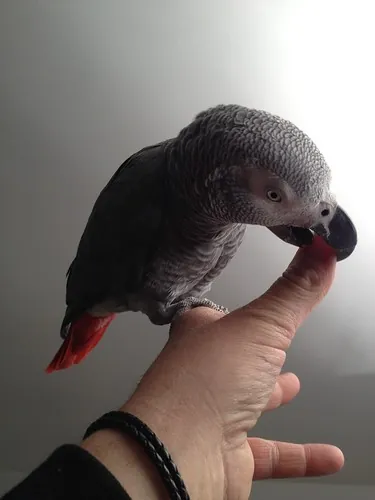
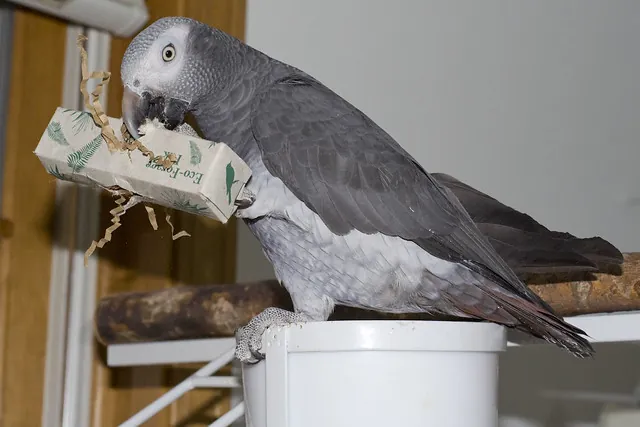
Is a Male or Female African Grey Better as a Pet?
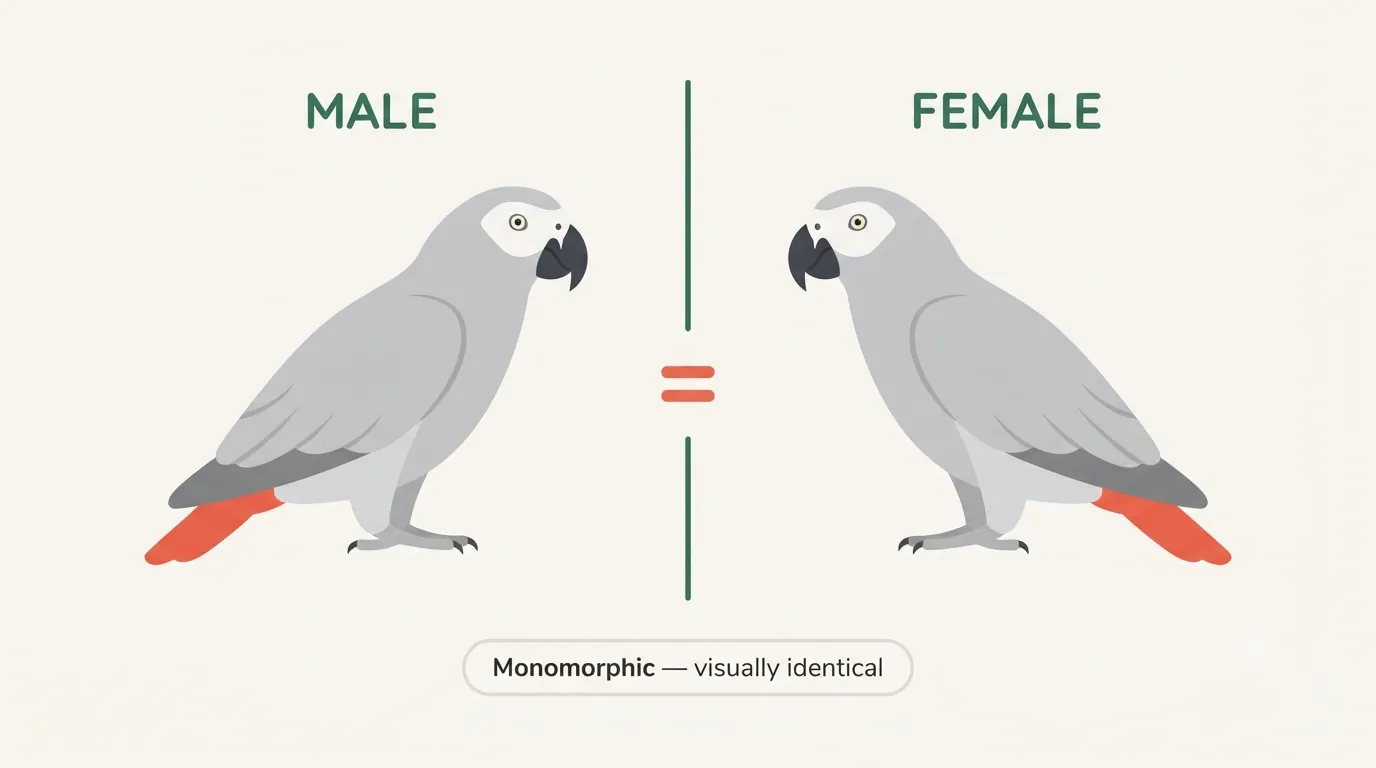
Quick Answer: Neither — and we say that as the breeders who raise and DNA-sex both. Male and female African Greys are a monomorphic species: they look identical and behave within the same range, so the individual bird's temperament and how it was hand-raised matter far more than its sex. Pick a male African Grey if the cock in front of you is the one you connect with; pick a female if the hen is. The sex is confirmed by a DNA test, not by which bird talks or cuddles more.
Buyers reach this page searching every phrasing of it — male or female African Grey, which is better male or female, even "African gray" with an a — and the answer holds across all of them. Whether you're after the best talker, the calmer companion, or simply the bird that bonds to you, the deciding factor is the individual grey and the hours you give it, not the chromosome. The rest of this page shows you exactly why, and hands you the DNA-sexed documentation that settles the sex for certain.
What Actually Differs Between a Male and Female African Grey?
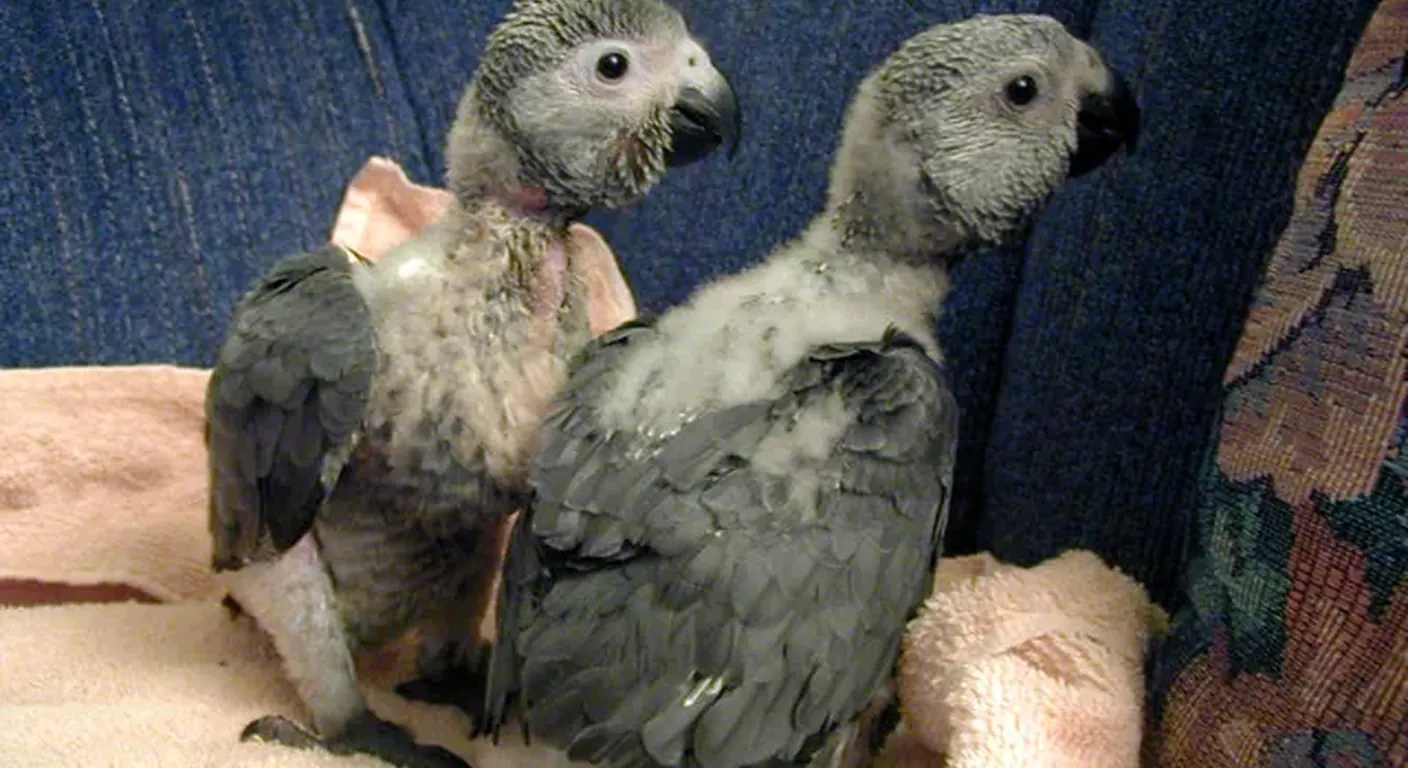
What genuinely differs is narrower than most listings imply. The one reliable, real difference is reproductive — only a hen lays eggs, which brings a calcium consideration we cover further down. Everything else buyers ask about, from "do males talk more" to "are females calmer," sits inside a wide band of individual variation that swamps any sex average. We've weaned quiet cocks and motor-mouth hens out of the very same clutch. When a seller tells you a sex guarantees a personality, that's folklore doing the selling.

Still Deciding Male or Female? Get New-Clutch Alerts
Join the list for first word when a DNA-sexed Congo or Timneh chick — cock or hen — is ready to reserve.
Which Eight Facts Do Buyers Screenshot From This Page?
Short on time? These are the facts about male and female African Greys that buyers screenshot and text to their spouse — why the sexes look identical, how they're actually sexed, why price never depends on sex, and where the individual bird outweighs every generalization. Every number below comes from our own aviary records and the DNA certificates we hand out, not a rewritten listicle.
Cock vs Hen on Paper: Which of 12 Traits Actually Split by Sex?
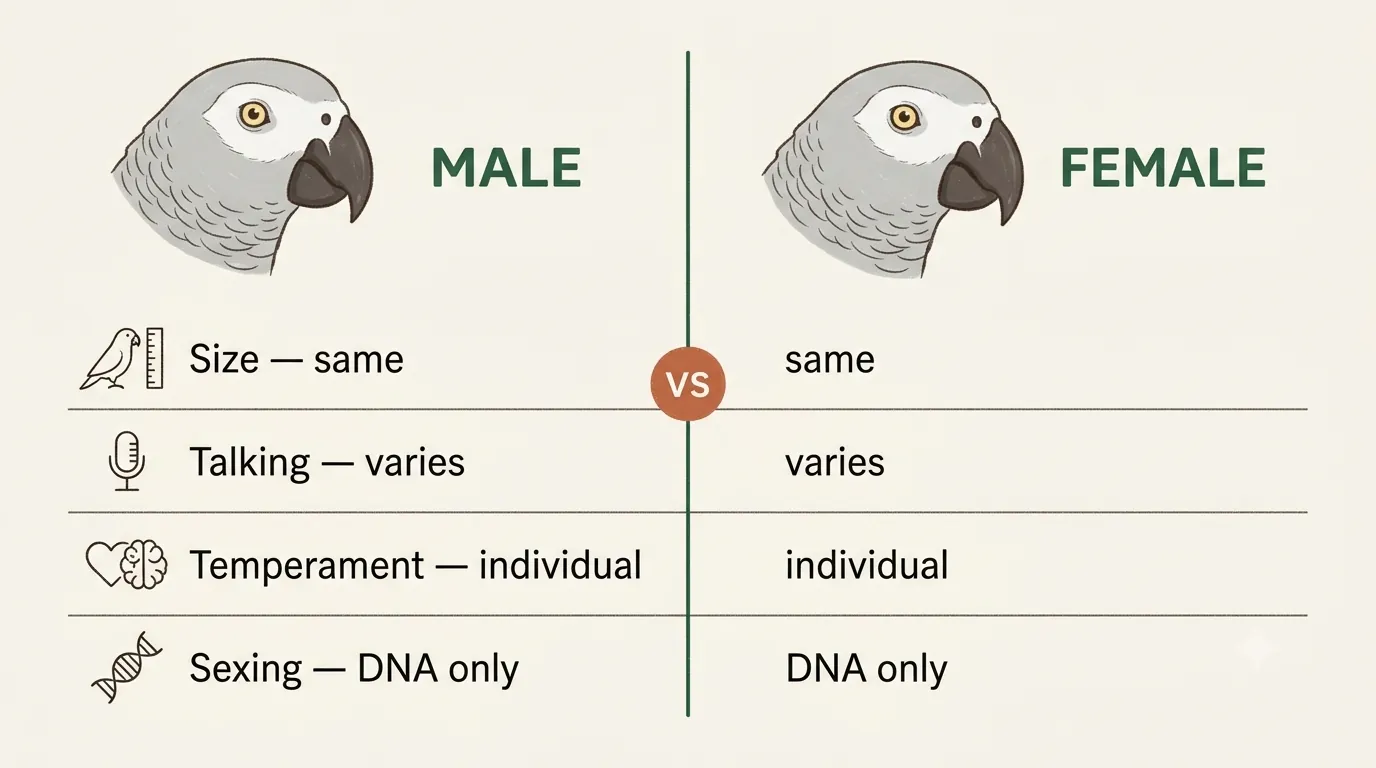
Twelve attributes, one honest verdict column — and notice how often that column reads "the bird, not the sex." Every cell is written the way we'd say it to a buyer standing in our kitchen, certificate on the counter. The only rows where sex genuinely decides anything are the reproductive ones. On a phone, tap the sex you're weighing and the table follows you.
| Attribute | MaleA cock African Grey | FemaleA hen African Grey | Verdict |
|---|---|---|---|
| Appearance | Monomorphic — identical | Monomorphic — identical | Can't sex by sight |
| Size & weight | Same for the variant | Same for the variant | No sex difference |
| Talking ability | Individual; can excel | Individual; can excel | The bird, not the sex |
| Temperament | Full individual range | Full individual range | The bird, not the sex |
| Bonding | Bonds to time & handling | Bonds to time & handling | Not sex-linked |
| Hormonal phase | Seasonal display | Seasonal; may lay infertile eggs | Both seasonal |
| Egg-laying | Not applicable | Possible without a mate — manage calcium | Female-specific |
| How you sex it | DNA (PCR) only | DNA (PCR) only | DNA, never looks |
| Price at C.A.Gs | Set by variant & age | Same — set by variant & age | Identical |
| Lifespan | 40–60 years | 40–60 years | Equal |
| DNA certificate | Included | Included | Equal |
| CITES documentation | Appendix I — included | Appendix I — included | Equal |
Every "Verdict" call above is ours, from raising and DNA-sexing both — not aggregated from other websites.
What Does the Male vs Female Comparison Table Show?
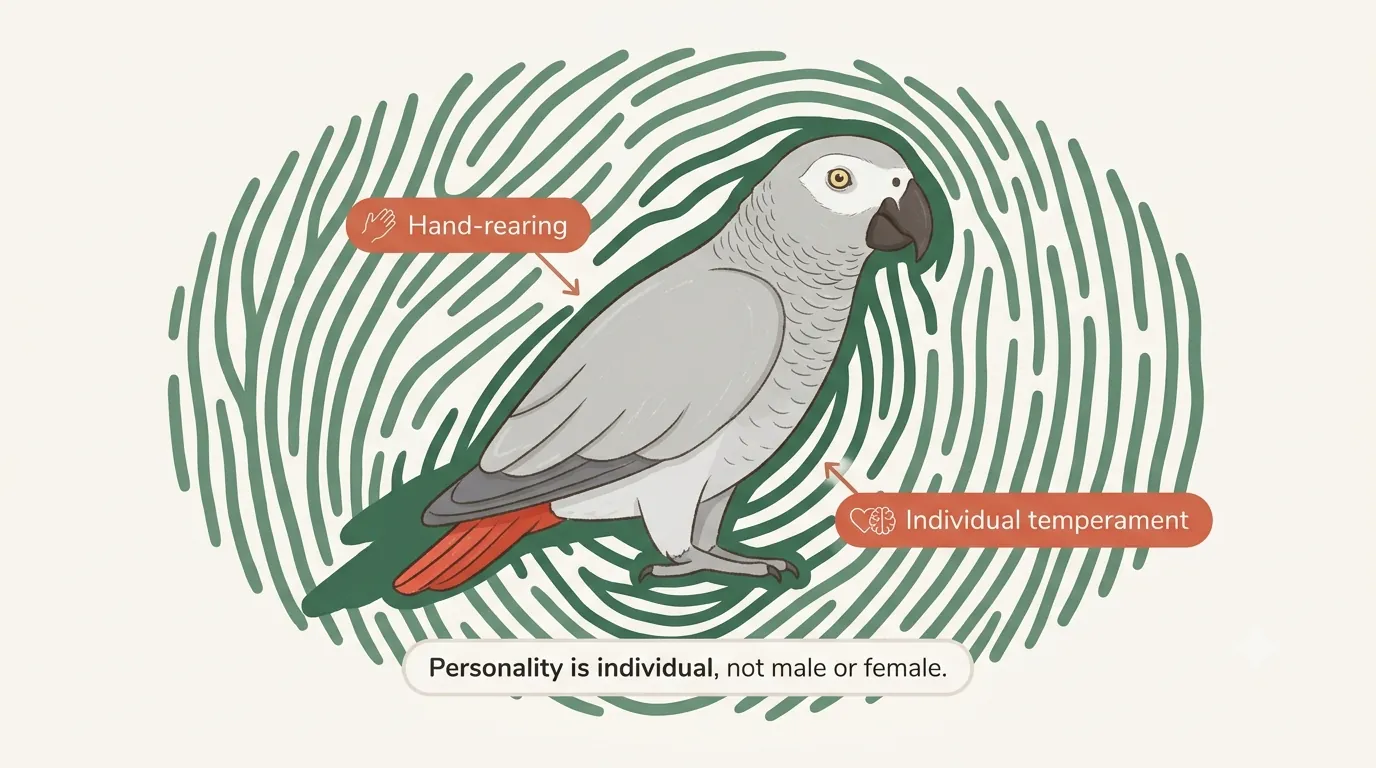
Read down the verdict column and the story tells itself: appearance, size, talking, temperament and bonding all land on "the individual bird, not the sex." The two rows that actually break by sex are biological — a hen can lay eggs and carries the calcium consideration that comes with it, and hormonal seasons show up a little differently in each. For the question most buyers arrive with — which is better, male or female — the table's answer is that you're choosing between two versions of the same excellent companion.
Who's Answering This — and Have They Raised Both Sexes?
Advice about male versus female African Greys is only worth the experience behind it. Ours comes from DNA-sexing every chick we hatch and raising cocks and hens side by side for over a decade — here is who is talking.
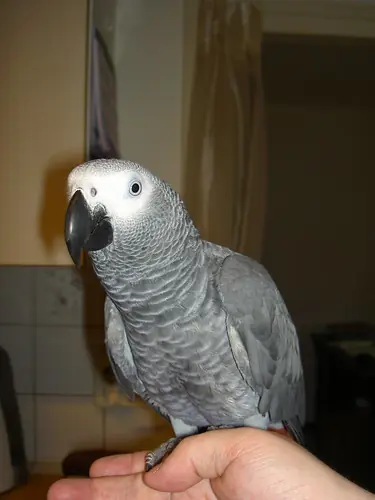
Mark & Teri Benjamin
DNA-sexing every chick we hand-raise — Midland, TX, since 2014
USDA AWACITES docsDNA sexingPCR screened
Most "male vs female African Grey" articles come from writers who have never opened a lab envelope to learn a chick's sex. We're Mark and Teri Benjamin, and here at C.A.Gs we've hand-raised both cocks and hens side by side since 2014 — same nursery, same hand-feeding schedule, same vet — and we sex every single bird by PCR before it leaves. So when we tell you the sexes barely differ, it's because we've watched whole clutches grow up before the certificate ever told us who was who.
That matters for this question, because most of the internet's answers come from single-bird owners generalizing from a sample of one. Someone's aggressive male becomes "males are aggressive"; someone's sweet hen becomes "females are calmer." Raising and sexing dozens of both, we get to see where a pattern is real and where it's just one bird's personality wearing a sex label.
Why Does Every C.A.Gs Chick Leave With a Paper Trail?
A grey's sticker price is the small number; the 40–60 years that follow are the real spend. That's why the paperwork protecting those years comes first here: PBFD and Avian Polyomavirus PCR screening, the DNA-sexing certificate that confirms male or female, an avian veterinarian's health certificate, a hatch certificate with closed band, and the CITES Appendix I documentation proving your bird was captive-bred in the USA. Whichever sex you choose, our health guarantee page spells out that stack in writing.
Does an African Grey's Sex Actually Predict Its Behavior?
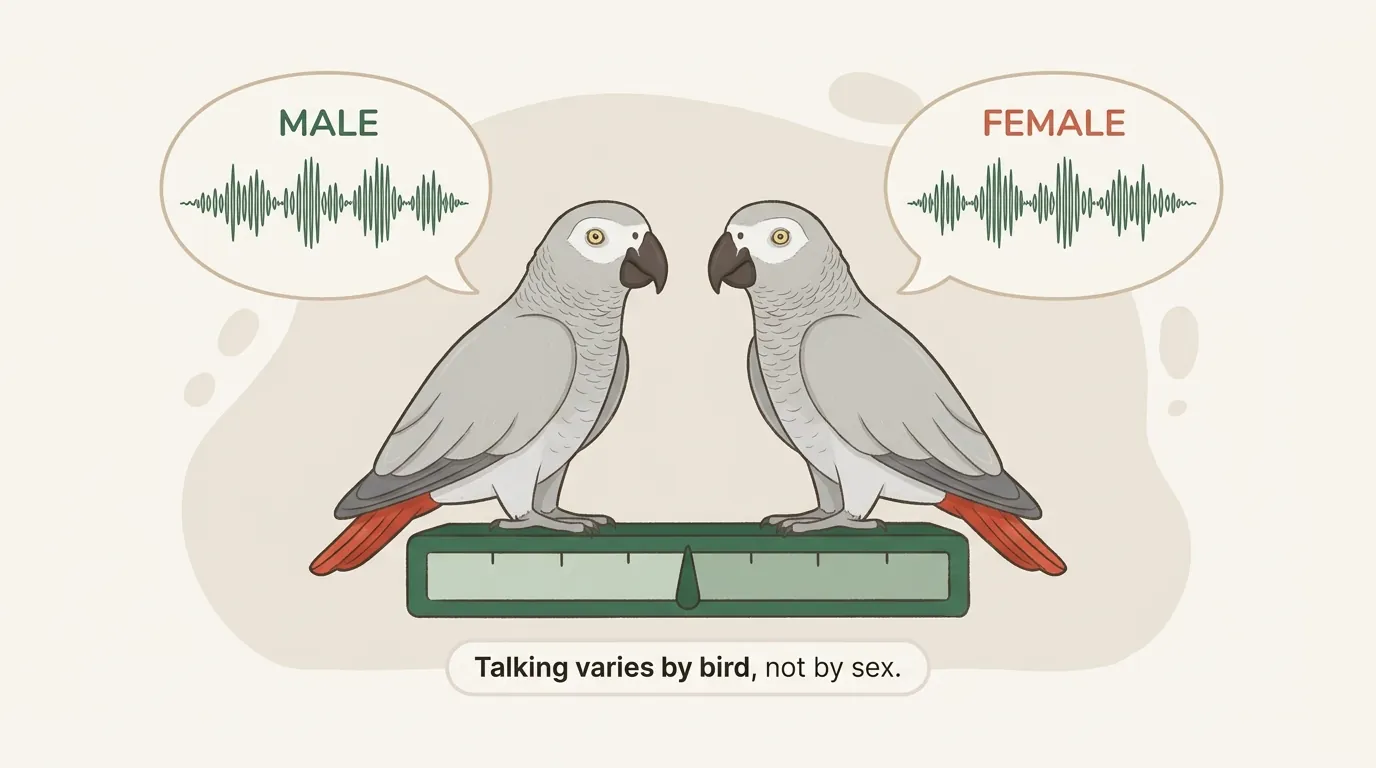
Here's the question underneath every other question on this page: does buying a cock or a hen actually change what you get? In our experience raising both, the honest answer is barely. Sex is a weak predictor of African Grey behavior — hand-rearing, early socialization, daily interaction and the bird's own wiring do the heavy lifting, and they swamp any male-versus-female average. Below we take the three things buyers most often pin to sex — talking, owner bonding and temperament — and show you where the pattern is real and where it's just folklore.
Do Male or Female African Greys Talk Better?
Do males talk more than females? Not reliably. Both sexes carry the same astonishing vocal apparatus, and both can become precise, context-aware talkers or stay comparatively quiet — it tracks the individual bird and how much you talk to it, not the sex. The old line that "cocks are the better talkers" doesn't survive contact with a real clutch: our chattiest bird last season was a hen, and we've raised silent-until-two-years males. Decades of cognition research at Dr. Irene Pepperberg's Alex Foundation ↗ point the same way — Alex's famous vocabulary came from years of one-on-one work, not from his sex. If a big vocabulary is the dream, choose the demonstrably chatty individual in front of you and let the DNA test tell you its sex afterward. Our African Grey talking ability guide breaks the timeline down further.
Do African Greys Bond Better With a Male or Female Owner?
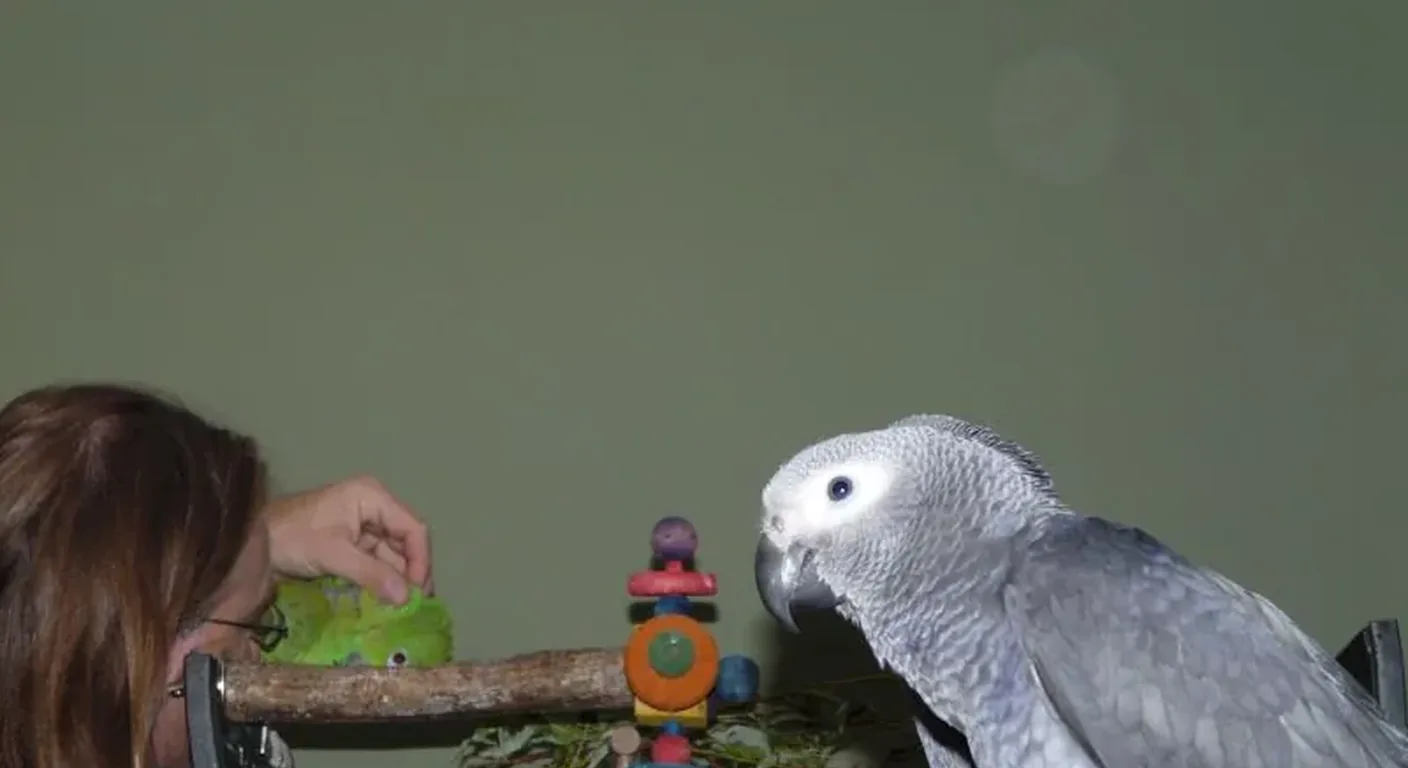
Will your Grey prefer a man or a woman? This one comes up constantly, and the folklore runs both directions — some swear Greys "prefer women," others insist the opposite. Neither holds up. A hand-reared African Grey bonds to whoever gives it consistent time, reads its body language and doesn't rush it. Mark and Teri both raise deeply bonded birds here, and the deciding factor is never gender — it's presence. The owner's calm, repeated attention is what the bird attaches to.
Will a Hand-Raised Grey Prefer One Person?
Often, yes — but that's a Grey trait, not a sex trait or an owner-gender trait. Many Greys of either sex quietly elect a favorite person over their first year, usually the one who handles them most patiently. You can widen that bond by having several household members share feeding, training and out-of-cage time early. The bird chooses its person the way it chooses its words: by who shows up.
Is Temperament a Male or Female Trait, or an Individual One?
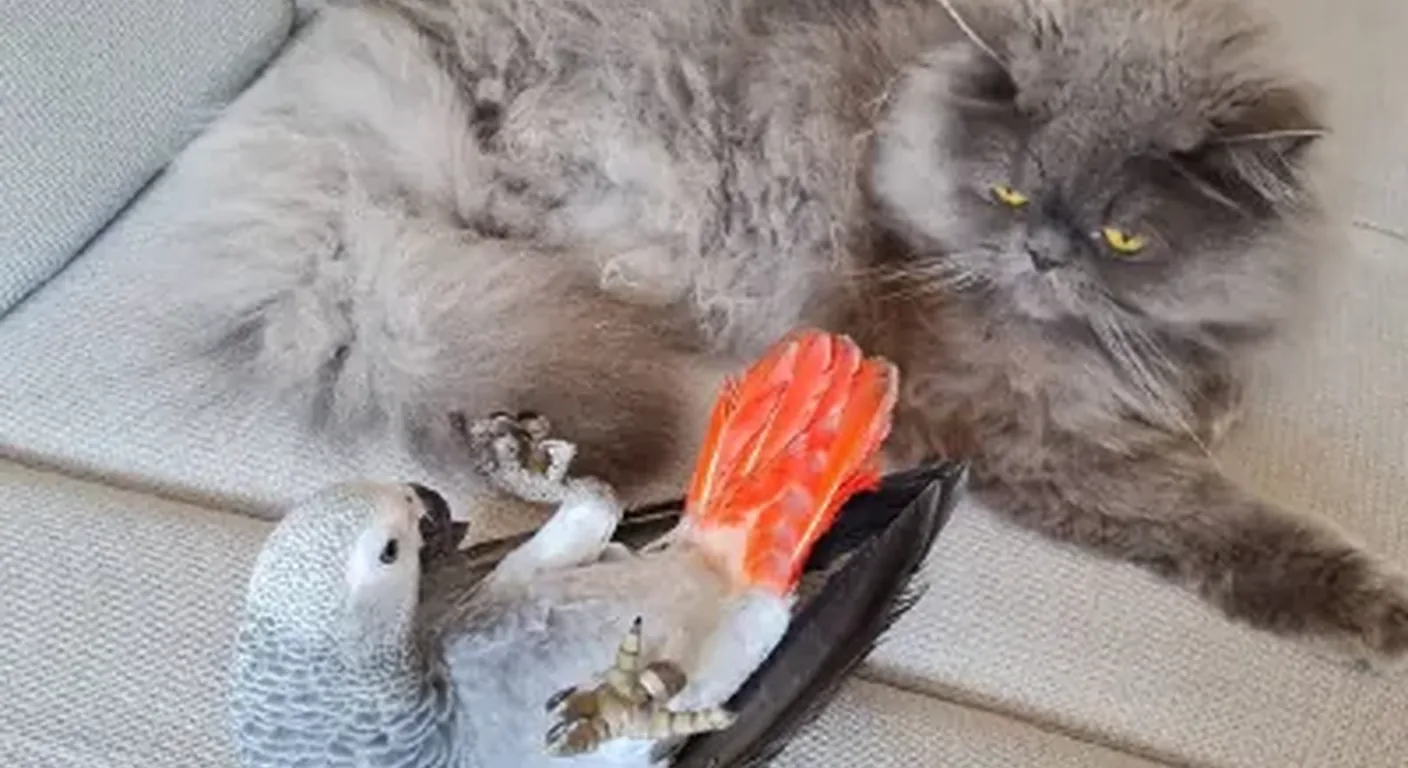
Are females more placid and males more spirited? Sometimes — and just as often the reverse. Temperament in African Greys spans a wide range within each sex, and the individual bird lands somewhere on it regardless of chromosome. We've raised bold, into-everything hens and gentle, cautious cocks in the same nursery. What shapes an even temperament is early handling and a stable routine, which is exactly why we socialize every chick to hands, household noise and even the family cat before it goes home.
Are Male African Greys Gentle or Aggressive?
Both labels get pinned on males — which is your clue that neither is a sex rule. A male African Grey can be a marshmallow or go territorial during a hormonal stretch, and so can a female. Aggression in Greys is nearly always situational: hormones, fear, a boundary being pushed, or a bird protecting a favored person. Read the body language and keep the routine steady and the "aggressive male" you were warned about usually never appears.
Fact: Hormonal Display Is Seasonal in Both Sexes
Every mature African Grey, cock or hen, goes through seasonal hormonal phases — more display, more nipping, shorter patience — typically in spring. It is not a male-only phenomenon and it passes. Limiting nest-like dark spaces, keeping handling low-key during the peak, and holding your routine steady carry both sexes through it without drama.
Breeder note: what we see across our clutches
After a decade of sexing every bird by DNA, the pattern we can actually confirm is that we can't pick the talkers, the cuddlers or the bold ones by sex before the certificate comes back. Individuals win, every clutch. That's not a hedge — it's the most useful thing we can tell a buyer choosing between a male and a female.
What Is a Male African Grey Like?
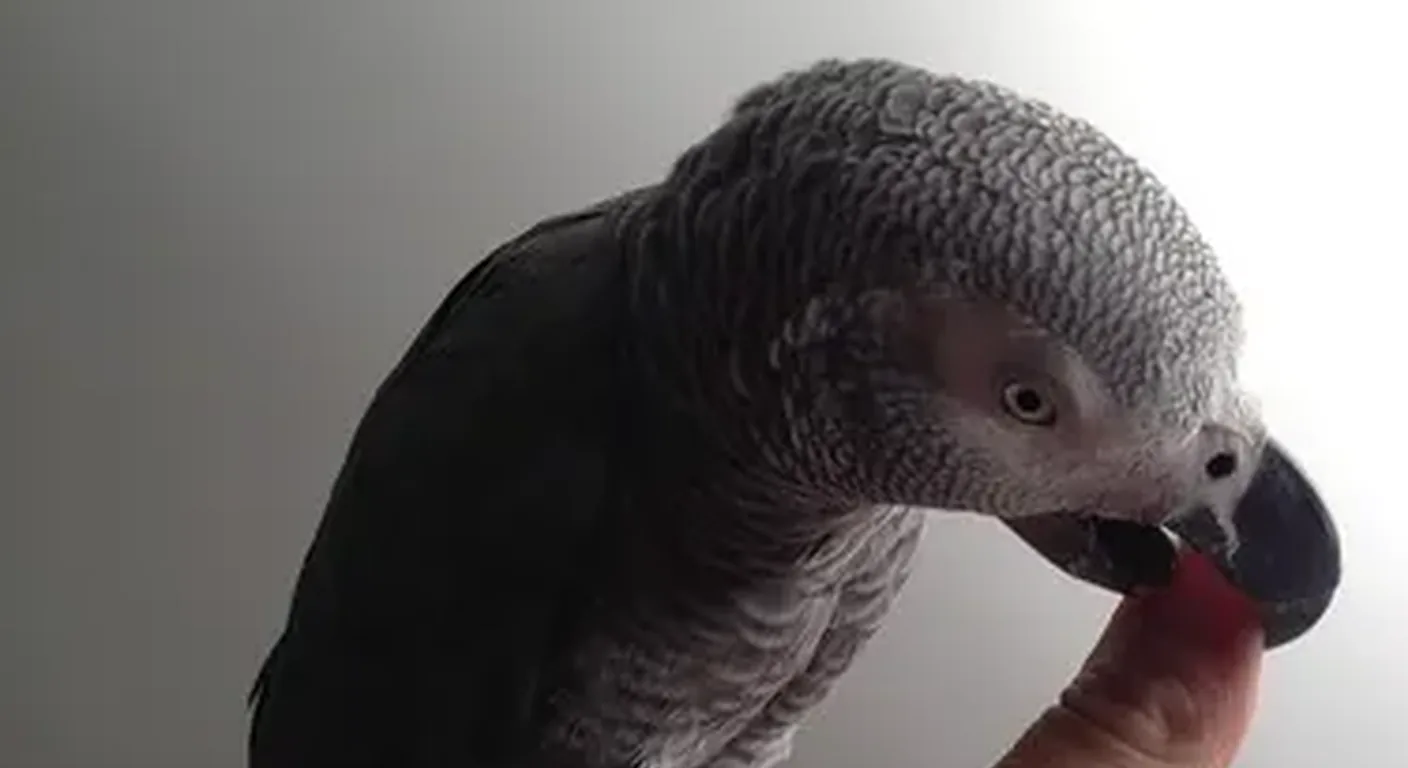
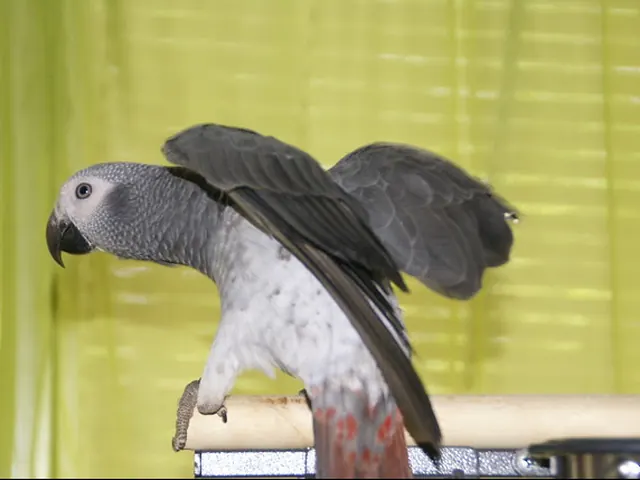
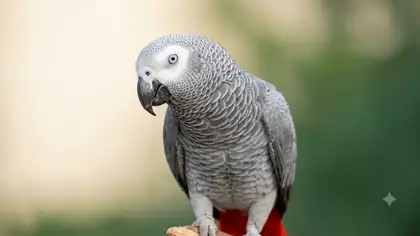
What can you actually expect from a male African Grey? The honest picture is: exactly what you'd expect from any well-raised Grey. A cock — that's the correct word for a male bird — is the same size, the same silver-grey with the red tail (Congo) or charcoal with the maroon tail (Timneh), and carries the same intelligence and 40–60 year lifespan as a hen. Kent, pictured here, is a playful young male Congo, and nothing about his looks announces his sex. If you've searched "male African Grey for sale" or "male baby African Grey parrot," this is the from-the-nursery reality — and you'll meet current cocks among our hand-raised Congo Grey chicks.
How Big Is a Male African Grey, and Does It Have a "Squared-Off" Head?
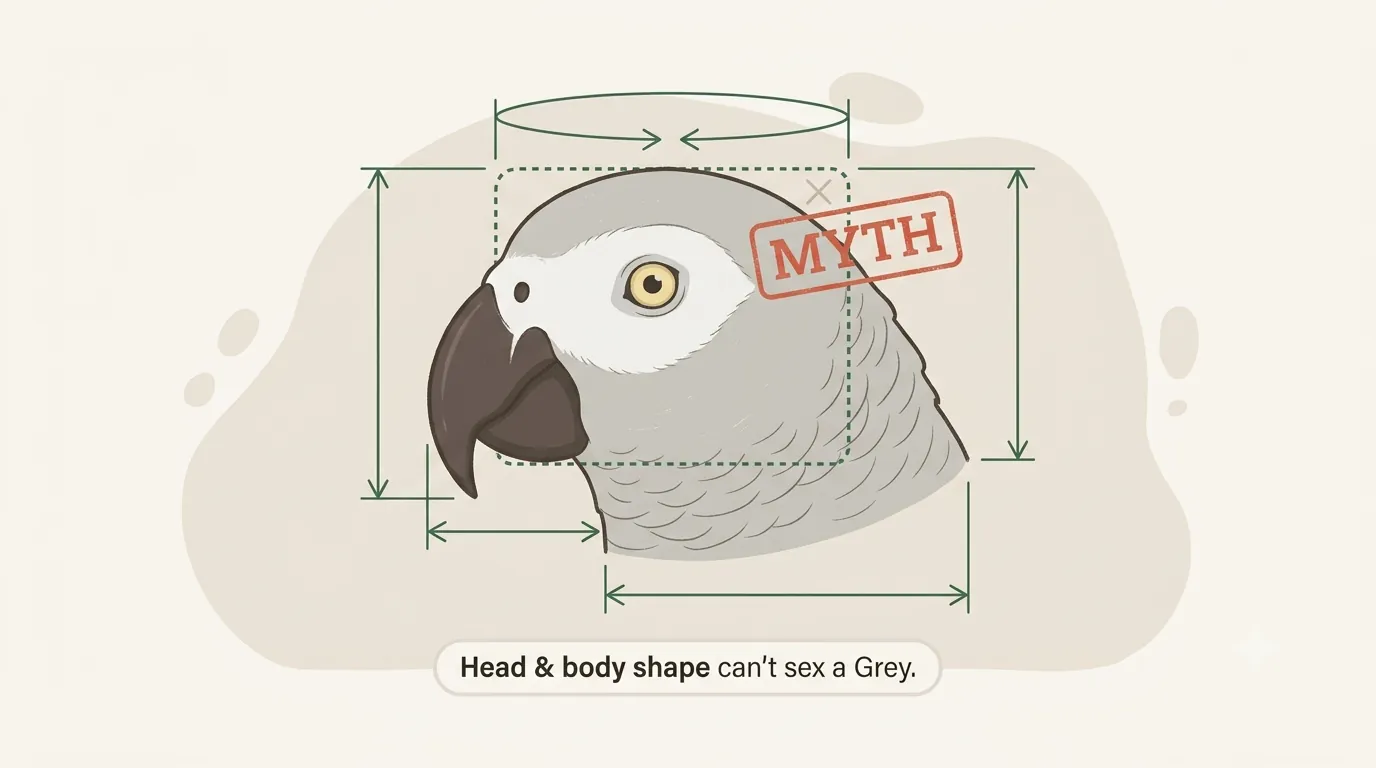
Is a male bigger, or does it have the "squared-off" head you've read about? No. A male African Grey is the same weight and length as a female of the same variant — Congos 400–600 g and 12–14 inches, Timnehs 275–375 g and 9–11 inches, for both sexes. The "males have a flatter, more squared head; females are rounder" claim is one of the most repeated sexing myths online, and it's wrong often enough to be useless. Head shape varies bird to bird, not sex to sex.
Can You Sex an African Grey by Head or Body Shape?
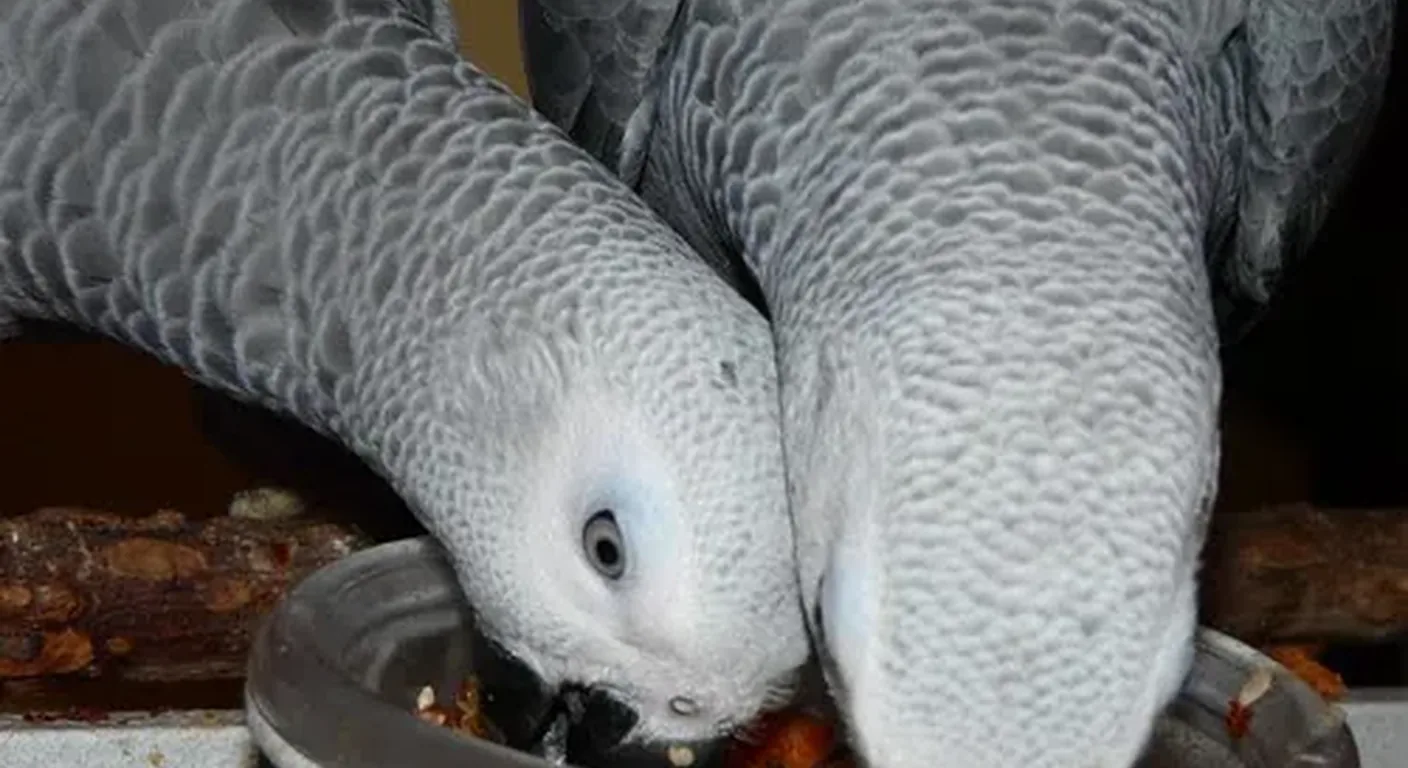
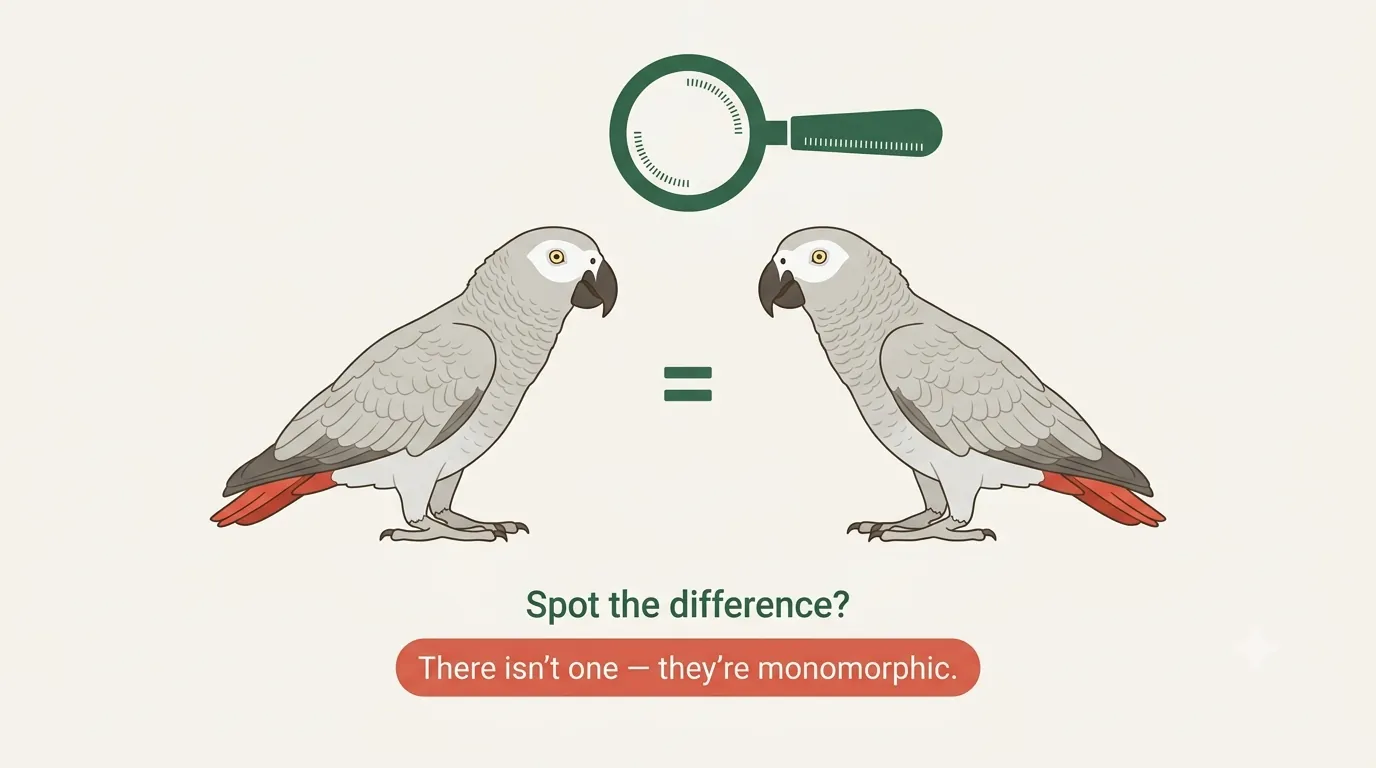
You cannot — reliably or otherwise. Body build, head shape, eye color, wing tips and the width of the "spectacles" all get cited as sex tells, and every one of them fails across a real population. Some breeders can improve their guess a little on birds they know well, but "a little better than a coin flip" is not identification. The only thing that separates a male from a female with confidence is a chromosome test, which is why we don't guess and neither should you.
Example: The Visual-Sexing Folklore, and Why Each Cue Fails
Run down the list owners trade in Facebook groups — squared head, rounder head, larger beak, slimmer body, darker "mask," a particular eye ring — and here's the problem: every one of those traits varies more within each sex than between the sexes. Line up ten of our cocks and ten hens and you couldn't sort them by any of these cues better than chance. That's the definition of a trait that can't sex a monomorphic bird.
Citation: African Greys are a monomorphic species
That the sexes are visually indistinguishable is standard avian reference, echoed in the World Parrot Trust's Psittacus erithacus profile ↗ and in the avian-medicine guidance at Lafeber's veterinary resources ↗ — both of which point to DNA as the reliable sexing method.
What Is a Female African Grey Like?
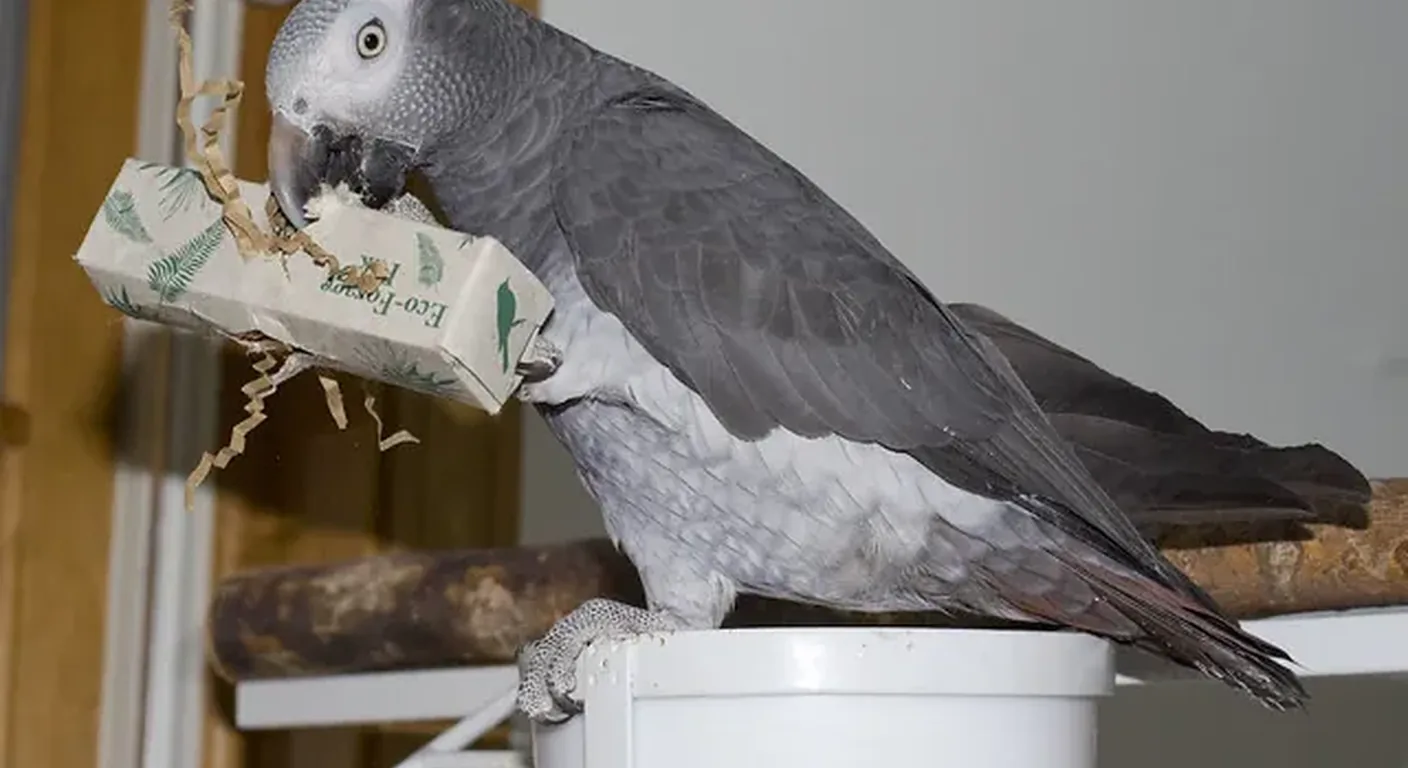
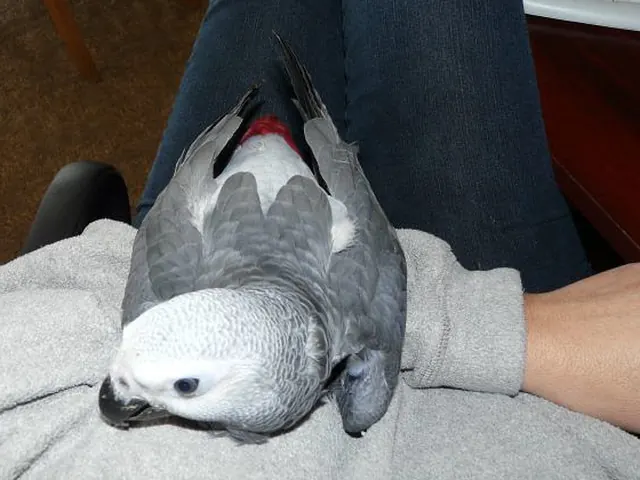
Are female African Greys the calmer, sweeter choice? That's the reputation, but the reality is subtler. A female — a hen — is the same size, color and intelligence as a cock, with one genuine biological difference: she can lay eggs. Evie, our young female Timneh pictured here, is affectionate and observant, but plenty of our hens are bold and busy, so "females are the gentle ones" only holds for the individual hen who happens to be gentle. If you've searched "female African Grey for sale," here's the honest brief on hens, including the one consideration that is truly female-only.
Are Female African Greys Calmer, More Placid, or More Independent?
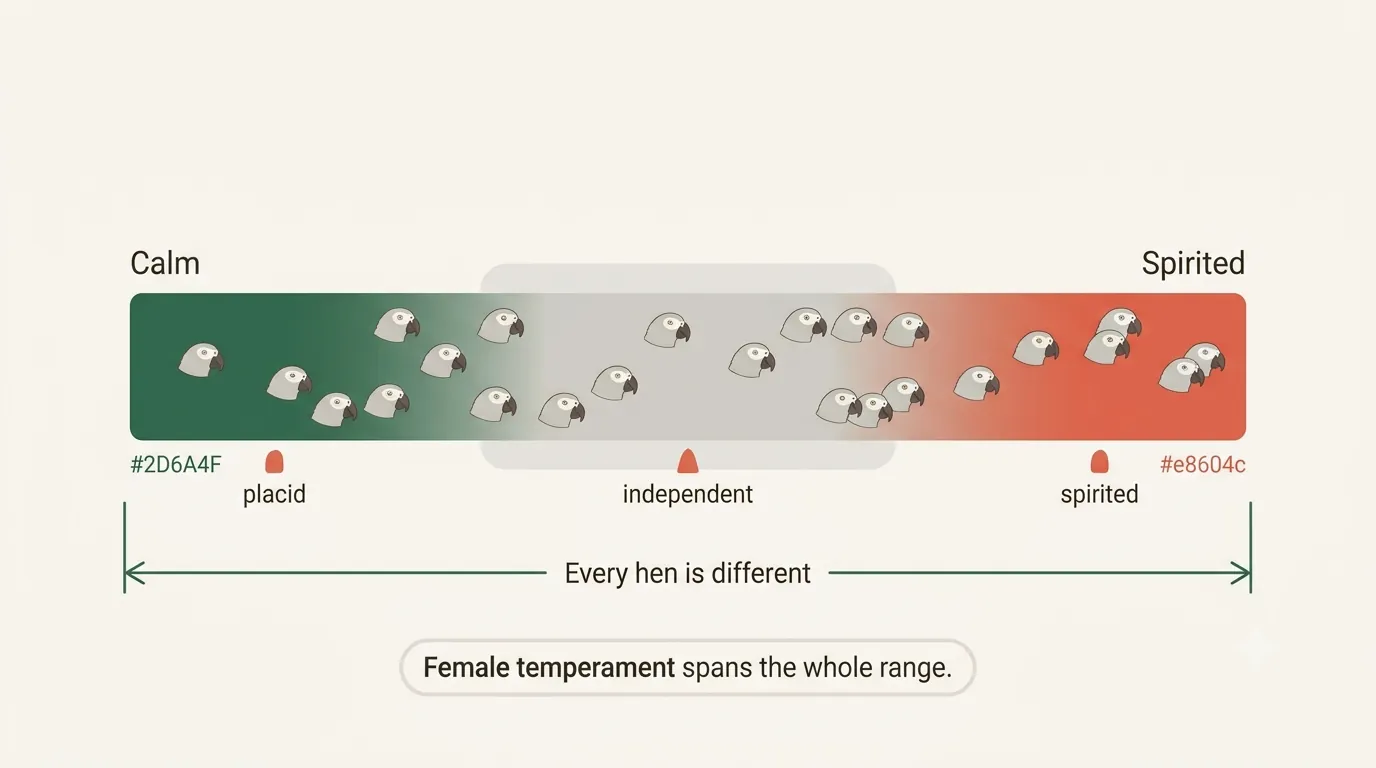
Sometimes, and sometimes not. Female temperament spans the whole calm-to-spirited range, exactly like the males' does — we've raised placid hens and hens with a strong independent streak from the same pairing. The idea that hens are categorically more placid or more independent is a generalization that dissolves across a real clutch. What makes any hen even-tempered is the same thing that makes any cock even-tempered: patient early handling and a predictable routine.
Do Female African Greys Lay Eggs Without a Mate?
Yes — this is the one place sex genuinely matters. A lone hen can become hormonally stimulated and lay infertile eggs even with no male in the house. It doesn't mean something is wrong, and for many owners it's an occasional, manageable event. But it is the reason "which sex should I get" has a real answer for some households, and it deserves a clear-eyed look rather than a shrug.
Is Chronic Egg-Laying Dangerous?
It can be, if it becomes chronic. Repeated laying draws calcium out of a hen faster than diet replaces it, and that opens the door to hypocalcemia and, occasionally, egg-binding — a genuine emergency. The good news is that it's largely preventable with management, and the vast majority of pet hens never have a serious problem. You simply need to know it exists before you choose a female, not discover it afterward.
Warning: Lone-Female Egg-Laying and the Calcium It Costs
If you keep a hen, watch for repeated clutches and support her with a calcium-adequate diet — our African Grey food guide covers the pellet base we recommend — and daily UV-B exposure so her body can make vitamin D3 and actually use that calcium. Discourage laying by limiting dark nest-like spaces, keeping her cage well-lit on a normal day-length, and not over-bonding to the point of hormonal stimulation. If a hen lays repeatedly, that's an avian-vet conversation, not a wait-and-see.
Breeder note: how we set a hen up
Every hen leaves us on a calcium-adequate pellet base with a UV-B lighting recommendation in writing, because we'd rather prevent a calcium problem than treat one — general owner-level guidance from VCA Animal Hospitals ↗ lines up with what we send home. Set a hen up right and egg-laying stays a footnote, not a crisis.
How Do You Actually Tell a Male African Grey From a Female?
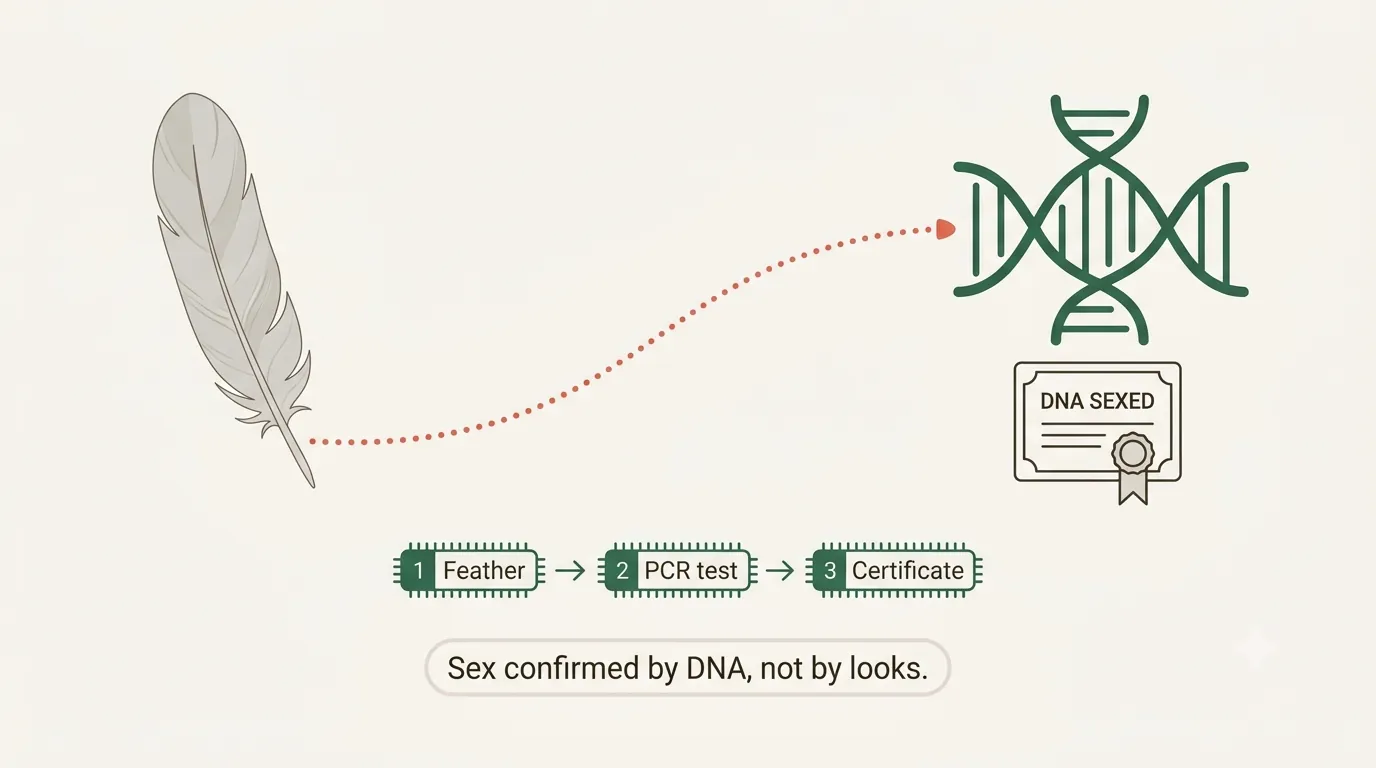
If the sexes look identical, how does anyone know which is which? The answer is a lab test, not a look. Because African Greys are monomorphic, the accurate way to sex one — the only way we trust — is DNA testing: a PCR analysis of the bird's chromosomes from a feather or a small blood sample. Every bird we place is DNA-sexed before it goes home, so you're never buying a guess. Here's how that works and what your certificate actually tells you.
Why Can't You Sex an African Grey Visually?
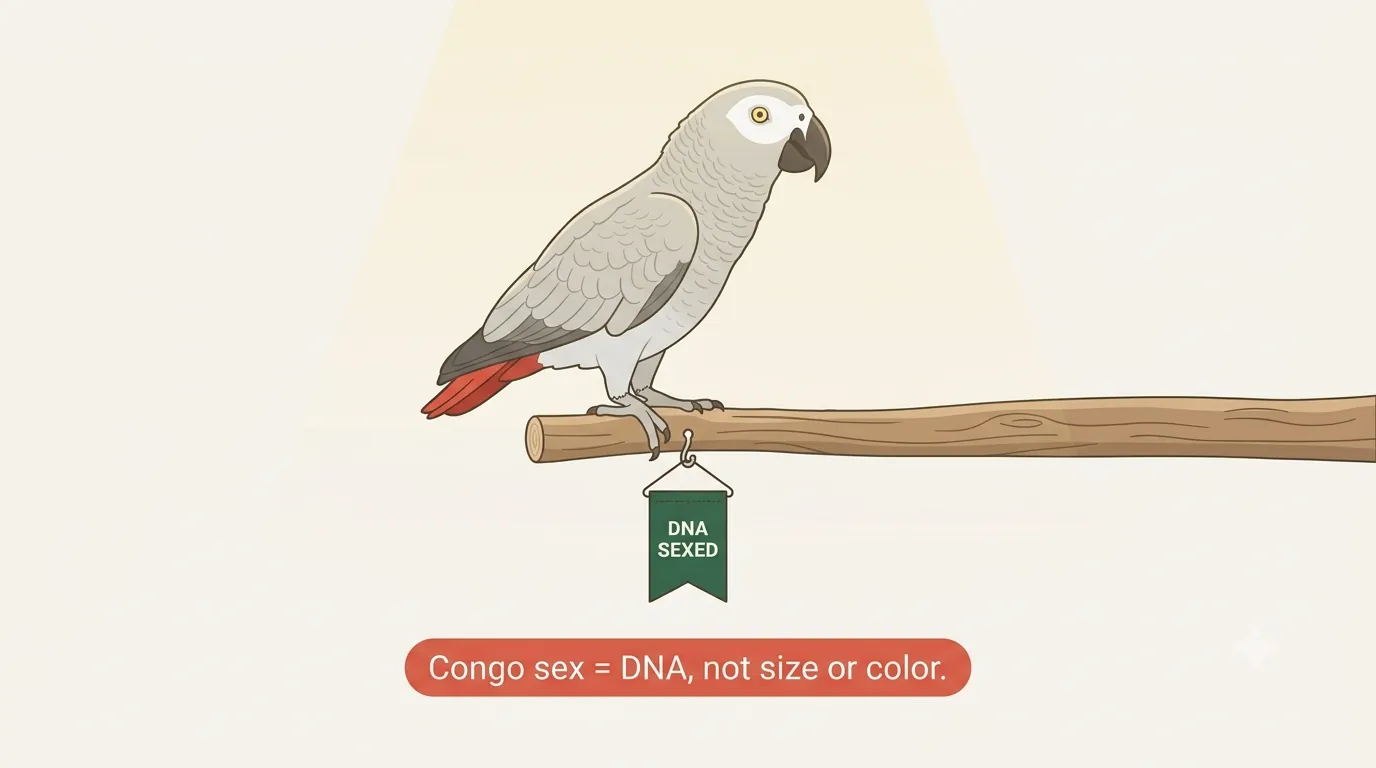
Because there's nothing reliable to look at. As one owner on r/parrots ↗ put it bluntly, African Greys "look 100% identical — you need a blood test." No consistent difference in size, plumage, tail, beak or eye separates a cock from a hen, which is why vent sexing is unreliable and the old surgical method is outdated and invasive. Looking harder doesn't help; testing does.
What Is DNA Sexing, and Do Your Birds Come Sexed?
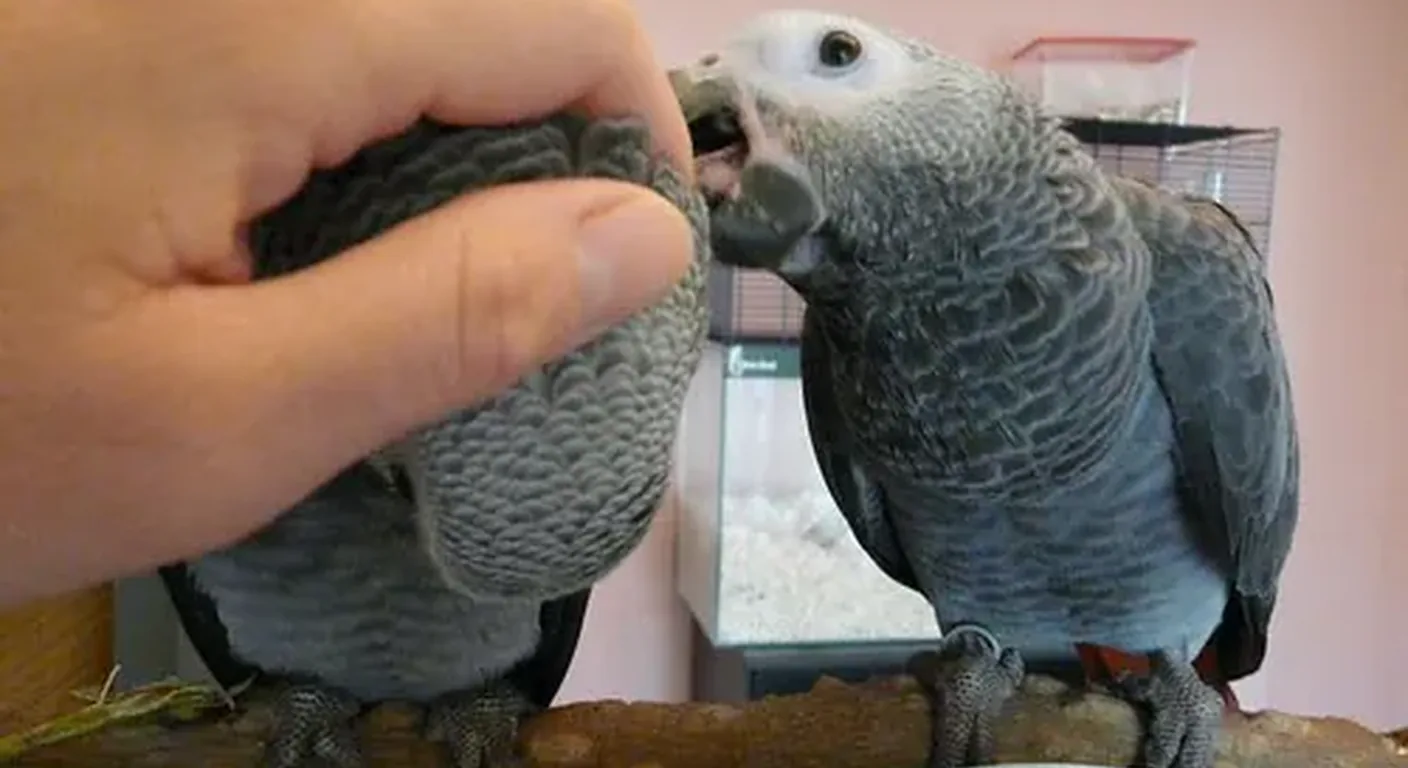
DNA sexing is a laboratory PCR test that reads the bird's sex chromosomes and returns male or female with high accuracy — the industry standard for any monomorphic parrot. And yes: every C.A.Gs African Grey is DNA-sexed and leaves with the certificate in hand, so you know exactly what you're bringing home. We link the full method on our DNA-tested African Greys for sale page rather than repeat it all here.
What Does the C.A.Gs PCR DNA-Sexing Certificate Show?
It names your bird, records the sample and lab, and states the result — male or female — as determined by the chromosome test. It's a document you can hand to your avian vet, and it's the piece a legitimate seller can always produce. If a seller can't show you a DNA certificate for a bird they're calling "a proven male" or "definitely a female," treat the claim as a guess.
What the Lab Tests: Feather or Blood PCR
The lab needs only a tiny sample — a freshly plucked chest feather with its follicle, or a drop of blood — and amplifies the DNA to read the sex chromosomes. It's minimally invasive, quick for the bird, and far more reliable than any physical exam. That's the whole reason the industry standardized on it.
Citation: PCR sexing accuracy
DNA sexing by PCR is the method avian-medicine references point to for monomorphic parrots; the client-level overview at VCA Animal Hospitals ↗ and the veterinary resources at Lafeber ↗ both treat it as the reliable standard.
How Do You Determine a Congo African Grey's Gender?
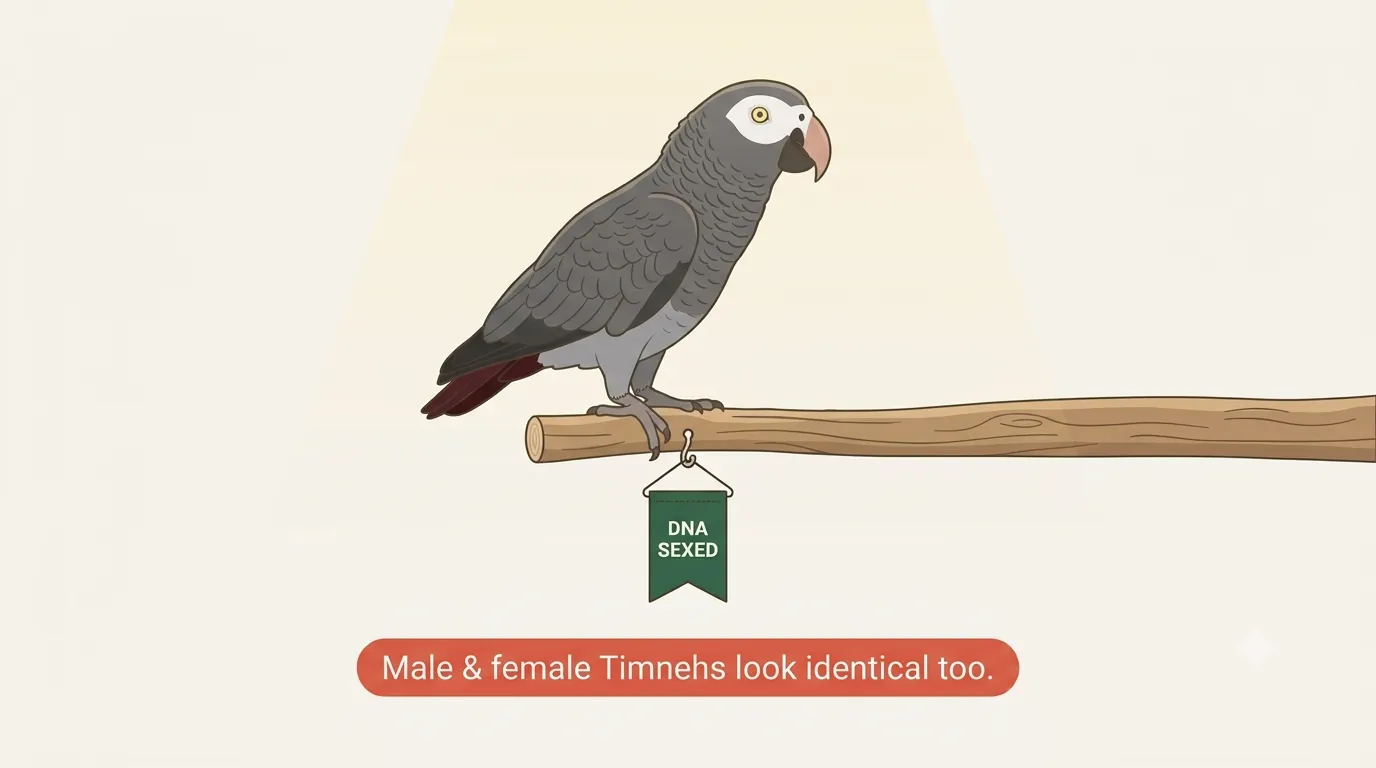
Exactly the same way — by DNA. A Congo African Grey is monomorphic like every Grey, so its size, red tail and light plumage tell you it's a Congo, not whether it's a cock or a hen. People search "how to determine Congo African Grey gender" hoping for a size or color trick; there isn't one. Our Congos are PCR-sexed, and you'll find the sexed birds among our available Congo Grey parrots. Our Congo vs Timneh comparison answers the variant question itself, if that's the distinction you're actually weighing.
Is Sexing a Timneh Any Different From a Congo?
No difference at all. A Timneh African Grey is just as monomorphic as a Congo, so male and female Timnehs are indistinguishable by sight and confirmed the same way — a PCR DNA test. The charcoal body, maroon tail and horn-colored beak identify the bird as a Timneh, not its sex. Sexed Timneh youngsters live on our Timneh Grey availability page, each with its certificate.
Can a Scorecard Separate the Sexes? Six Traits, Scored Honestly
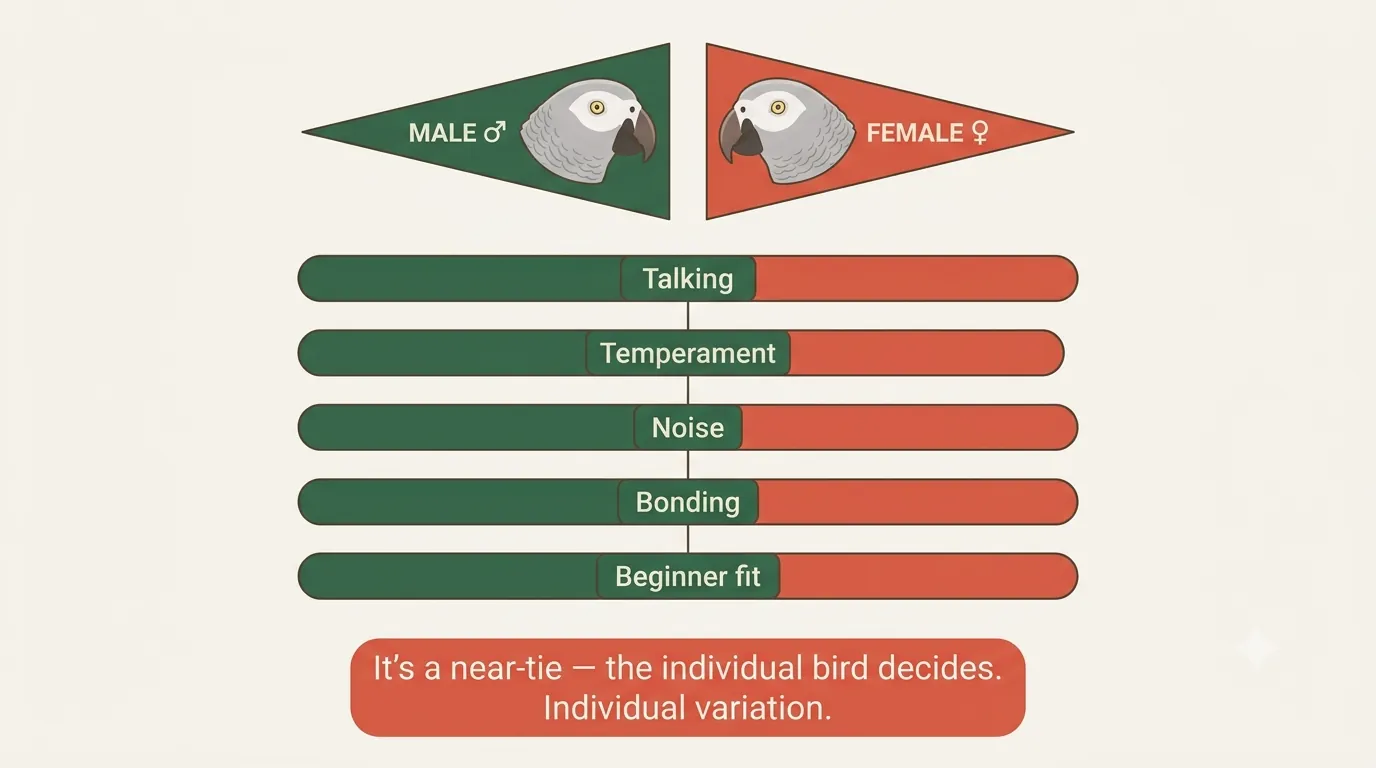
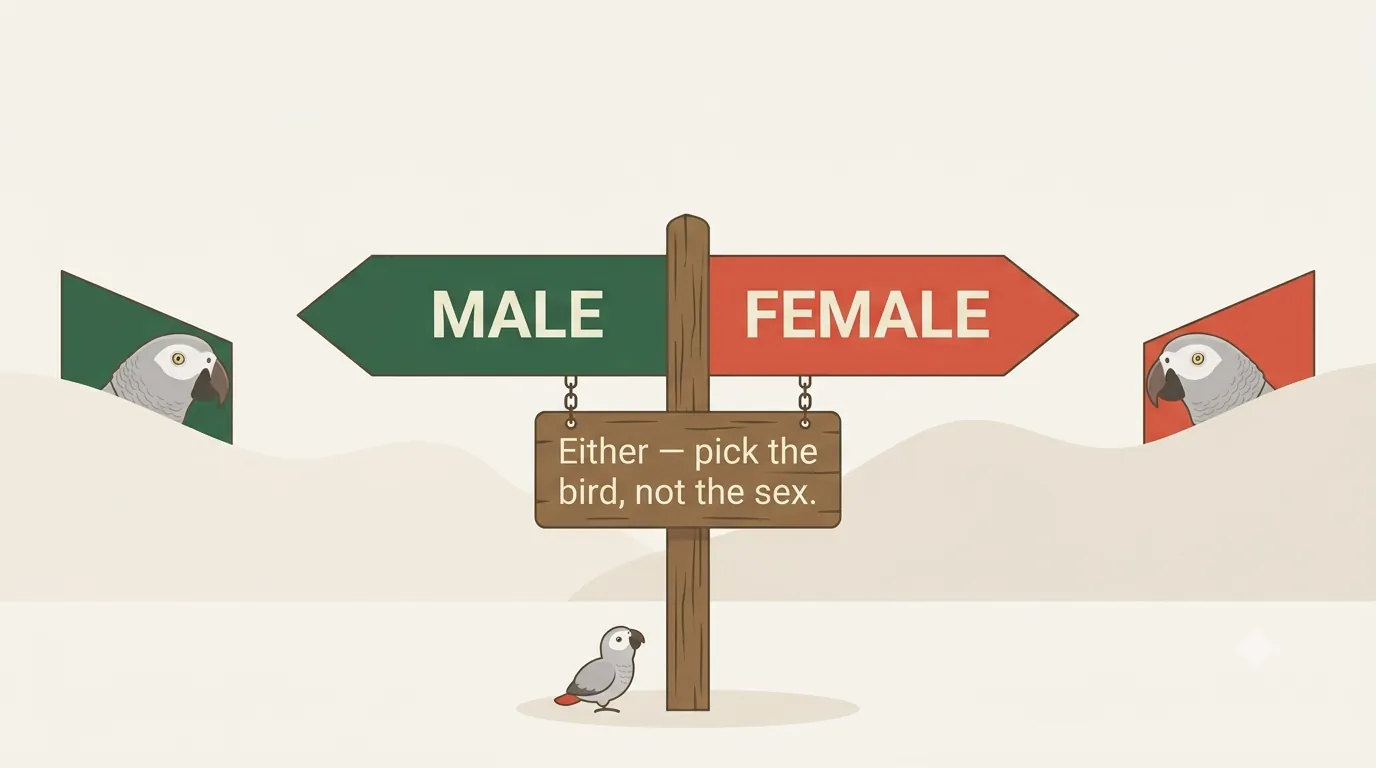
If you arrived here from a "is a male or female African Grey better as a pet" search, here's the numeric version. We put our own 0–10 marks on six traits after a decade of raising cocks and hens side by side — editorial calls, not lab measurements. And notice the honest thing before you read a single row: the two columns land almost on top of each other, because sex is one of the weakest predictors of how an African Grey turns out.
| Trait | Male | Female | Our note |
|---|---|---|---|
| Talking ability | 8 | 8 | no reliable sex gap — it's the bird |
| Temperament steadiness | 8 | 8 | individual range, not sex-linked |
| Noise level | 7 | 7 | same vocal range |
| Depth of bond to you | 9 | 9 | driven by handling, not sex |
| Beginner suitability | 8 | 8 | pick temperament, not sex |
| Hormonal ease | 8 | 7 | hens can egg-lay; both go seasonal |
Read the pattern, not the totals: the only row where the sexes part ways at all is hormonal ease, and only because a lone hen can lay infertile eggs. Every other trait is a tie, because the variable that actually moves those numbers is the individual chick's temperament and how much time you put in — not whether it's a cock or a hen.
Which Grey Fits Your Home — and Does Sex Change the Answer?
Scorecards average; your living room doesn't. An apartment with shared walls, a house full of kids, a quiet retirement routine — each changes which individual chick we'd steer you toward, and almost never because of its sex: in four of these five setups the certificate result doesn't move our recommendation an inch. These are the five situations buyers most often write us from, answered the way we answer them.
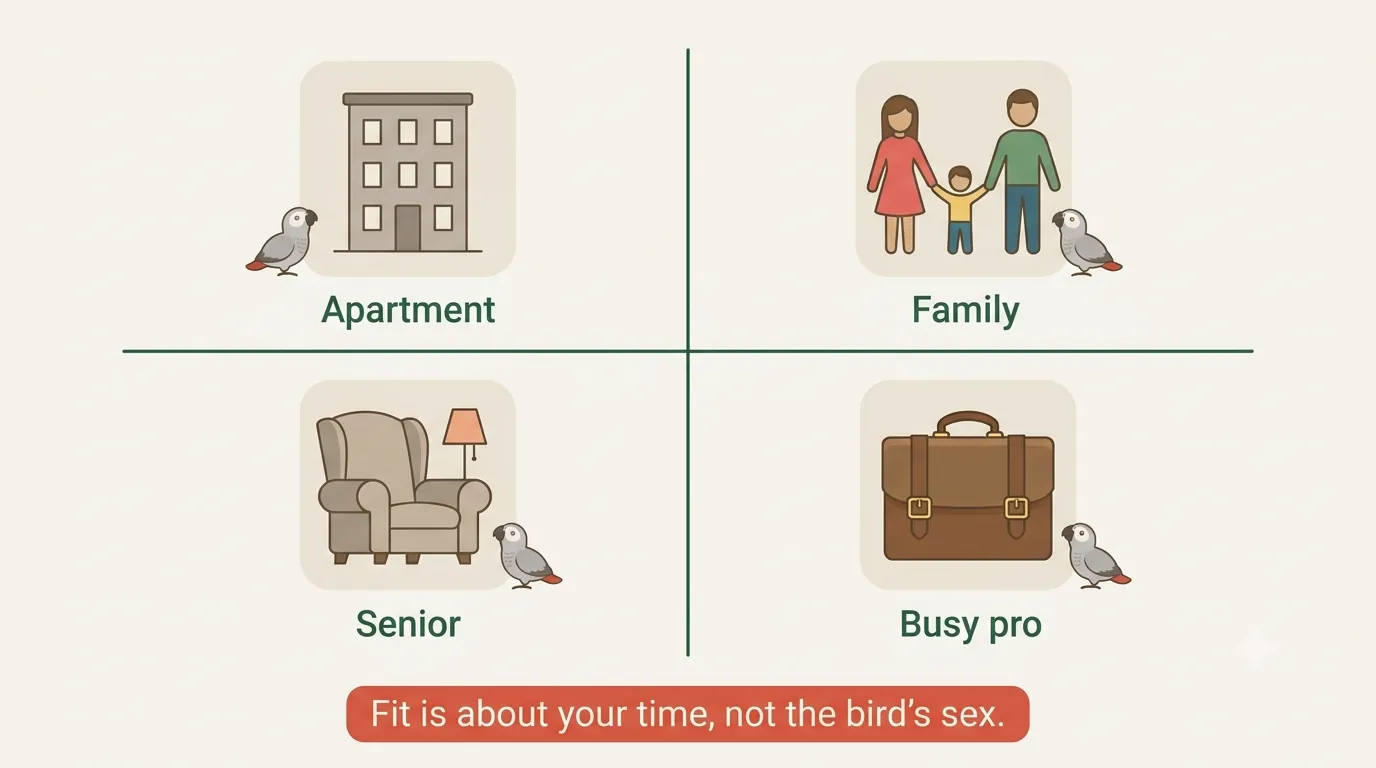
Five Households, Five Honest Sex-vs-Temperament Calls
Five setups, five straight calls — including the single one where sex genuinely tips the scale, and the one where our advice is "not this year."
Your First Bird Ever?
Pick the calmest, most hand-tame chick in the nursery — sex is not the variable to optimize. A steady, well-socialized bird forgives the mistakes every first-timer makes, and that steadiness is an individual trait, not a male or female one. We'll match you to the temperament that fits your home and hand you the DNA certificate afterward.
Kids in the House?
Choose for sociability, not sex. Some greys elect one person and treat the rest of the flock as furniture; others accept the whole household — and that's an individual disposition we can read in the chick, not a thing you get by ordering a hen over a cock. Whatever the certificate says, keep toddlers at supervised distance: you're adding a four-decade family member, not a starter pet.
Apartment Walls and a Talking Bird?
Not a sex question — cocks and hens own the same vocal range. What actually sinks apartment ownership is an under-stimulated grey of either sex discovering its alarm-call volume. Commit to daily out-of-cage hours first and worry about square footage second.
Gone Ten Hours a Day?
We'll say it plainly: a cock and a hen left alone ten hours a day head toward feather-plucking at the same speed. If your calendar is genuinely full, an adult bird with an established temperament may suit you better than a chick — and sometimes the honest call is to wait a season.
Set on a Hen? One Real Caveat
This is the single household where sex earns a footnote: a lone female can become hormonal and lay infertile eggs, which draws down calcium. It's manageable with the right diet, calcium and UV-B/D3 — not a dealbreaker — but if you specifically want a hen, go in knowing that one job comes with the choice. A cock never lays.
If none of the five reads like your house, describe yours in the inquiry form below — matching a specific chick to a specific home is the part of this job we like best.
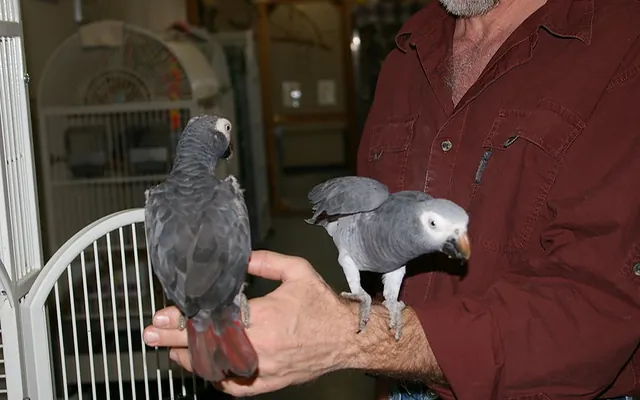
 Cock or hen, DNA-confirmed
The Sex Is Settled Before You Ever Pay a Balance
Every chick we place is DNA-sexed with the certificate in hand. Join the list and we'll email you the moment a male or female Grey is ready to reserve.
Do Male and Female African Greys Cost the Same?
Yes, to the dollar. Whether the DNA sheet says cock or hen, a C.A.Gs Congo prices at $1,700–$2,500 as a weaned chick and up to $3,500 as an older or proven bird, and a Timneh at $1,500–$1,600 — the sex line on the certificate never moves the figure. Either reserves with the same $200 deposit, and per-bird numbers are kept current on the price guide as each clutch weans.
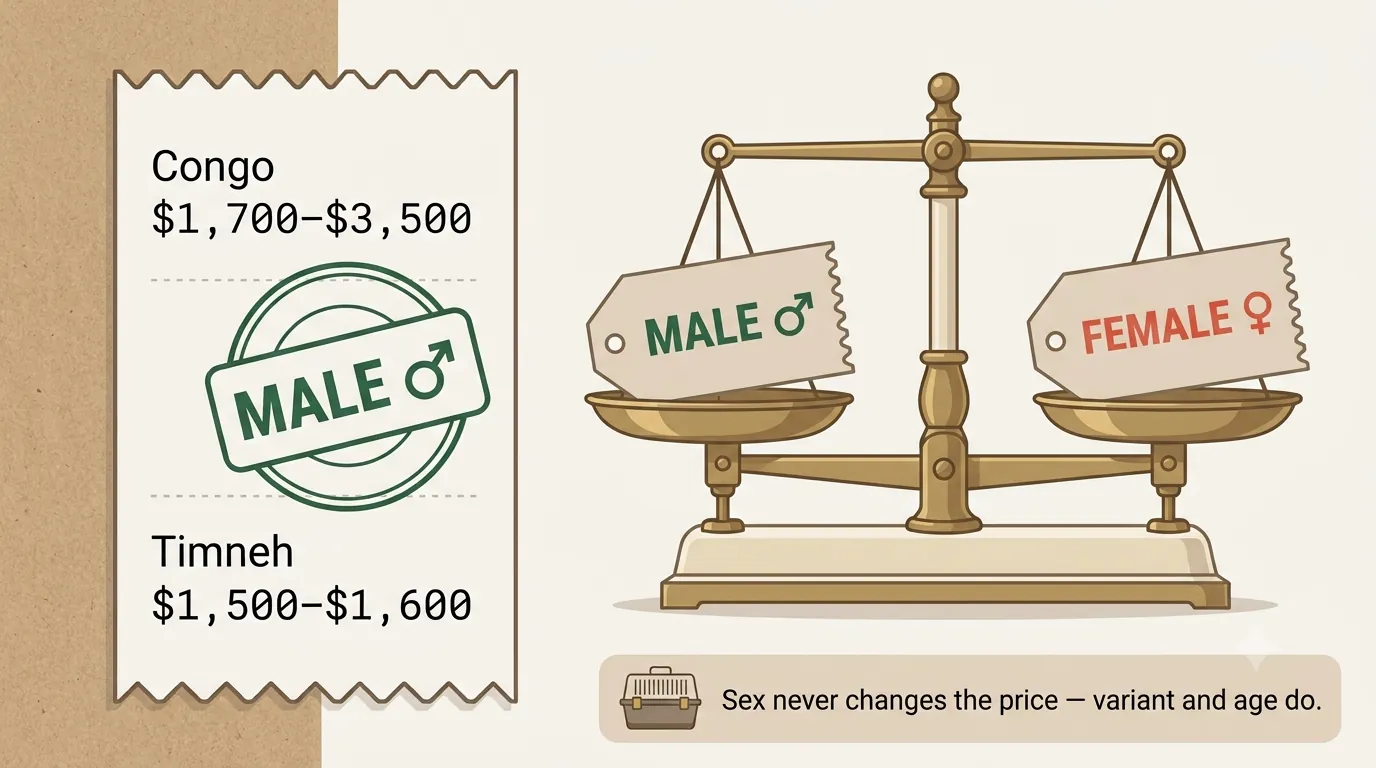
Why Sex Doesn't Move Our Price
Price tracks two things — variant (Congo vs Timneh) and age or training stage (weaned chick vs older, proven bird) — and nothing else. Sex isn't one of the levers, because the DNA test that tells us the sex costs the same whether the answer is male or female. If you ever see a seller charging a premium for "a talking male" or "a calmer female," that's a price built on folklore, not on what the bird actually is. We track competitor grey pricing weekly, and a sex surcharge is a small red flag that the bigger paperwork claims may be soft too.
What's Included — for Either Sex
Everything in the trust stack, at no line-item cost, identical for cocks and hens: the CITES captive-bred file, the DNA sexing certificate (the sheet that actually tells you the sex), an avian vet's health certificate, the banded hatch record, and PBFD plus Polyomavirus PCR screening. The low-end $800–$900 "cheap grey" ads skip every one of those — that's not a discount, it's a different product. Delivery is the sole extra — $185 to your airport or $350 to your door.
What Should You Budget in Year One, Beyond the Purchase?
Cock or hen, year one adds $825–$2,000 to the purchase: $300–$800 for a genuinely large cage (skimp anywhere but here), $100–$300 in perches and starter toys, $75–$200 for the establishing avian-vet exam — find a certified practice through the Association of Avian Veterinarians ↗ — plus $200–$400 in quality pellets and $150–$300 in enrichment. After that, expect roughly $375–$1,350 a year depending on vet luck and how fast your bird shreds toys.
Breeder note: the unweaned-chick "bargain" we won't sell
Cheap unweaned chicks are all over the classifieds, and we refuse to compete with them: in untrained hands a single hand-feeding error — crop burn, aspiration — is fatal, so "finish the weaning yourself and save" is a bargain nobody should take. A C.A.Gs grey, male or female, only goes home fully weaned; that patience is baked into our price.
How Will a New Grey — Cock or Hen — Settle in the First Month?
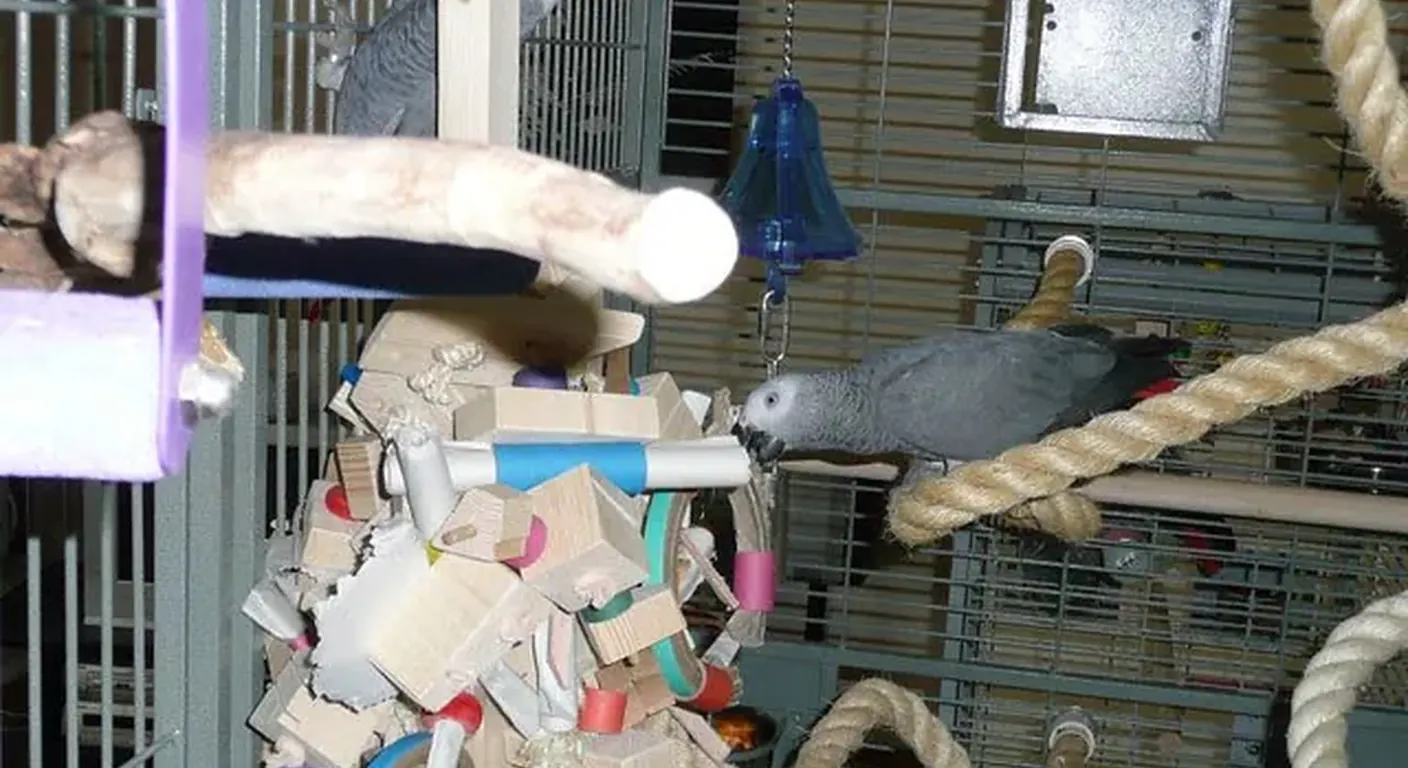
The sex you choose changes almost nothing about the first month — the arc below is the same for a cock or a hen, and our African Grey care guide picks up where day 30 ends. Teri walks every buyer through the same four phases:
Which Four Phases Does Every New Grey Move Through?
Screenshot this before pickup day — it separates "my new grey hates me" panic from recognizing a bird exactly on schedule.
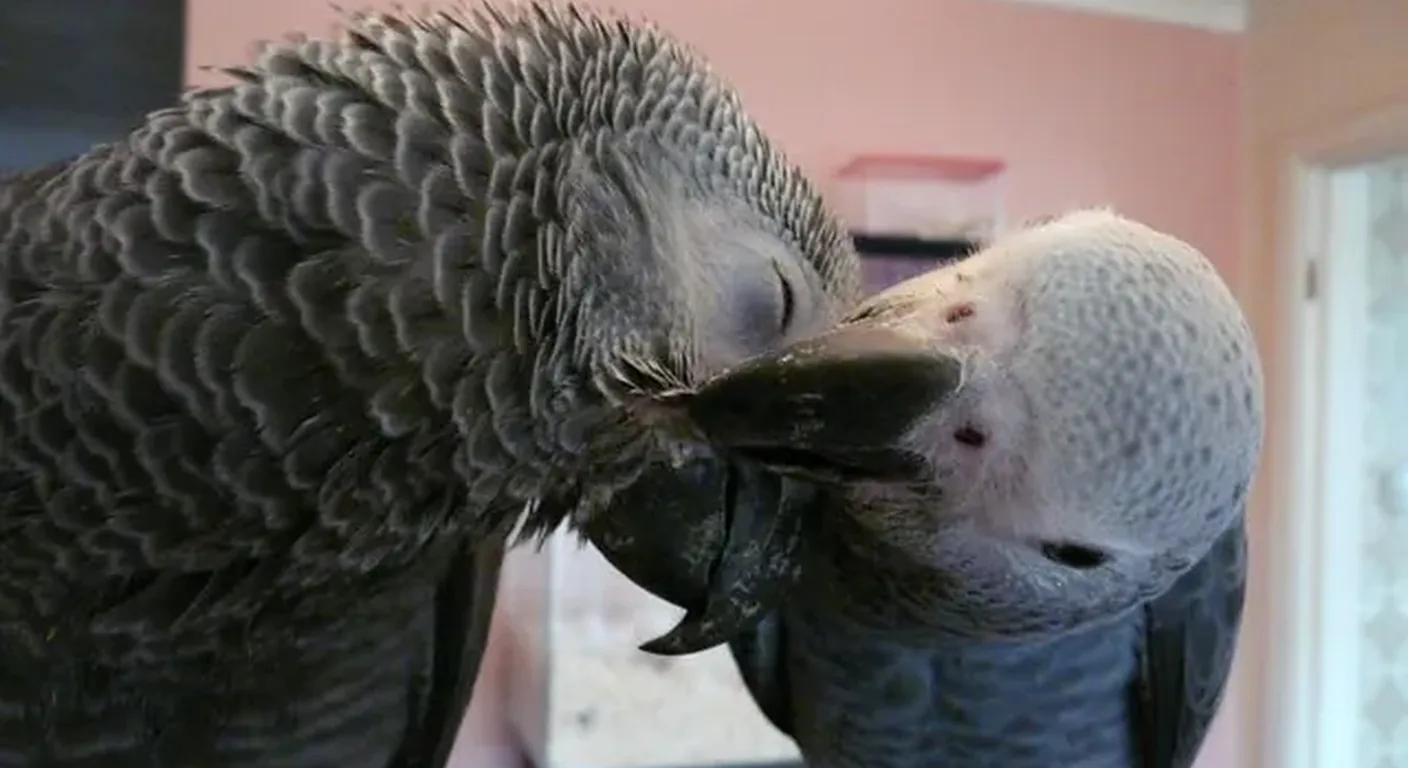
Expect a quiet bird perching low and eating mostly when unwatched. Day-two chattiness is individual, never a cock-or-hen thing — early test-mumbling and a reserved first week are equally on schedule.
Your grey is memorizing the house — footsteps, feeding times, which sounds mean what. Be deliberately boring; predictability is the whole assignment.
Voluntary step-ups arrive, treats are taken softly, and the first borrowed noises of your household start playing back.
The real personality surfaces — and this is the week our check-in call lands. Whichever sex you chose, you hold our direct line for the entire first month.
Male vs Female African Grey Myths — What's Actually True?
The sex myths arrive in our inbox pre-installed — buyers quote them to us before we've said a word. Mainstream references such as The Spruce Pets' African Grey overview ↗ already note the species is monomorphic and behaviorally individual; below is where each piece of folklore parts ways with what our own clutches do.
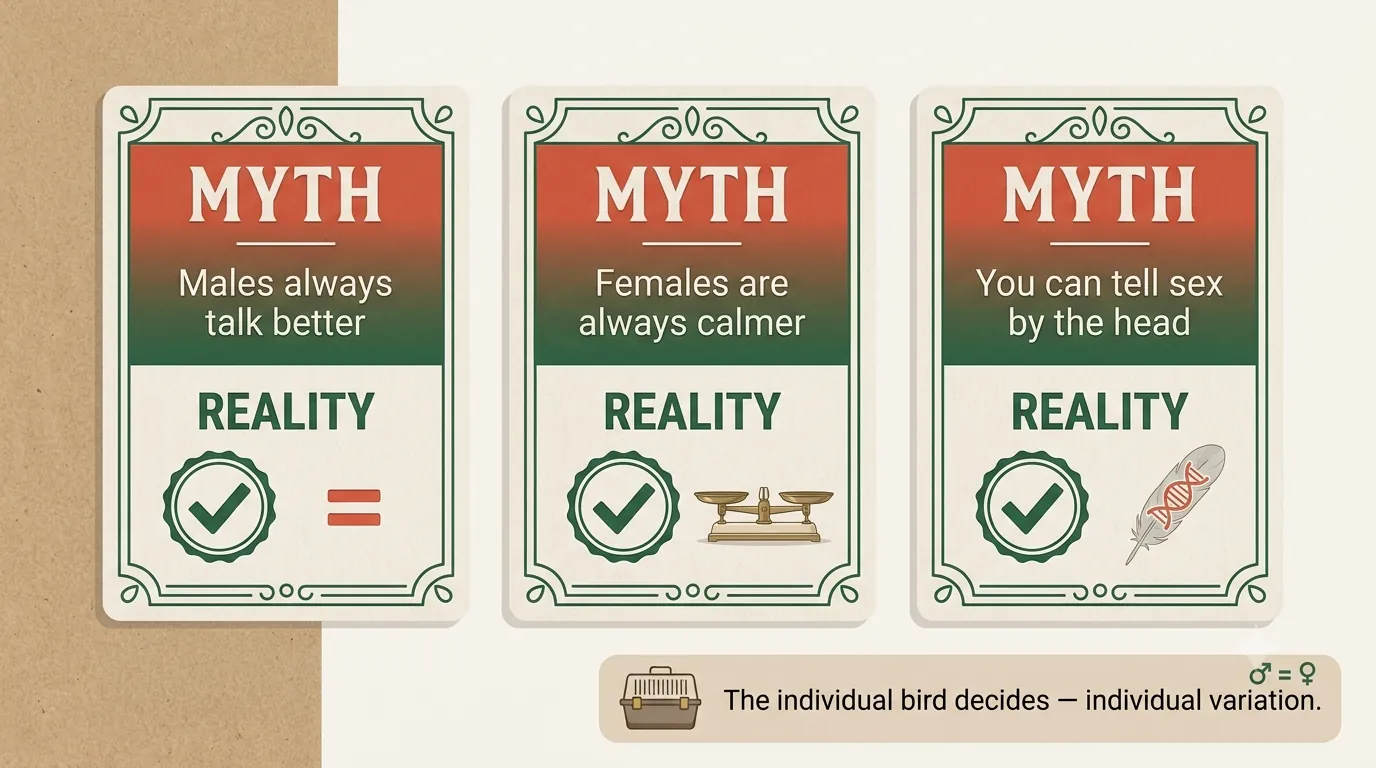
Which Sex Myths Land in Our Inbox Every Week?
Two short debunks, then the heavyweight claim goes under the microscope.
"Hens are always calmer." We've raised placid cocks and spirited hens and the reverse. Calm is an individual temperament with the same range in both sexes — routine, enrichment and handling shape it far more than chromosomes do.
"Greys prefer a man / a woman." A hand-reared grey bonds to whoever shows up consistently and reads its body language — not to the owner's gender. Men and women both raise deeply bonded birds here, with cocks and hens alike.
So Do Males Really Talk Better? The Claim, Under the Microscope
The most repeated claim online, usually stated as law.
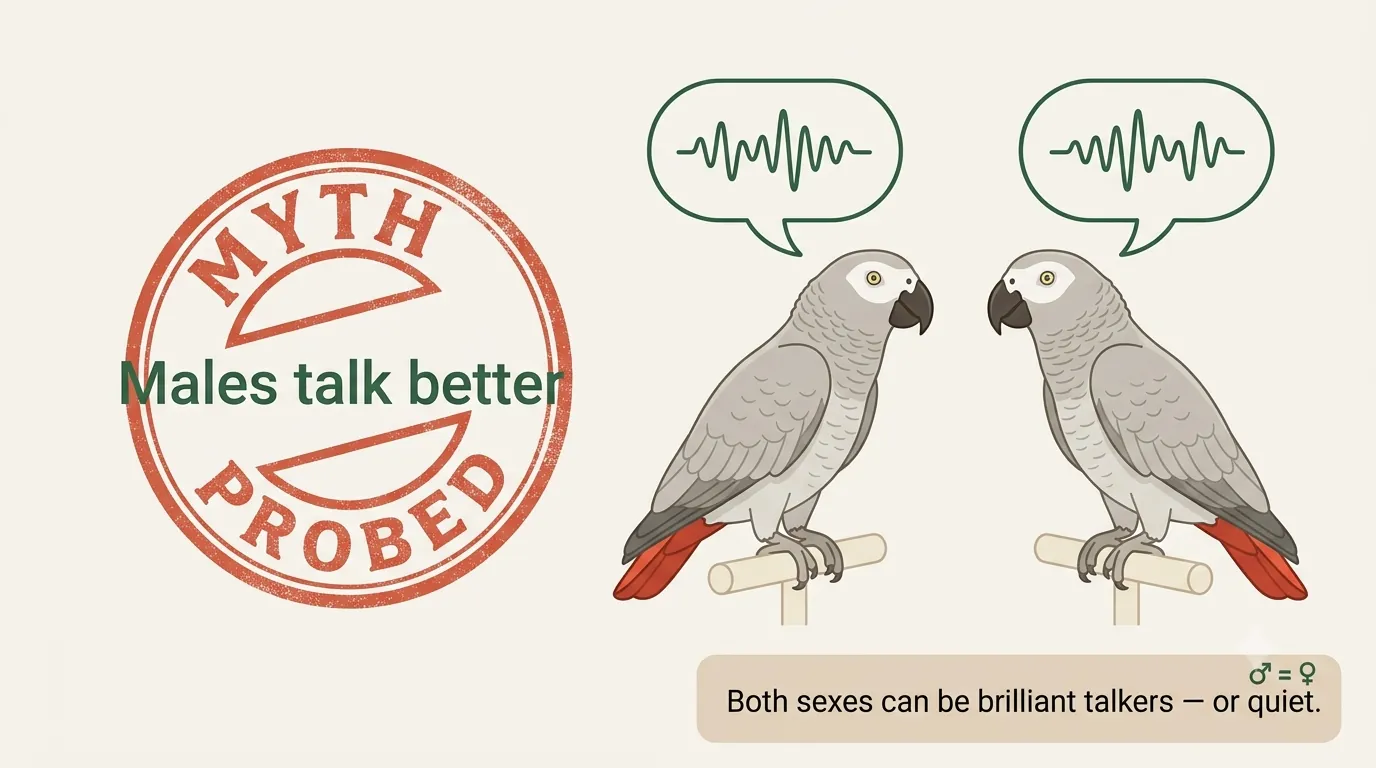
The Reality: The Individual Bird Talks, Not the Sex
Owners report brilliant hens and quiet cocks just as often as the reverse; how much you talk to the bird and how hand-tame it is drive vocabulary far more than sex does. Our honest version: there is no reliable talking gap between cocks and hens — pick the chatty individual in front of you, not a chromosome.
Citation: owner reports across both sexes
Sample the big grey-owner communities on Reddit or Facebook and the reports line up with our nursery ledger: brilliant hens, quiet cocks, and no sex-linked talking edge that survives a real clutch.
One Bird, a Male–Female Pair, or Same-Sex?
Once buyers accept that sex barely predicts personality, the next question is usually about numbers rather than sex: should you bring home one grey, a male–female pair, or two of the same sex? Here's how we answer it honestly, because the right call depends entirely on what you want from the bird.
If You Want a Talking Companion, Get One
A single hand-reared African Grey bonds hardest to you — regardless of whether it's a cock or a hen — and that undivided bond is what produces the affectionate, chatty companion most families picture. Two birds housed together often bond to each other first and talk to each other more than to you. So if talking and cuddling are the goal, one bird beats any pairing, and the sex of that one bird is a detail.
If You Want a Pair, Compatibility Beats Sex
A compatible male–female pairing and a compatible same-sex pairing can both work; what matters is whether the two individual birds actually get along, not the chromosomes. A male–female pair can still learn words, but expect a bonded pair to talk to each other more than to you. If you're set on a pair for company rather than conversation, we'll help you read compatibility — that's the variable that decides it.
After a Proven Breeding Pair or Fertile Eggs Rather Than a Pet?
Not every inquiry here is for a single companion chick. Established aviaries write us about our bonded, proven-producing African Grey pair, and experienced incubator keepers ask about candled fertile African Grey hatching eggs — both live on their own pages, and both carry the same documentation stack as our companion birds.
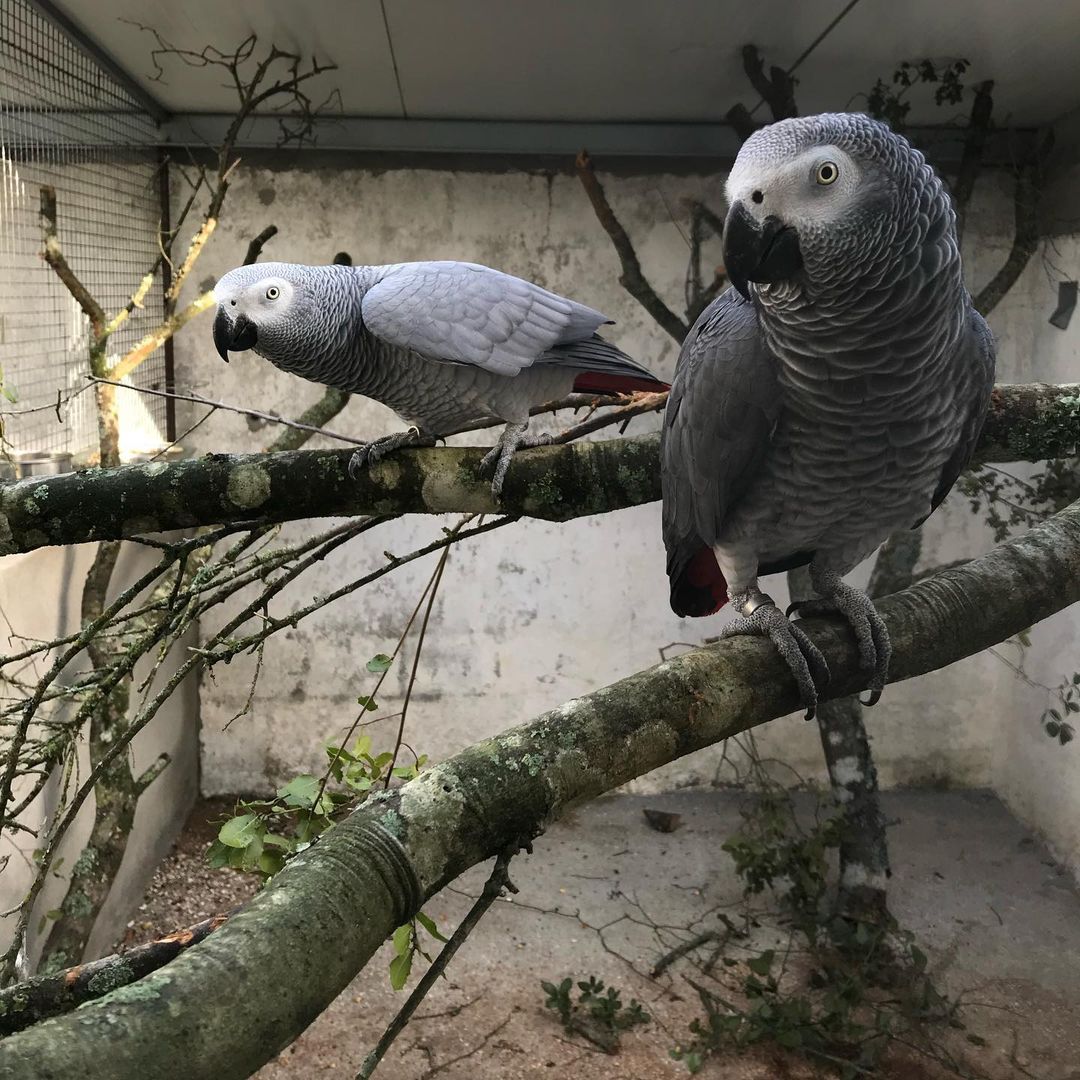
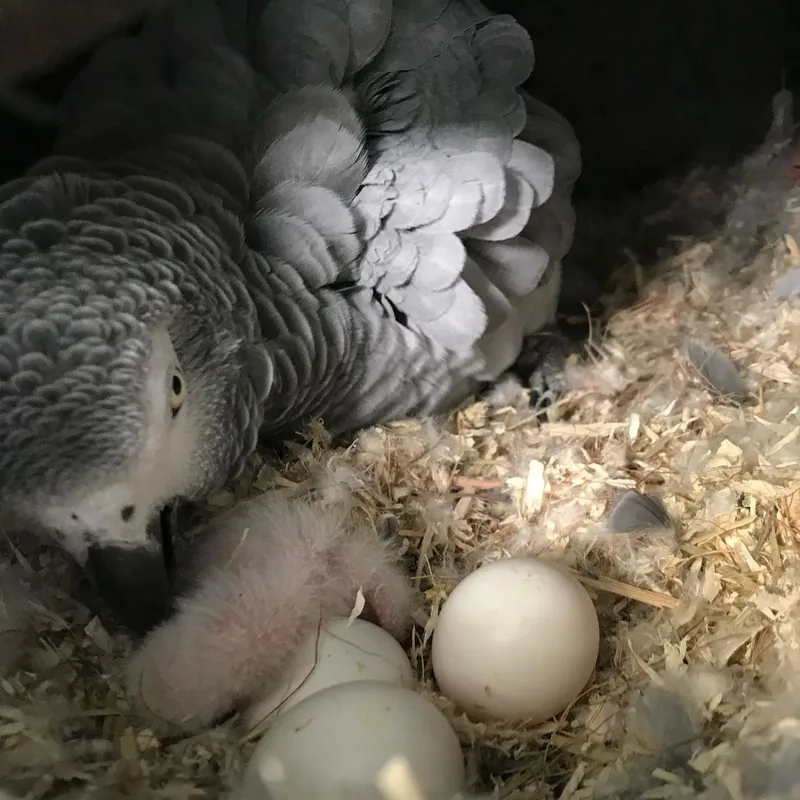
Is Owning a Male or Female Grey Legal — and What Proves Yours Is?
Every African Grey, male or female, sits on CITES Appendix I — the treaty's highest protection tier, applied at CoP17 and in force since January 2017, after wild trapping emptied whole forests of greys — the species entry at Encyclopaedia Britannica ↗ sketches that history. The listing doesn't outlaw ownership; it makes captive-bred paperwork the whole ballgame — and for this page's question, one paper in that folder does double duty.
Which Four Documents Ride Home With Your Bird?
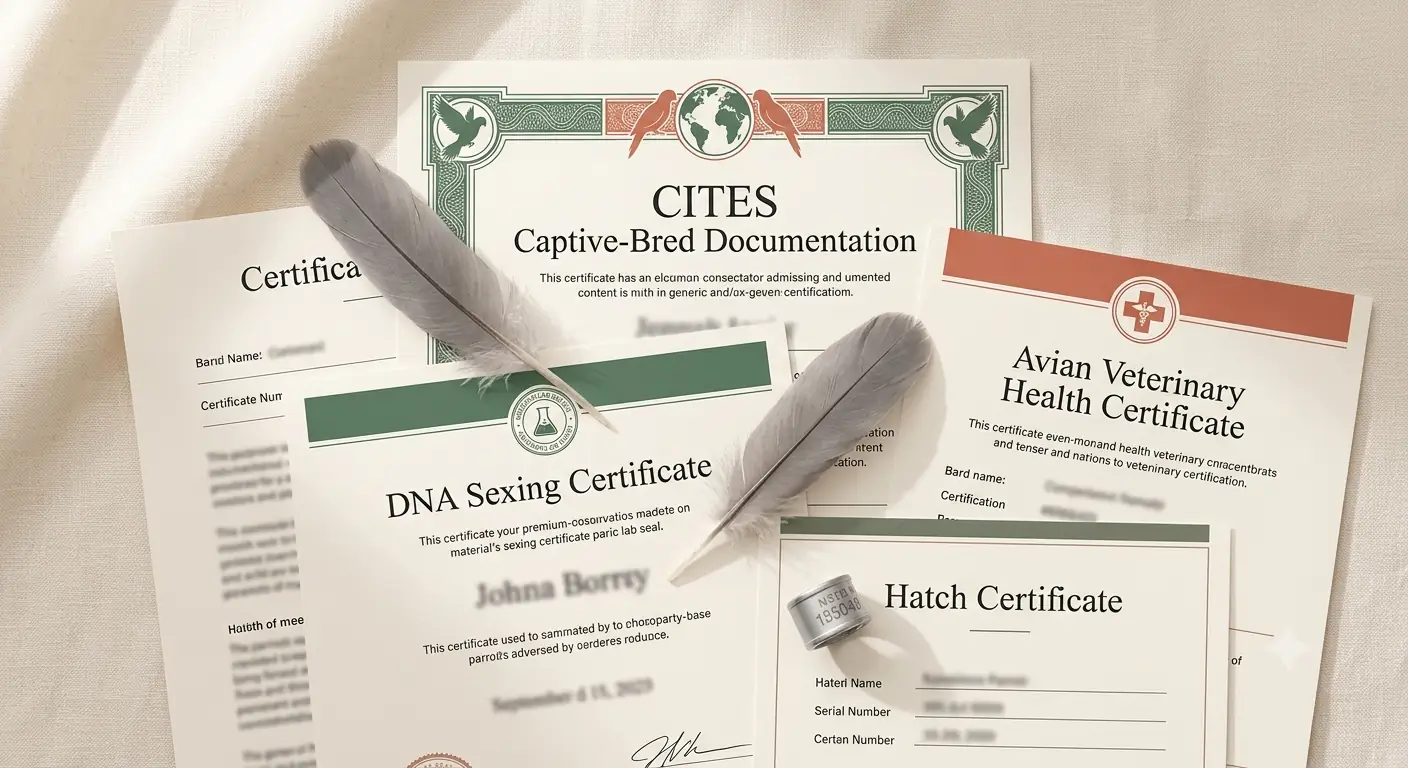
Cock or hen, four papers travel: CITES captive-bred documentation, a hatch certificate tied to the closed leg band, the DNA-sexing result — the sheet that settles this page's entire question — and an avian veterinarian's health certificate. A seller who stalls on producing any one of them has already answered the question you were really asking.
What Does Appendix I Mean When You're the Buyer?
Decades ago the U.S. Fish & Wildlife Service's Wild Bird Conservation Act ↗ shut the door on wild-caught greys entering the American pet trade; documented captive-bred birds move freely inside the country. Your strongest proof is the closed band — it slid over a chick's foot in its first weeks and can never be fitted onto a trapped adult, which is why it outranks any receipt a seller can print.
How Do the Wild Congo and Timneh Rank on the IUCN Red List?
On the IUCN Red List the wild Congo sits at Endangered and the Timneh at Vulnerable. Neither ranking touches your captive-bred bird's legality — we cite them for accountability: every documented, DNA-certified sale is one fewer order a trapper fills.
Citation: the CITES appendices and IUCN species assessments
Primary sources for both species: the CITES species database ↗ and the assessments of Psittacus erithacus and Psittacus timneh on the IUCN Red List ↗.
How Does a DNA-Sexed Grey Travel — and What Covers It After Arrival?
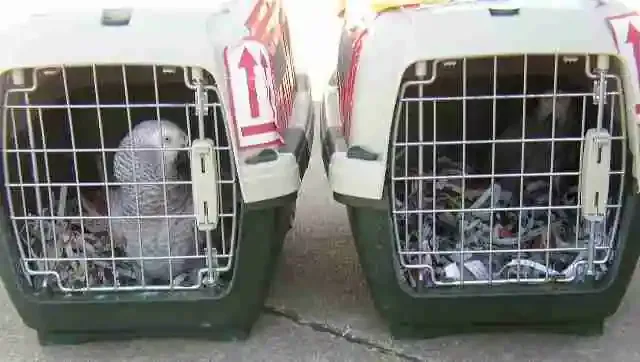
We book United PetSafe, Delta Cargo or American live-animal service into whichever major hub sits closest to you — DFW, DEN, LAX, MIA, ORD and more

A climate-controlled van or vetted Avian Flight Nanny hand-delivers your sexed chick — paperwork folder included — to your own doorstep
Two delivery tiers, nationwide, whichever sex you reserve. Airport pickup runs $185 through United PetSafe live-animal cargo; home delivery is $350 by climate-controlled van or a vetted Avian Flight Nanny who hand-carries your Grey in the cabin. The DNA certificate rides in the crate paperwork, so the "is it really a hen?" question is answered before you've left the cargo desk.
Which Seven Routes Carry Most of Our Cocks and Hens?
Buyers deciding between a male and a female tend to reserve from a chick's photo, sight-unseen — which is why the delivery leg matters as much as the DNA result. These are seven destinations we're actively booking sexed chicks into this season (the step-by-step crate-to-doorstep walkthrough lives on our African Grey shipping process page). Tap your area to see which cocks and hens can reach you:
- Arizona hens & cocks, flown to PHX
- Pennsylvania doorstep courier
- Ohio next-clutch reservations
- Miami same-week cargo slot
- Dallas–Fort Worth short hop
- Washington state Sea-Tac route
- New Jersey Newark arrivals
- PBFD PCR screening
- Avian Polyomavirus PCR
- DNA sexing certificate
- Avian-vet health certificate
- Hatch certificate + closed band
The written health guarantee reads the same whether the certificate says male or female — the exact terms are spelled out on the health guarantee page. A refundable $200 deposit locks your chick in; nothing else is due until the crate is booked.
Before your Grey lands, line up a certified avian vet near you — the Association of Avian Veterinarians directory ↗ lists board-certified avian hospitals by state, and we'll confirm whether your state requires an exotic-bird permit before delivery (most don't for a captive-bred, CITES-documented companion Grey, but a handful do).
Ships nationwide · $185 airport · $350 home
Who's in the Nursery Right Now — Cocks, Hens, or Both?
If you've settled the male-or-female question, these are the DNA-sexed Greys you can put a deposit on today. Each Male or Female badge below is a lab result, not a listing guess, and clutches here are small — when a sexed chick is reserved, the next one may be months out. Click through to a bird's page for its photos, parentage and full document folder, or reserve straight away with the refundable $200 deposit.
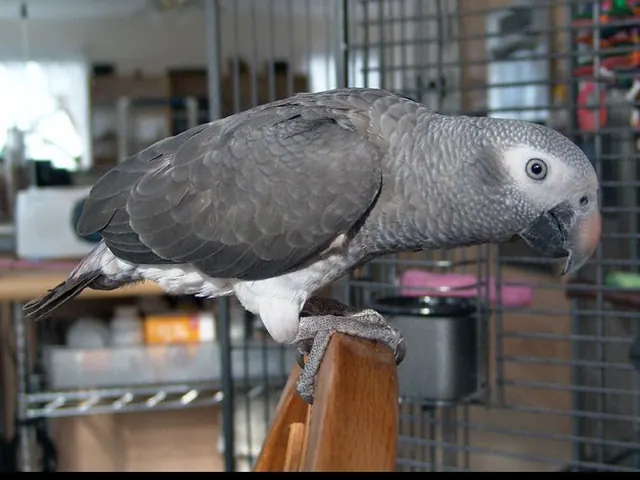
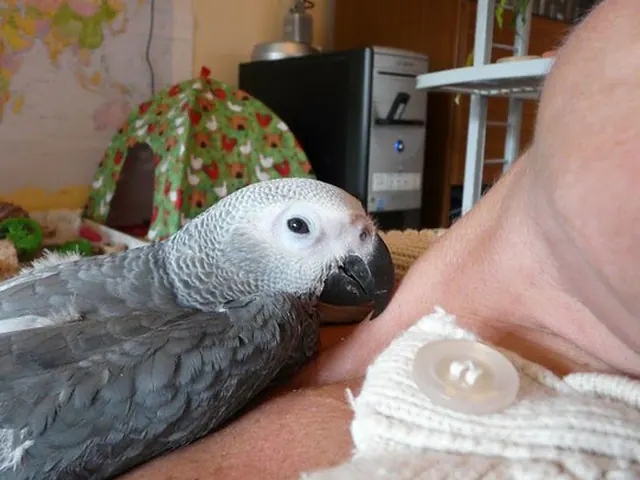
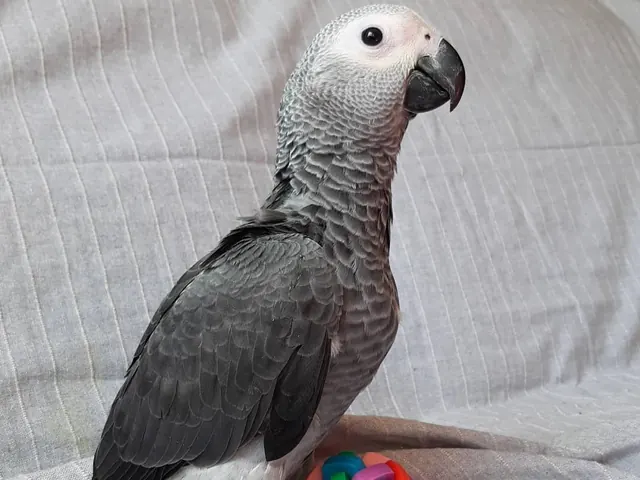
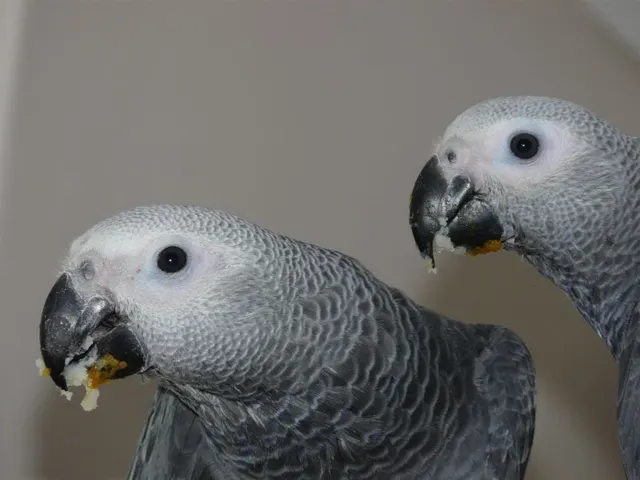 Pair Congo · Available
 Jins & Jeni (Pair)
$3,500- CITES Cert
- PCR DNA-Sexed
- Vet Certified
- PBFD & APV Screened
- Fully Weaned
Did Real Buyers Pick a Sex — or Pick a Bird?
Rather than us condensing ten years of male-or-female emails, hear it from two buyers who made the call. Notice what neither of them agonized over: whether they were getting a cock or a hen. Each chose the bird whose temperament fit their home and let the DNA certificate fill in the sex. Our buyer review wall holds dozens more verified accounts like theirs.
 Catherine KempfSchaumburg, IL · Congo African Grey★★★★★
"I ordered a Congo African Grey from C.A.Gs and the experience was flawless. My parrot is healthy, friendly, and well-trained. Watching it grow and bond with my family has been an absolute joy. I recommend C.A.Gs to anyone looking for a quality African Grey."
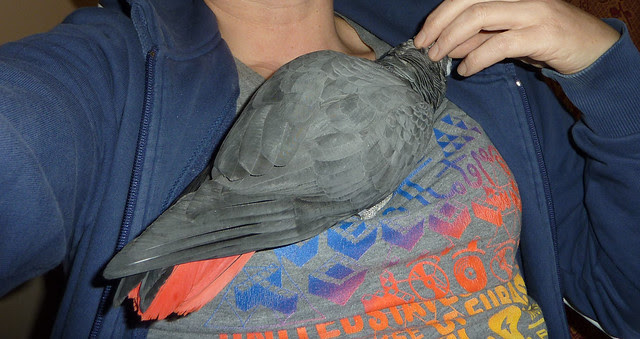 Ida BrimNashville, TN · African Grey★★★★★
"From the first email to home delivery, everything was exactly as promised. My grey arrived hand-raised, weaned, and confident — with his health certificate and CITES documents in hand."
Notice what neither family mentions: the sex of their bird, or regretting the choice. Match the bird to the household and neither sentence ever gets written.
How Do You Buy a Male or Female African Grey Safely?
The sex question has a scam attached to it, so this section earns its place. Because buyers believe the folklore — that males talk better, that hens are calmer — dishonest sellers price and pitch birds on it, and "guaranteed talking male" is one of the phrases we most often get asked to sanity-check. Here's how to buy the bird you actually want without getting worked.
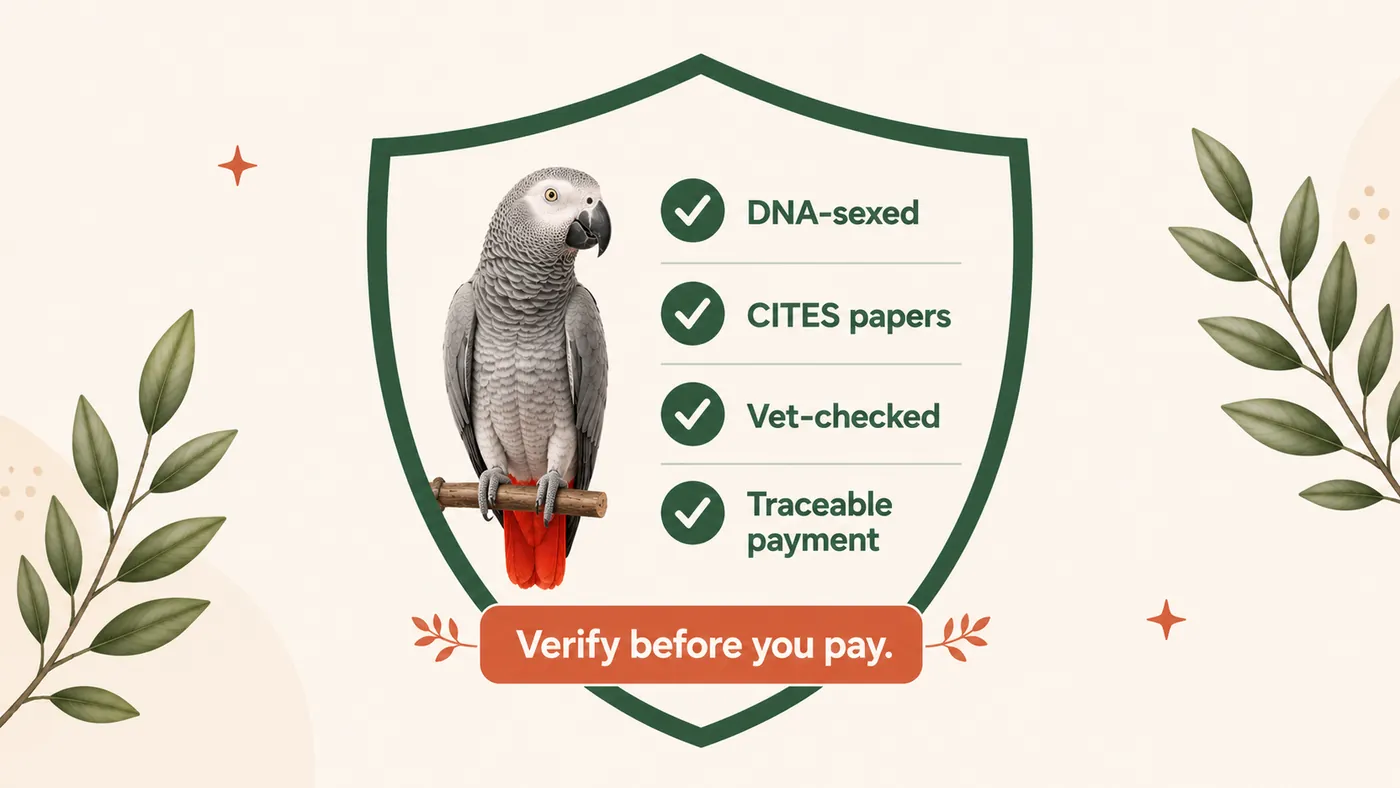
The Three Sex-Related Red Flags
Two are specific to the male-vs-female question; the third is the universal one that sinks most buyers.
A surcharge for one sex. The DNA test costs the same whether the answer is male or female, so a "talking male premium" is a price built on folklore. Real breeders charge by variant and age.
"Guaranteed" sex with no certificate. Greys are monomorphic — nobody can promise a sex by looking. If a seller states the sex but can't produce a PCR DNA certificate, they're guessing or lying. Ask to see the paperwork before any deposit.
The Universal One: Payment Pressure
Whichever sex you're after, the moment a seller pushes an irreversible payment (wire, gift cards, crypto) for a "rare" bird you haven't verified, stop. Our fuller guide to avoiding African Grey scams walks through the pattern, and a documented breeder will always let the paperwork come first.
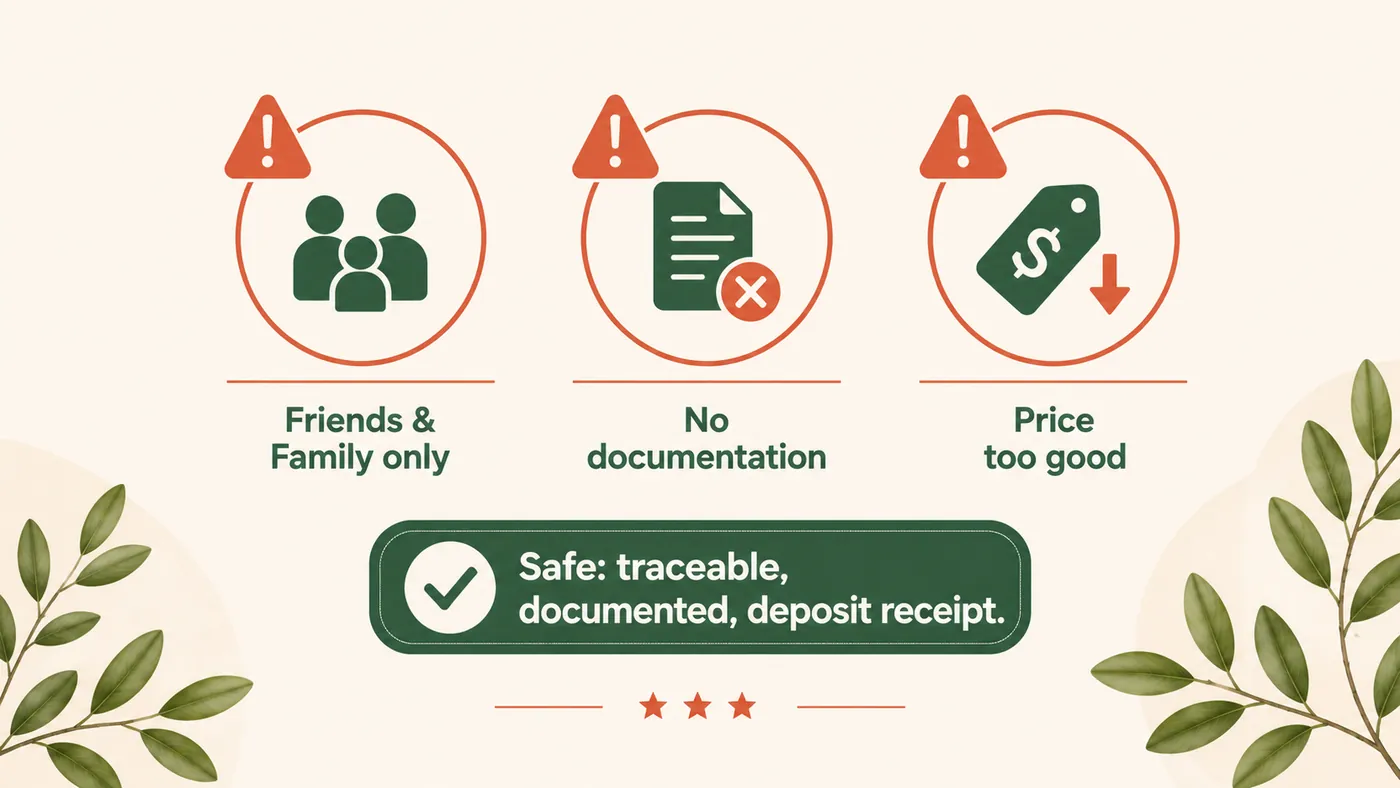
What a Safe Reservation Looks Like Here
Our buying an African Grey near you guide walks the whole journey; here is the short version. A refundable $200 deposit, the DNA-sexing certificate and full document folder shown before the balance is due, and a real conversation with Mark and Teri first. That's the whole process — no pressure, no sex surcharge, no paperwork that appears only after the money does.
Breeder note: why we lead with the certificate
We hand over the DNA certificate because it's the one document that ends the argument. You never have to take our word for a bird's sex — the lab already settled it, and the paper travels with the bird.
Male or Female African Grey FAQ: What Buyers Still Ask Us
Once the scorecard is read, these are the follow-ups buyers actually send — each answered the way we'd reply by email, minus the pleasantries. For the care, diet and setup questions beyond sexing, our full African Grey parrot FAQ picks up the thread.
Is a male or female African Grey better as a pet?
Neither, and we say that as the people who raise both. Male and female African Greys are so close in temperament, talking and bonding that the individual bird outweighs its sex every time. What actually predicts a great companion is hand-rearing, early socialization and the time you put in — not whether it's a cock or a hen. Choose the bird whose personality clicks with your household; let DNA tell you the sex afterward.
Do male or female African Greys talk better?
There's no reliable talking difference between the sexes. Both males and females can become brilliant, precise talkers, and both can stay quiet — it comes down to the individual bird, how much you talk to it, and how hand-tame it is. Folklore that 'males talk more' isn't supported by how our clutches actually turn out. If a big vocabulary matters, pick the chatty individual in front of you, not a sex.
How can you tell if an African Grey is male or female?
You can't tell by looking — African Greys are a monomorphic species, meaning males and females are visually near-identical in size, color and markings. The head-shape, body-shape and eye 'tells' you'll read online are folklore and are wrong often enough to be useless. The only accurate method is a DNA test (a PCR test on a feather or a drop of blood). Every C.A.Gs bird leaves with a DNA-sexing certificate, so the guesswork is already done.
Do male and female African Greys look different?
No. Both sexes have the same light silver-grey body, red tail and pale face mask (Congo) or charcoal body, maroon tail and horn-colored beak (Timneh). There is no visible feature — not the head, not the 'squared-off' skull, not the wing tips — that reliably separates a male from a female. That visual sameness is exactly why DNA sexing exists.
Are female African Greys calmer or quieter than males?
On average, no more than the individual bird's own temperament dictates. We've raised placid males and spirited females and vice-versa. 'Hens are calmer, cocks are louder' is a generalization that falls apart across a real clutch. Both sexes have the same vocal range and the same capacity for calm — enrichment, routine and handling shape the noise far more than sex does.
Do female African Greys lay eggs without a mate?
A lone female can lay infertile eggs if she becomes hormonally stimulated, even with no male present. It's manageable — the risk to watch is chronic egg-laying, which draws down calcium and can cause hypocalcemia or egg-binding. A correct diet, calcium and UV-B/D3 exposure, and limiting nest-like spaces keep it in check. It's a real consideration if you specifically want a hen, not a dealbreaker.
Is a male or female African Grey better for a first-time owner?
Either. Sex isn't the variable a first-timer should optimize; temperament and hand-taming are. A calm, well-socialized bird of either sex is the right first grey. We match first-time buyers to the individual chick that suits their home, then hand them the DNA certificate — the sex is information, not the decision.
Do African Greys bond better with a male or female owner?
Hand-reared African Greys bond to their primary caregiver's time and calm handling, not to the owner's gender. The idea that Greys 'prefer women' or 'prefer men' is folklore — the bird bonds to whoever shows up consistently, reads its body language and doesn't rush it. Men and women both raise deeply bonded Greys here.
Are male African Greys more aggressive or hormonal?
Both sexes go through seasonal hormonal phases, and both can nip or get territorial during them — it's not a male-only trait. The folklore runs both ways (some call males 'aggressive,' others call females 'moody'), which is a good sign it's individual, not sex-linked. Consistent routine and reading your bird's signals matter far more than which sex you picked.
What is DNA sexing and do your birds come sexed?
DNA sexing is a lab PCR test — on a feather or a small blood sample — that reads the bird's chromosomes to confirm male or female with high accuracy. It's the only reliable method for a monomorphic species. Yes: every C.A.Gs African Grey is DNA-sexed and leaves with the certificate, so you know exactly what you're getting. You can read more on our DNA-tested African Greys page.
Is it better to get two males or a male and female pair?
For a talking companion bird, a single hand-reared grey bonds hardest to you regardless of sex — two birds often bond to each other and to you less. If you want a pair, a compatible male–female or same-sex pairing can both work; sex matters less than whether the two birds actually get along. A male–female pair can still learn to talk, though a bonded pair typically talks to each other more than to you.
Do male and female African Greys cost the same?
Yes. At C.A.Gs the price is set by variant and age, never by sex — a male and a female Congo of the same age cost the same, and so do our Timnehs. Any seller charging a premium for one sex is pricing on folklore, not on what the bird is worth.
Sex Settled — What Should You Research Next?
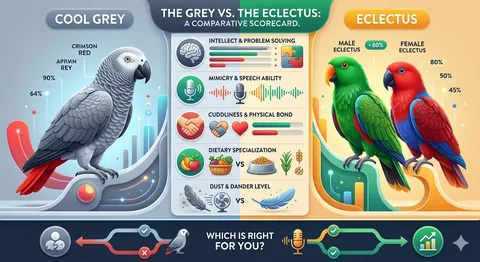
Choosing between cock and hen was the easy part — the grey itself is a four-decade commitment. These three guides cover what careful buyers study next: the species facts worth knowing cold, the cage that should be assembled before your bird lands, and how a Grey measures against an Eclectus if you're still weighing parrots.

Ready to Reserve Your DNA-Sexed Male or Female?
Whether you've landed on a cock, a hen, or "just the friendliest chick you've got," the path forward doesn't change: describe your household below and we'll name the birds that genuinely fit it — and say so plainly if none currently do. Every bird arrives DNA-sexed, so the sex is settled before you ever pay a balance.