Species Comparison · Which Bird Fits Which Owner · Midland, TX
African Grey vs Eclectus: Which Parrot Is Better for You? (2026)
Two smart, mid-sized companions that suit calmer homes — but they split hard on talking, diet and looks. Here's the honest breeder side-by-side, and a simple way to tell which one fits your life.
Written by Mark & Teri Benjamin · C.A.Gs African Grey breeders, Midland TX · USDA-licensed since 2014
Grey or Eclectus? It comes down to who you are, not which bird is 'best'.
USDA
Licensed since 2014
CITES
Appendix I docs
PCR
DNA-sexed birds
$185
Ships nationwide
Leaning toward an African Grey?
Tell us what you're looking for and we'll send live video, full paperwork and the hand-raised Greys available now — no pressure.
✓ USDA AWA Licensed✓ CITES Appendix I✓ DNA Sexed✓ Avian Vet Certified✓ Ships Nationwide
On This Page
The short answer
Quick Verdict: Should You Get an African Grey or an Eclectus?
Choose an African Grey for the best talking ability, the deepest intelligence and a bird that bonds like family — if you'll give it daily interaction and enrichment. Choose an Eclectus for a calmer, quieter, stunningly colourful companion — if you'll commit to its specialised fresh-food diet. Most buyers who came looking for conversation want the Grey; the best bird is always the one whose needs match the home you can give it.
Best talkerAfrican Grey
Calmer & quieterEclectus
Simpler dietAfrican Grey
Bonds like familyAfrican Grey
How Do African Grey and Eclectus Compare at a Glance?
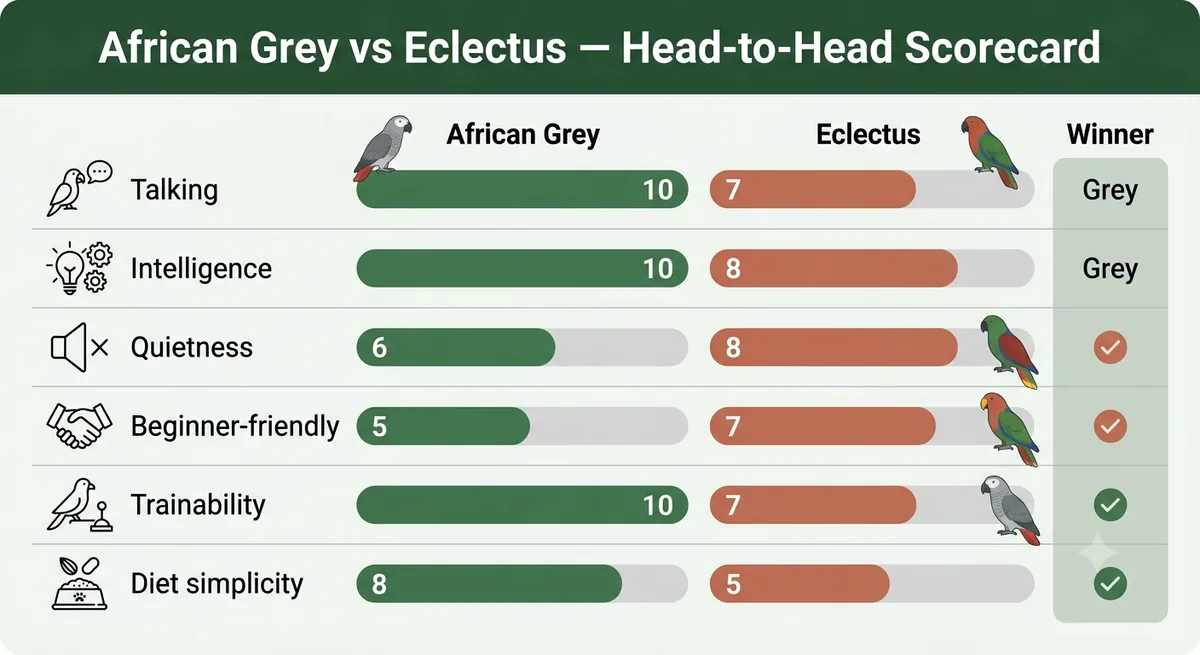
Before the deep dive, here's the whole comparison on one card. This is the block the forum threads that dominate this search never give you — a structured, trait-by-trait scorecard you can read in ten seconds. We raise African Greys and don't breed Eclectus, so treat the Grey scores as first-hand and the Eclectus scores as fair, well-sourced species facts.
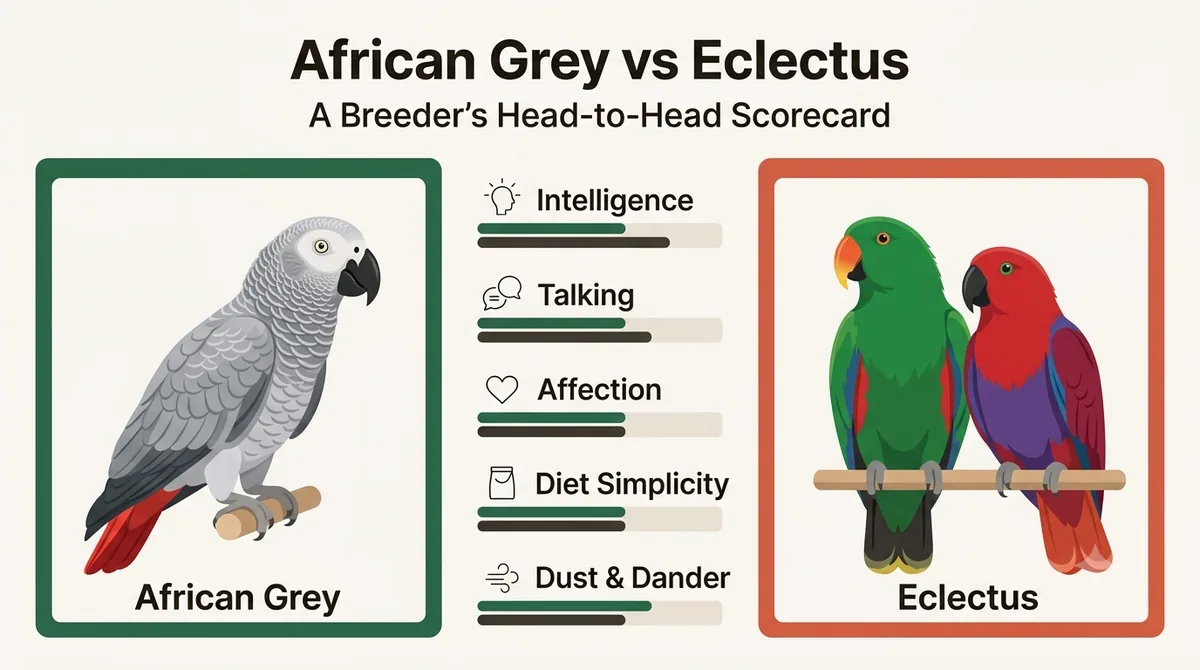
The head-to-head scorecard — Grey leads on talking and brains, Eclectus on calm and quiet.
Trait
African Grey
Eclectus
Winner
Talking ability
Exceptional, context-aware
Very good, clear voice
African Grey
Intelligence
Extremely high
High
African Grey
Noise level
Moderate
Low–moderate
Eclectus
Beginner-friendly
Demanding
A little more forgiving
Eclectus
Diet
Pellet + fresh produce
Specialised fresh, low-fat
African Grey (simpler)
Training
Loves it
Willing
African Grey
Telling sexes apart
Identical — needs DNA
Obvious — male green, female red
Depends
Lifespan
40–60 years
~30 years
African Grey
Breeder verdict: For a talking, trainable companion that bonds like family, the African Grey wins most rows; for a calmer, quieter, showstopping-colour bird, the Eclectus is the pick. Read across the row that matters most to you, not down the column you like.
How to Read This African Grey vs Eclectus Scorecard
Don't just tally the wins — weight the rows by what actually matters in your home. If conversation is your whole reason for getting a parrot, the talking and intelligence rows should outweigh everything else, and the Grey runs away with it. If your deciding factors are noise and a forgiving temperament, the Eclectus's two green rows may matter more to you than the Grey's six.
What Each Score Means for Your Decision
A "win" here isn't a grade — it's a fit signal. "African Grey wins talking" means *if talking is your priority*, buy the Grey; it doesn't mean the Eclectus is a poor talker. Read the scorecard as a mirror: the row you care about most is the one that should decide your bird, and the honest truth is that most people who reach this page care most about the rows the Grey wins.
What Are You Actually Choosing Between?
These two birds are often cross-shopped because they overlap on the things beginners screen for — mid-size, intelligent, not as loud as a macaw. But underneath, they're built for different owners. Here's who each bird really is before we score them category by category.
The African Grey Parrot at a Glance
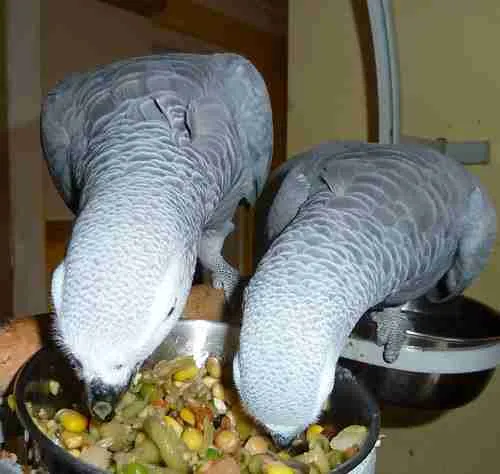
The African Grey — understated silver plumage, extraordinary mind.
The African Grey ↗ is the parrot the whole hobby points to when the subject is intelligence and speech. Native to the rainforests of West and Central Africa, it's an understated silver-grey bird with a scarlet tail (Congo) or maroon tail (Timneh) — plain next to an Eclectus, and famous precisely for what's going on behind the eyes rather than the plumage.
Congo vs Timneh: The Two African Greys
There are two African Greys, and it's worth knowing the split before you compare with an Eclectus. The Congo is larger, silver-bodied with a bright red tail and the classic clear voice; the Timneh is a little smaller, darker, with a maroon tail and often an earlier, more relaxed start to talking. We break the two down fully in our Congo vs Timneh comparison.
Origin, size and lifespan of the African Grey
The Cornell Birds of the World profile ↗ puts it at roughly 12–14 inches and 400–550 grams, living, with good care, 40–60 years — a genuine multi-generational commitment. That lifespan is one of the Grey's quiet advantages over the Eclectus, and one of the biggest reasons to buy from a source you can still reach in year twenty.
The Eclectus Parrot at a Glance
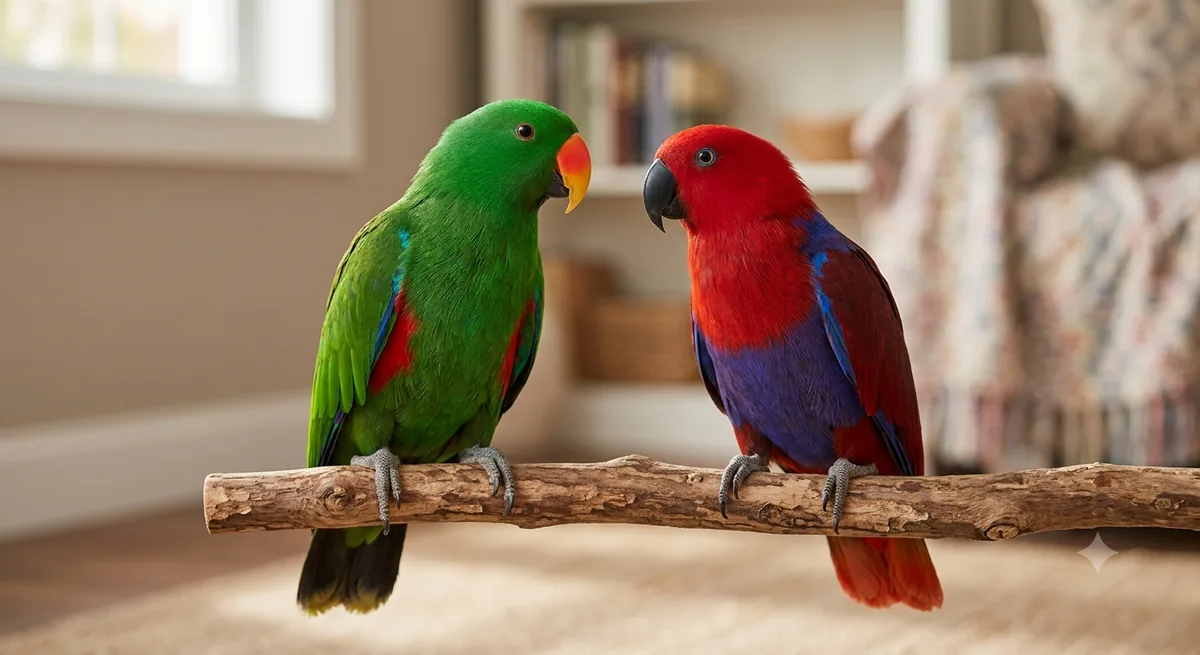
The Eclectus — the most colour-divided parrot in the world.
The Eclectus is the Grey's visual opposite: a calm, glossy, spectacularly coloured parrot from the Solomon Islands, New Guinea and northern Australia. Where the Grey wins you over with its mind, the Eclectus stops you in the room with its colour and its easy, laid-back temperament.
Why Male and Female Eclectus Look Like Two Different Birds
The Eclectus is the most sexually dimorphic parrot in the world ↗ — males are brilliant emerald green, females deep crimson and purple. The difference is so extreme that early naturalists classified them as two separate species. It's a genuine charm of the bird, and, as we'll see in the sexing section, the exact mirror image of the African Grey's problem.
Origin, size and lifespan of the Eclectus
An Eclectus runs a similar size to a Congo — around 13–15 inches — but typically lives closer to 30 years rather than the Grey's 40–60. Still a long commitment, just a meaningfully shorter one, which matters if lifespan is part of how you're weighing the two.
African Grey vs Eclectus, Category by Category
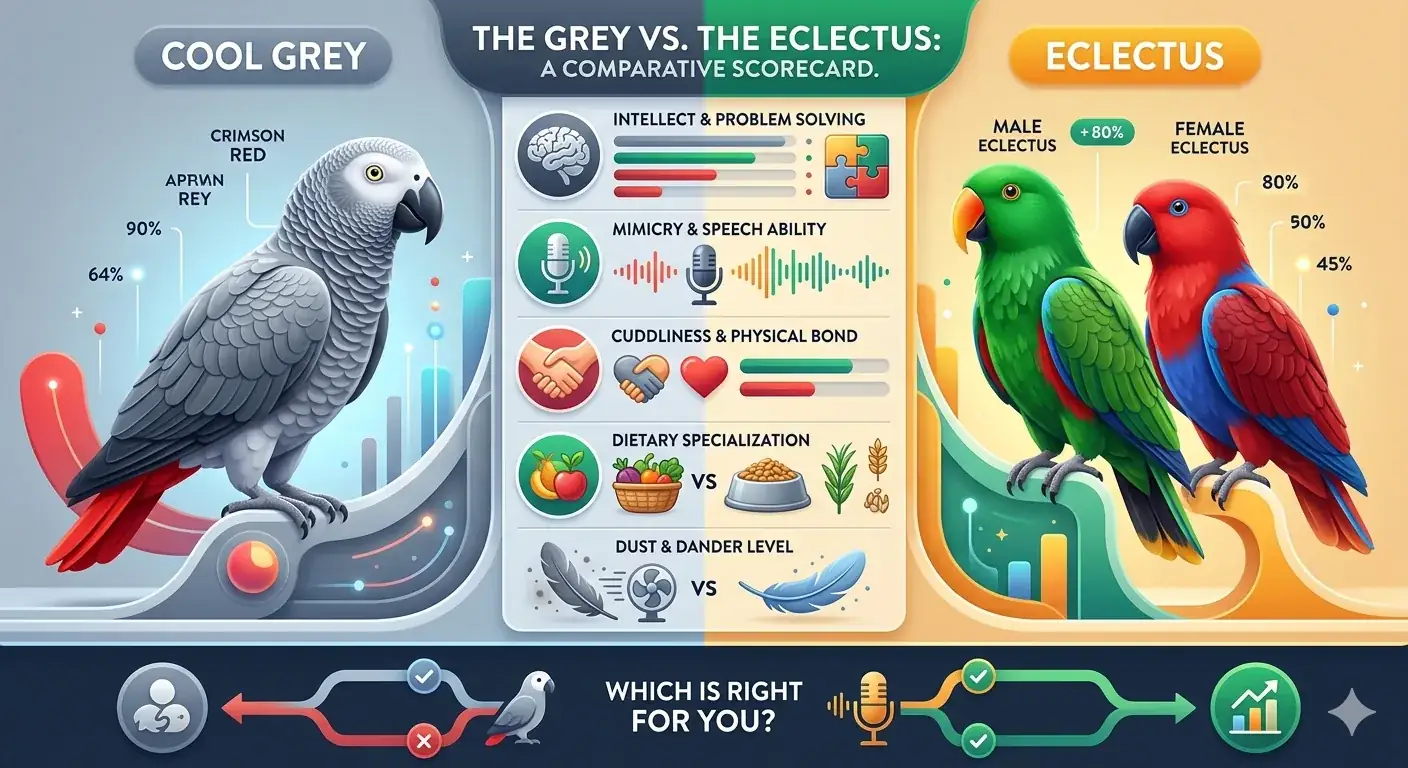
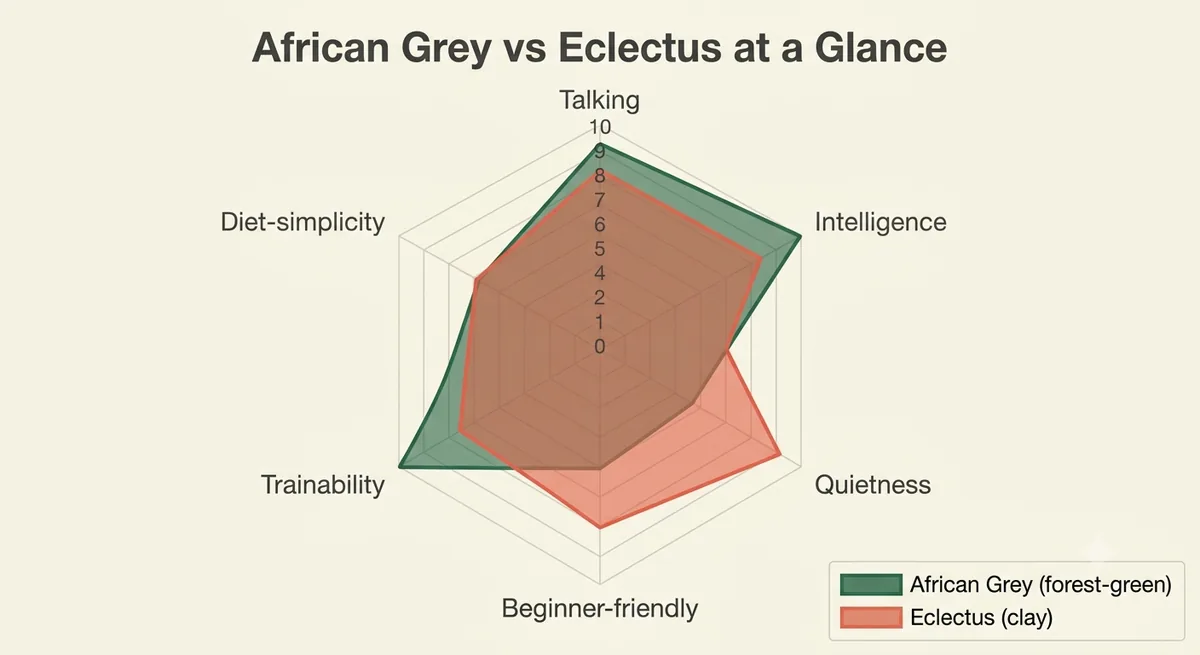
Now the head-to-head. Here's the same data as the radar chart below, walked through one decision at a time — because the "winner" only matters once you know which category is your priority.
The two birds' strengths, shape for shape — Grey stretches toward brains, Eclectus toward calm.Grey on the left, the emerald male and crimson female Eclectus on the right — the trait-by-trait scorecard.
Which Parrot Is Smarter?
The African Grey, decisively. It's the species behind the most famous parrot-cognition research on record, and the difference isn't subtle — a Grey solves, remembers and problem-solves at a level the Eclectus, clever as it is, doesn't reach. The flip side: a smarter bird gets bored faster and needs more from you.
Speech, Problem-Solving and Boredom
Intelligence in a Grey shows up as three things at once — quick learning, real problem-solving, and a low tolerance for boredom. Give a Grey puzzles and interaction and it flourishes; leave it under-stimulated and that same brainpower turns into screaming or feather-plucking. The Eclectus is content with less mental load, which is part of why some owners find it easier to live with.
Vocabulary size: how many words each really learns
A well-raised Congo commonly builds a working vocabulary of several hundred words, and — the part that sets it apart — uses many of them in context, a trait Dr. Irene Pepperberg documented with the Grey named Alex ↗. Eclectus parrots can learn a respectable vocabulary with clear pronunciation, but context-aware speech is the Grey's signature. We go deeper in our guide to African Grey talking ability.
Breeder note: what "talking in context" sounds like day to day
People picture a parrot reciting words; what a Grey actually does is spookier. Ours ask for specific foods by name, comment when someone leaves, and reuse phrases at the moment they fit. That's the real gap between the two birds — not how many words, but whether the words mean something to the bird using them.
Which Parrot Talks Better?
The Grey, on both clarity and use. Eclectus parrots genuinely surprise people — many develop clear, pleasant voices and a real vocabulary — but across the hobby the Grey is still the species most often crowned the best talking parrot in the world. If conversation is your top priority, this row alone tends to settle the decision.
Which Parrot Is Quieter?
The Eclectus, slightly. Both are moderate — a Grey whistles and mimics far more than it screams, and an Eclectus is generally calm — but the Eclectus edges it on sheer volume and is often the pick for close neighbours. If quiet is your hard constraint, note that both still make daily noise, and see how much louder the alternatives get in our African Grey vs Macaw comparison.
Which Parrot Is More Affectionate?
This one genuinely depends on the individual bird and how it was raised. Greys bond hard and read your mood closely, but they show it through trust and interaction more than constant cuddling; Eclectus tend to be gentle and even-keeled. Neither is a guaranteed lap-parrot — affection in both is earned through patient daily handling.
Which Is Easier for Beginners?
The Eclectus, by a hair, on temperament — it's a touch more forgiving of an inconsistent owner than a sensitive Grey. But "easier" flips the moment you factor in diet, where the Eclectus is far less forgiving. If you're weighing your first parrot seriously, read our honest take on whether the African Grey is good for beginners before you decide.
Which Has the Simpler Diet?
The African Grey — and this is the most underrated difference between the two birds. A Grey does well on a quality formulated pellet plus fresh produce and calcium support. The Eclectus needs something genuinely more demanding.
Why the Eclectus Diet Trips New Owners Up
The Eclectus has an unusually long digestive tract and does best on a fresh, low-fat, high-fibre diet built around fruits and vegetables. Many react to synthetic vitamins and heavily fortified pellets — the very foods that are fine for other parrots — with visible stress behaviours. It's the single most common reason a new Eclectus owner ends up at the avian vet.
Toe-tapping and wing-flipping as diet warning signs
Two odd behaviours — rhythmic toe-tapping and repetitive wing-flipping — are classic red flags that an Eclectus's diet or supplementation is off. A Grey simply doesn't have this failure mode; get its calcium and pellets right and diet largely takes care of itself. With an Eclectus, diet is a daily, hands-on responsibility.
Citation: World Parrot Trust & avian-vet guidance on Eclectus nutrition
The Eclectus's dietary sensitivity is well documented — the World Parrot Trust ↗ and most avian vets stress a fresh, natural diet and caution against over-supplementation. If you're choosing on care effort rather than looks, this is the row that most often points a realistic owner back toward the Grey.
Which Is Easier to Train?
The African Grey — its intelligence makes it a fast, enthusiastic student for step-up, recall and target training, provided you keep sessions short and positive. The Eclectus is willing and trainable too, just less driven. Our step-by-step African Grey training guide shows the method we start every chick on.
Myth
African Greys are cold, one-person birds, and Eclectus parrots can't really talk.
Fact
Both are half-myths. A Grey socialised with a whole family bonds with several people — the 'one-person' pattern usually comes from being handled by only one. And Eclectus parrots can be genuinely clear talkers; they're just outshone by the Grey's context-aware speech. Judge the individual bird and how it was raised, not the stereotype.
Which Bird Fits Your Lifestyle?
This is the question the trait table can't answer for you — and the one this whole page is really about. Stop asking "which bird is better?" and ask "which bird fits the home and routine I actually have?" Here's how the two sort by owner.
Match the bird to your life, not your wish list.
Best for Families with Children
Either bird can suit a family, with a nudge toward the Eclectus for its calmer temperament around busy households — as long as the Grey is socialised with everyone from the start. A family that wants a talking, interactive bird the kids will bond with usually loves a hand-raised Grey; a family that wants a gentler, lower-key presence often leans Eclectus.
Best for Working Professionals
Neither bird suits someone who's genuinely out all day, but the calmer Eclectus copes marginally better with quiet stretches than a stimulation-hungry Grey. If your days are long, be honest about it before you choose either.
How Much Alone Time Each Bird Tolerates
A rough rule: both want several hours of daily interaction, but the Grey's boredom threshold is lower and its reaction to neglect is louder. An Eclectus left alone tends to go quiet and withdrawn; a Grey left alone tends to get loud, then destructive, then plucked.
Why a bored African Grey starts plucking
Feather-plucking in a Grey is usually a symptom, not a disease — the outlet of a brilliant bird with nothing to do. It's the clearest reason not to buy a Grey for its intelligence and then fail to feed that intelligence daily.
Breeder note: the daily routine we teach new Grey owners
We send every Grey home with the same simple rhythm: a morning greeting and out-of-cage time, foraging toys rotated through the day, a few short training moments, and a settled, dark night's sleep. Owners who keep that rhythm almost never see the plucking and screaming that make people wrongly call Greys "difficult."
Best for Experienced Bird Owners
Experienced keepers can thrive with either and often relish the challenge each brings — the Grey's mental complexity or the Eclectus's dietary precision. If you've kept parrots before and want the deepest cognitive relationship on offer, the Grey is hard to beat; if you want a calmer bird and enjoy dialling in a fresh diet, the Eclectus rewards the effort.
What Health Problems Should You Plan For?
Every long-lived parrot comes with a short list of things to watch, and the two birds' lists barely overlap. Knowing each one up front is part of choosing honestly — and part of budgeting for a bird that may outlive the decision by decades.
Common African Grey Health Concerns
The Grey's two headline issues are calcium-related and behavioural. Both are largely preventable with the right start, which is exactly what a good breeder builds in. Our full African Grey health-problems guide covers the wider list.
Hypocalcemia and Feather-Plucking
African Greys are prone to hypocalcemia — low blood calcium — more than most parrots, which makes calcium and vitamin D3 management a real part of care. Feather-plucking, as covered above, is the other classic Grey issue, and it's usually about boredom and stress rather than illness.
The UV-B and calcium link every Grey owner should know
Greys need adequate calcium and the vitamin D3 to use it, which is why access to UV-B light or supplementation matters more for this species than for many others. Get that foundation right early and you sidestep one of the Grey's most common long-term problems.
Breeder note: how we screen chicks and set the calcium foundation
Every C.A.Gs Grey is vet-checked and DNA-screened, and we start chicks on a calcium-aware diet with proper lighting from the beginning, so the foundation is laid before the bird ever reaches you. Prevention on day one is far cheaper — and kinder — than treatment in year five.
Common Eclectus Health Concerns
The Eclectus's problems cluster almost entirely around diet and supplementation — the price of that specialised digestive system. Get the diet right and the Eclectus is a robust bird; get it wrong and the warning signs appear fast.
Toe-Tapping, Wing-Flipping and Nutritional Sensitivity
The Eclectus's signature red flags are toe-tapping and wing-flipping, widely linked to over-supplementation and synthetic vitamins. It's a health profile with no real African Grey equivalent, and the clearest illustration of why "easier to care for" depends entirely on which kind of effort you'd rather give.
How Do You Tell Males from Females — and Does It Matter?
Here the two birds are perfect opposites, and it's one of the most charming contrasts between them. With one, your eyes tell you the sex instantly; with the other, only science can.
Eclectus: The Most Sexually Dimorphic Parrot in the World
With an Eclectus, sexing is effortless: the male is emerald green, the female crimson and purple. You know the sex the moment you see the bird — no test, no guesswork. It's a genuine practical advantage if knowing the sex up front matters to you.
African Grey: Identical Sexes, So We DNA-Sex Every Bird
African Greys are the opposite — males and females look identical, so the only certain way to know the sex is a DNA test. That's why every Grey we place comes with its sex confirmed and documented, rather than guessed.
What PCR DNA Sexing Puts on Your Bird's Paperwork
A PCR DNA-sexing certificate tells you for certain whether your Grey is male or female, and it goes home in the same folder as the CITES Appendix I documentation, avian-vet certificate and health guarantee. With a Grey, the paperwork tells you the sex; with an Eclectus, the colour does.
How the PCR test is run and why it's certain
PCR sexing reads the bird's chromosomes from a small blood or feather sample, so it isn't an estimate — it's a genetic result. It's the same method reputable breeders across the hobby rely on precisely because visual sexing of a Grey is impossible.
Citation: PCR DNA-sexing accuracy in psittacines
Molecular sexing of monomorphic parrots is the established standard — the peer-reviewed literature on avian PCR sexing ↗ documents its reliability. For a species where you simply cannot tell by looking, that certainty is exactly what a certificate is for.
The Final Verdict: Grey or Eclectus?
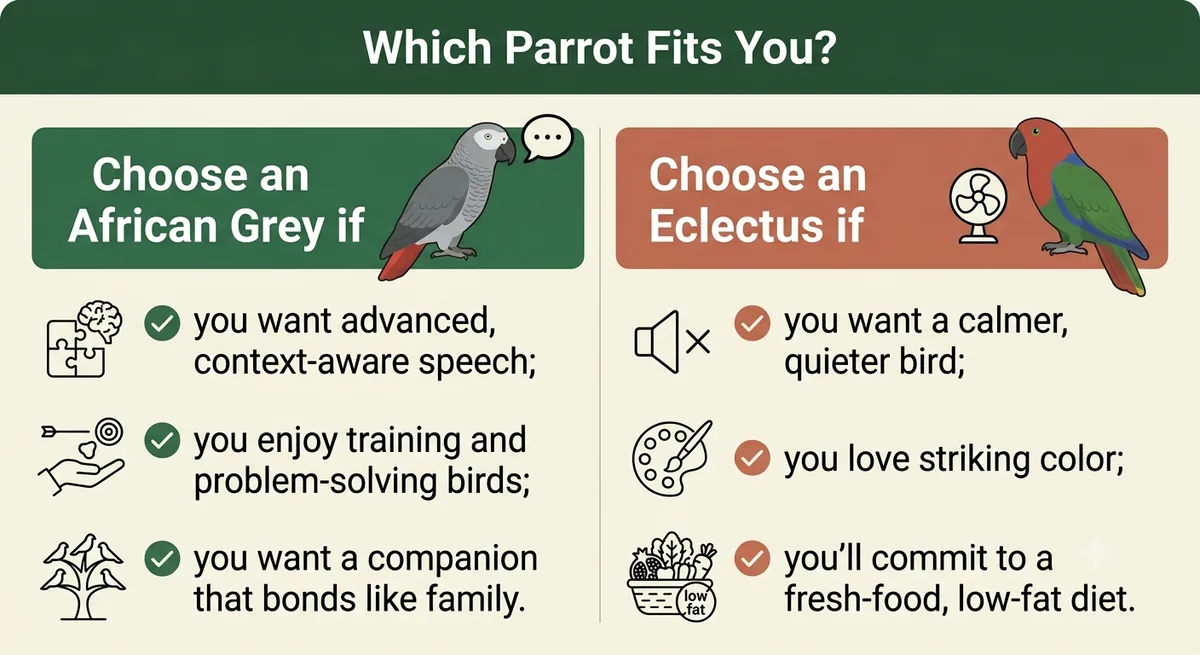
Put it all together and the choice is genuinely simple once you're honest about yourself rather than the birds. Answer the one line below that sounds most like you.
Which Parrot Is Right for You?
You want the best talker and a bird that bonds like family
Choose an African Grey. You get superior, context-aware speech, deep family bonding, and a bird that thrives on the training and enrichment you'll enjoy giving it. Our hand-raised Congos are raised for exactly this.
You want a calmer, quieter bird and you love striking colour
An Eclectus fits beautifully — laid-back temperament, lower volume, and the most spectacular sexual dimorphism in the parrot world. Commit to its fresh-food, low-fat diet and it's a wonderful companion.
You're a first-time owner who wants a gentle, predictable start
Either can work, but be honest about your routine. A hand-raised African Grey arrives socialised and predictable; an Eclectus is a touch more forgiving on attention but far less forgiving on diet. Match the bird to the routine you can actually keep.
You need a bird you can leave alone all day
Reconsider both species. Neither a Grey nor an Eclectus does well on long solitude — a bored Grey plucks, a neglected Eclectus withdraws. If all-day alone time is unavoidable, this pair of birds may not be the right fit right now.
Why Buyers Who Choose the Grey Choose C.A.Gs
If the honest answer for you is the African Grey, the next question is where to get one — and that decision matters as much as the species. Here at C.A.Gs we raise Greys, not Eclectus, and everything about how we place a bird is built around the checks a careful buyer should insist on.
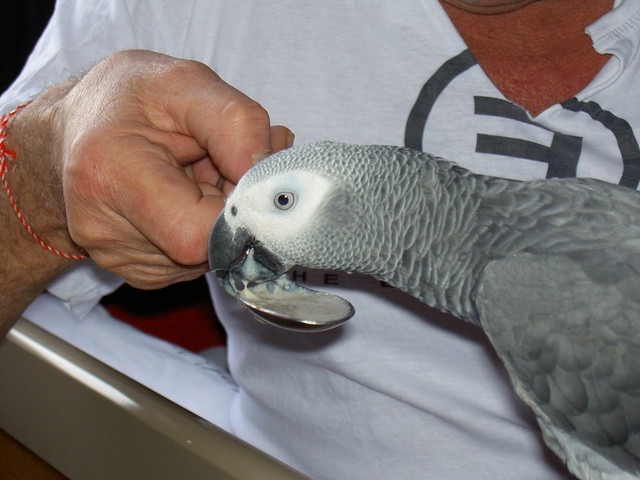
Real people, real birds, real paperwork — a breeder you can verify.
Hand-Raised, DNA-Sexed and Documented
Every C.A.Gs Grey is hand-raised in our home in Midland, Texas, PCR DNA-sexed, examined by an avian vet, and sent home with CITES Appendix I documentation and a written health guarantee. You're not hoping the bird is healthy and legal — you're holding the paperwork that proves it.
Lifetime Breeder Support and Nationwide Shipping
Because a Grey can share 40–60 years of your life, the relationship shouldn't end at the airport. We answer questions for the life of the bird and ship nationwide on IATA-compliant flights.
What Lifetime Support Actually Covers
It means you have a number to call for the plucking scare in year three and the diet question in year eight — the everyday milestones of Grey ownership — with the people who raised your bird on the other end.
Safe, IATA-compliant nationwide shipping
Our birds travel on IATA-compliant Delta, United or American flights — $185 to your nearest airport or $350 home delivery — crated, monitored and documented the whole way, so a verifiable breeder a few states away is still the right choice.
Breeder note: buyers who came to us torn between the two
Plenty of our owners arrived undecided between a Grey and an Eclectus. The ones who wanted conversation and a bird that engages with the whole family almost always landed on the Grey — and told us later that the daily "talking back" was exactly what they'd hoped for and what tipped the decision.
See Our Available Hand-Raised African Greys
If the Grey is your bird, here are the hand-raised African Greys available now — each PCR DNA-sexed, vet-checked and CITES-documented, at one fair, fixed price. We don't breed Eclectus, but for the smartest talking companion in the comparison, these are ready to meet on a live video call.
New Arrival Midland, TX
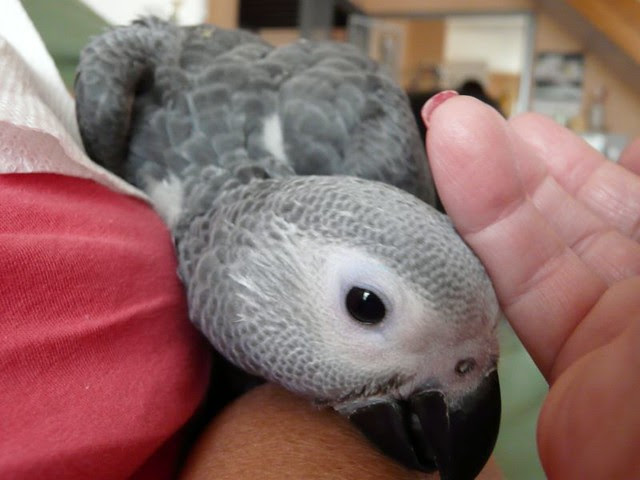
Amie
Female · 3 mo · Congo African Grey
"Hand-raised, fully documented, ready to reserve."
Premium hand-raised female, 3 months old. PCR DNA-sexed, vet-checked, CITES-documented — captive-bred in the USA with the full paper trail.
— Written by Mark & Teri Benjamin, the breeders behind C.A.Gs · USDA-licensed African Grey aviary, Midland, TX
African Grey vs Eclectus: Frequently Asked Questions
Which talks better, an African Grey or an Eclectus?
The African Grey is generally rated the better talker. Both build real vocabularies, but the Grey — especially the Congo — is famous for clear, human-sounding speech and for using words in context rather than only mimicking. Eclectus parrots are genuinely good talkers with clear voices too, but the Grey is the species most often called the best talking parrot in the world.
Is an Eclectus quieter than an African Grey?
Slightly, yes — but both are moderate by parrot standards and far quieter than a macaw or cockatoo. The Eclectus is famously laid-back and low-volume; the African Grey whistles, mimics and chatters more than it screams. Either one is usually manageable in a normal home, which is why both suit owners who can't tolerate a loud bird.
Is an African Grey or an Eclectus better for beginners?
Neither is truly a beginner bird, but they're demanding in different ways. The Eclectus is a little more forgiving on attention and temperament, while the African Grey is more emotionally sensitive and needs consistent mental stimulation. The catch is diet: the Eclectus needs a strict fresh-food regimen that trips up new owners, whereas the Grey eats a more straightforward pellet-plus-produce diet. A hand-raised, well-socialised bird of either species is the gentlest start.
Which parrot is more affectionate, an African Grey or an Eclectus?
It depends on the individual and how it was raised. African Greys bond deeply and read a household's mood closely, but they show affection more through trust and interaction than constant cuddling. Eclectus parrots are typically gentle and even-tempered. Neither is a guaranteed 'cuddle bird' — affection in both comes from patient, daily relationship-building.
Which parrot is smarter, an African Grey or an Eclectus?
The African Grey is widely considered the more intelligent of the two — the species Dr. Irene Pepperberg's decades of research with the parrot Alex made famous for reasoning, counting and using words in context. Eclectus parrots are clever and capable, but the Grey's problem-solving and cognitive depth are exceptional, which also means it gets bored faster and needs more enrichment.
Are African Greys really one-person birds?
Not inherently. The 'one-person bird' reputation usually comes from a Grey that was only ever handled by one person. A Grey socialised with the whole family from the start — as ours are — commonly bonds with several people. Both Greys and Eclectus do best when more than one household member handles them regularly from a young age.
Why is the Eclectus diet so different from an African Grey's?
The Eclectus has an unusually long digestive tract and does best on a fresh, low-fat, high-fibre diet built around fruits and vegetables. Many react to synthetic vitamins and heavily fortified pellets with stress behaviours like toe-tapping and wing-flipping. African Greys eat a more standard formulated-pellet base plus fresh produce, with calcium support because they're prone to hypocalcemia. Neither thrives on a seed-only diet.
Which lives longer, an African Grey or an Eclectus?
The African Grey typically lives longer — commonly 40–60 years with good care — while the Eclectus averages around 30 years. Either way you're making a multi-decade commitment, which is exactly why matching the bird to your life for the long haul matters more than any single trait.
New hand-raised African Grey clutches, verified and documented, before they're listed — socialised families first.


 New Arrival Midland, TX